 Bellingham Siding
 Siding Built for York's Corner of Bellingham
York is one of the older, established neighborhoods on Bellingham's east side, and homes there carry the marks of decades in a wet marine climate — moss on north-facing walls, faded paint on sun-exposed gables, and siding that never quite dries out between October and April. If you're looking at a siding job in York, you're not dealing with a generic weather problem. You're dealing with Whatcom County's specific mix of salt-tinged air off Bellingham Bay, driving rain that comes in sideways during winter storms, and a moss season that can run six months or longer on shaded exposures. Siding that isn't engineered for this combination fails here faster than it would somewhere drier.
We install James Hardie fiber cement siding exclusively — not as a sales pitch, but because after years of tearing old siding off Bellingham homes, it's the one product system we trust to hold up to this climate without turning into a maintenance chore for the homeowner.
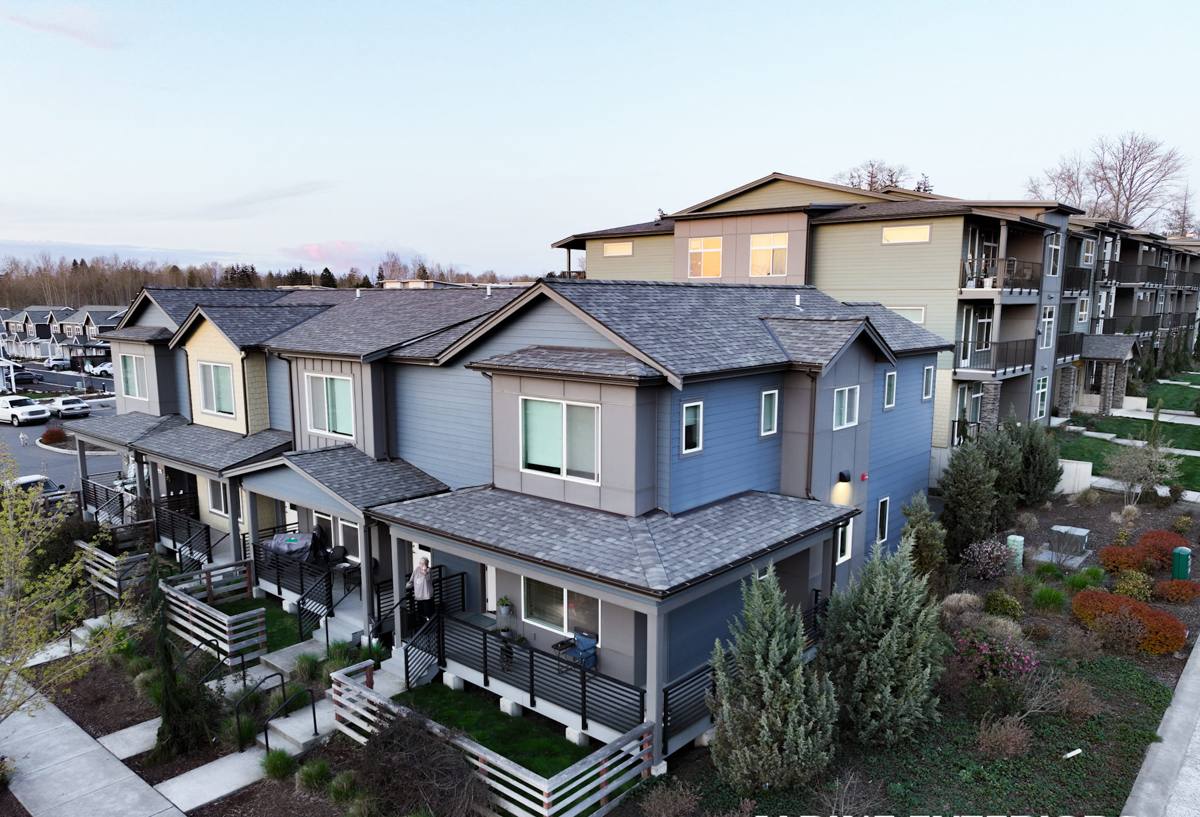
What This Climate Actually Does to Siding
Moisture That Never Fully Leaves
Bellingham doesn't get the heaviest rainfall in Washington, but it gets persistent, low-intensity rain and heavy fog for months at a stretch. Siding in York spends a lot of the year damp, even when it's not actively raining. Wood-based products — cedar, primed spruce, engineered wood — depend on paint film and caulk staying intact to keep that moisture out. Once a seam opens or a coating thins, the substrate starts absorbing water, and swelling, delamination, or rot follows.
Moss and Organic Growth
Shaded walls, especially on the north and east sides of a lot with mature trees, stay wet long enough for moss and algae to take hold. This is mostly a cosmetic issue on a properly finished surface, but on porous or poorly sealed siding it becomes an entry point for moisture over time, especially at horizontal laps and trim joints where debris collects.
Salt Air Off the Bay
Homes closer to Bellingham Bay pick up a fine salt content in the air that accelerates corrosion on fasteners and metal flashing, and it slowly degrades some paint systems faster than inland exposure would. It's not as aggressive as true oceanfront conditions, but it's a real factor in how we spec fasteners and flashing details on jobs in this part of town.
Wind-Driven Rain
Storms coming off the Strait of Georgia and Puget Sound don't just drop rain straight down — they push it laterally into walls, especially at corners, around windows, and under eaves with minimal overhang. This is where installation quality matters as much as the product itself. A well-built product installed with the wrong flashing details will still leak.
Why We Standardized on James Hardie
James Hardie fiber cement is cement, sand, and cellulose fiber, not wood. It doesn't absorb water the way wood-based siding does, it doesn't rot, and it's non-combustible — a genuine advantage during Washington's increasingly active wildfire smoke seasons, even for homes not in a direct fire-risk zone. Hardie engineers specific product lines (HZ5 and HZ10) for different climate zones, and the Pacific Northwest falls into a category where moisture resistance and freeze-thaw performance matter more than pure heat tolerance.
The other piece is the factory finish. Hardie's ColorPlus finish is baked on in a controlled environment, not brushed or sprayed on-site, which gives it more consistent coverage and a longer service life before repainting is needed — often well beyond what field-applied paint on wood siding delivers. For a neighborhood like York, where a lot of homes have older siding that's been repainted multiple times, that's a meaningful reduction in long-term upkeep.
We don't install LP SmartSide, vinyl, Cemplank, Allura, primed spruce, or cedar. Each of those has a legitimate place in the market, but they each come with trade-offs — engineered wood strand board that's still moisture-sensitive at cut edges, vinyl that can warp and doesn't hold paint, cedar that demands ongoing sealing and refinishing — that we're not willing to put our name behind in this climate. Hardie is the one system where we can stand behind the material and the installation together.
What a Correct Installation Involves
The material is only half the job. Most siding failures we get called out to inspect in this area trace back to installation shortcuts, not product defects. A correct James Hardie job in York includes:
- A weather-resistive barrier installed and lapped correctly, with all penetrations sealed before a single board goes up
- Rainscreen or drainage-gap furring where the wall assembly calls for it, so moisture that does get behind the siding can actually drain and dry
- Correct fastener type, spacing, and embedment depth per Hardie's published installation specs — over-driven or under-driven nails are one of the most common defects we find on tear-offs
- Proper flashing at every window, door, and roof-to-wall transition, not just caulk covering a gap
- Minimum clearance from grade, decks, and roof lines so siding doesn't sit in standing water or splashback
- Factory-cut and factory-primed edges kept intact; field cuts sealed per manufacturer spec, especially at butt joints
- Correct corner and trim details that shed water outward instead of channeling it behind the plane of the siding
Skipping any one of these doesn't show up immediately. It shows up in three to seven years as a soft spot behind a window, a stained soffit, or a section of siding that's swelling from the back side while the face still looks fine.
Our Process for a York Job
1. Inspection and Assessment
We look at the existing siding, sheathing, and any visible moisture damage before quoting anything. On older York homes this sometimes means finding problems that predate the siding itself — deferred flashing repairs, gutter issues, or grading that pushes water toward the foundation. We flag those honestly rather than siding over them.
2. Tear-Off and Sheathing Check
Once old siding comes off, we inspect the sheathing underneath. Soft or delaminated sheathing gets replaced before anything new goes up — this is non-negotiable, because new siding over compromised sheathing just hides the problem for a few more years.
3. Water Management Layer
This is the step that determines whether the job lasts. Weather-resistive barrier, flashing, and drainage details go in before the visible siding, and this work doesn't get shortcut regardless of schedule pressure.
4. Hardie Installation
Boards, panels, and trim go up to manufacturer spec — correct fastening, correct laps, correct clearances — with attention to the specific exposures on your lot (shaded north walls, wind-exposed corners, areas near mature trees that hold moisture).
5. Final Detail Pass
Caulking, touch-up painting at field cuts, and a walk-through so you understand what was done and why, including anything worth watching over the next few years.
Why Hiring a Crew That Already Works This Area Matters
Siding installation isn't uniform across Whatcom County. A crew that mostly works drier, more sheltered lots elsewhere in the state doesn't automatically know how much extra attention shaded, moss-prone walls need, or how aggressively salt air near the bay affects fastener choice. A crew that's already worked jobs in and around York has a working sense of which exposures on which lots tend to hold moisture, where drainage details matter most, and what kind of prep work older Bellingham-area homes typically need before new siding goes on. That local pattern recognition doesn't replace following the installation spec — it's what tells you where to spend extra care within it.
Cost Factors on a York Siding Job
Every job is different, and we won't quote a number without seeing the house, but these are the variables that actually move the price on a James Hardie installation in this area:
| Factor | Why It Matters |
|---|---|
| Sheathing condition | Rot or delamination found during tear-off adds repair scope before new siding can go on |
| Home size and wall complexity | More corners, gables, and dormers mean more cutting, flashing, and labor time |
| Siding profile chosen | Lap siding, shingle-style panels, and board-and-batten carry different material and labor costs |
| Existing siding type | Some tear-offs (vinyl, aluminum) go faster than others (multiple layers, hardboard) |
| Trim and accent work | Custom trim details and color-matched accessories add cost but improve long-term water shedding |
| Access and site conditions | Tight lots, mature landscaping, or multi-story sections affect staging and labor time |
Maintenance After Installation
One of the practical benefits homeowners in York notice within the first couple of years is how little upkeep a properly installed Hardie system needs compared to what they replaced. That said, no siding is maintenance-free in this climate:
- Rinse off moss and algae buildup on shaded walls once or twice a year with a garden hose — avoid pressure washing directly at seams
- Keep gutters clear so overflow doesn't run down the wall face repeatedly
- Trim back vegetation that keeps a wall section shaded and damp longer than the rest of the house
- Recaulk at trim joints if you notice separation, rather than waiting for water intrusion to show up inside
- Watch soffit and window areas for staining, which is often the first visible sign of a flashing issue elsewhere
Get a Straightforward Look at Your Siding
If you're in York and dealing with siding that's failing, showing moss you can't keep ahead of, or just old enough that you're wondering how much longer it has, we're happy to come take an honest look. We'll tell you what we see, what it would take to do it right with James Hardie, and give you a straightforward estimate — no pressure, no upsell to a product we wouldn't put on our own homes. Use the form below to get started.