 Bellingham Siding
 Allura Isn't a Bad Product — It's Just Not the One We Stand Behind
When homeowners in Bellingham start comparing siding quotes, they sometimes get a bid that specs Allura fiber cement instead of James Hardie. It's a fair question to ask why one contractor uses one brand and another uses a different one, especially when both are "fiber cement" and both look similar in a sample book. We want to answer that honestly instead of just saying "trust us."
Allura is a real fiber cement manufacturer, not a knockoff. Fiber cement as a category — Portland cement, sand, and cellulose fiber pressed into lap boards, panels, and trim — is a genuinely good choice for a marine, moss-prone climate like Whatcom County's. It doesn't rot, it resists the pests that go after wood siding, and it holds paint far better than most other exterior claddings. Allura makes that same basic product. So this page isn't about telling you Allura is junk. It's about explaining the specific, practical reasons we chose to build our business around James Hardie instead of carrying two competing fiber cement lines, and why that choice matters more here than it might in a drier climate.
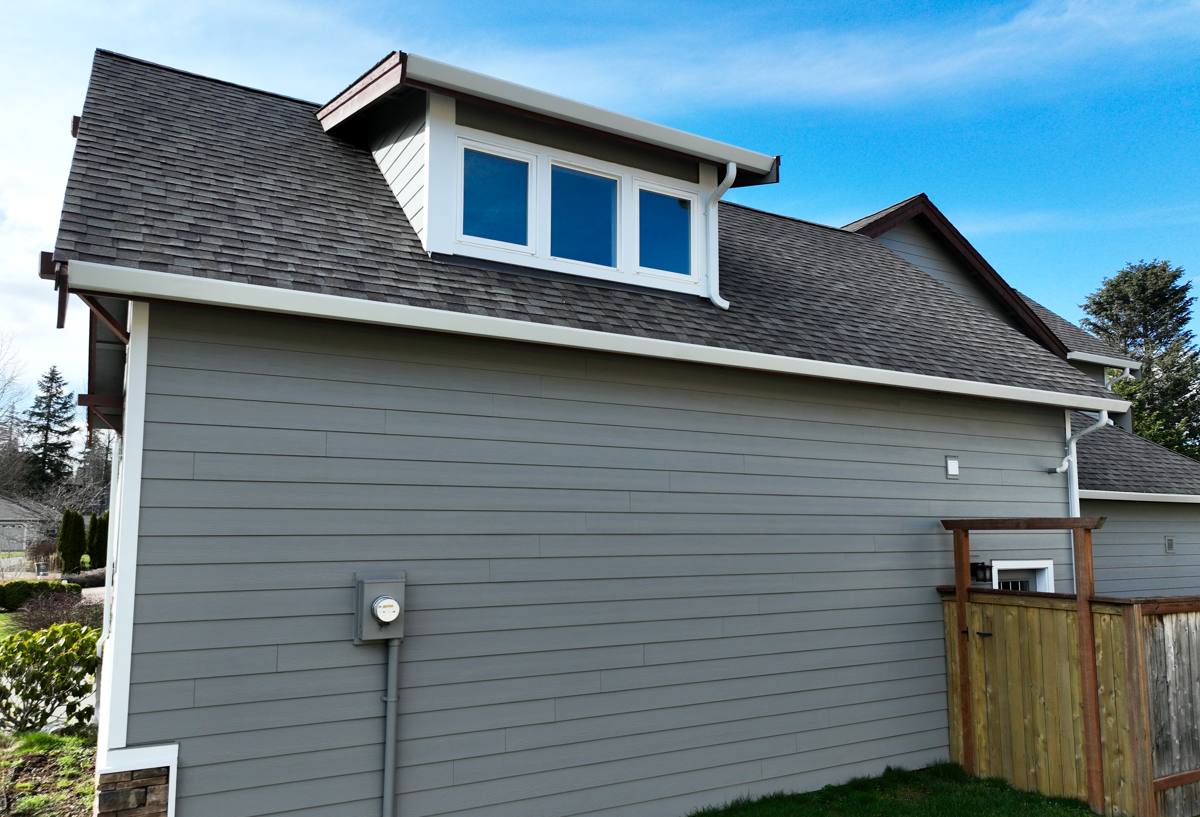
Why Fiber Cement Matters More in Bellingham Than Almost Anywhere
Whatcom County sits where salt air off Bellingham Bay meets one of the wettest, greyest stretches of the Pacific Northwest. Siding here deals with driving rain off the water, a moss and algae season that can run eight or nine months out of the year on north- and west-facing walls, and salt-laden air that accelerates corrosion on fasteners and trim. That combination is hard on wood siding, hard on vinyl (which chalks and can warp under prolonged UV and moisture cycling), and it's exactly the environment fiber cement was engineered for. Once you've settled on fiber cement as the right category of product for this area, the next decision — which manufacturer, and which installer — is where the real differences show up.
Where Allura and James Hardie Actually Diverge
On paper, a lot of the specs look close. The differences that matter to a homeowner aren't in the raw composition of the board — they're in the finish system, the regional support network, and how the product behaves over the 20-30 year window a siding job is supposed to last.
| Factor | James Hardie | Allura |
|---|---|---|
| Regional distribution in Western WA | Extensive — deep local stocking, wide profile and color availability | Thinner distribution footprint; fewer local stocking distributors, longer lead times on some profiles |
| Factory finish | ColorPlus baked-on finish with a long, well-documented track record in wet climates | Factory-finish options exist but with a shorter regional track record and less consistent local stock |
| Climate-engineered product lines | HZ5 formulation specifically engineered for cold, wet, high-moisture regions like ours | General-purpose fiber cement formulation, not marketed with a PNW-specific engineered line |
| Long-term color-match repairs | Widely installed regionally, making future panel replacement and color matching easier | Less common regionally, so matching an existing job years later can mean special-order lead times |
| Installer familiarity | Most fiber cement crews in this region are Hardie-trained and install it daily | Fewer local crews have deep repetition with Allura specifically |
None of this means Allura fails as a product. It means that in this specific market, at this specific latitude, the practical support system around James Hardie is stronger — and that support system is what protects you fifteen years from now, not just on install day.
The Regional Support Problem
Fiber cement siding is a 20-to-40-year investment. At some point, a tree branch takes out a section during a windstorm, a delivery truck backs into a corner board, or you decide to add a bump-out addition and need six more boards in a color that was discontinued or reformulated since your original install. When that happens, the question isn't "is this a good product" — it's "can anyone within a reasonable drive actually get me matching material, in the right profile, in the right finish, without a months-long special order."
Because James Hardie has such deep distribution throughout Western Washington, that kind of repair is usually straightforward. Allura's footprint here is real but thinner, and thinner distribution translates directly into longer waits and more guesswork on color matching when something needs to be patched years down the road. That's not a knock on the manufacturer — it's simply a fact about how established each brand's supply chain is in Whatcom County specifically, and it's the kind of detail that doesn't show up on a spec sheet but shows up on your house.
What This Looks Like in Practice
- Faster reorder times when a board is damaged after the original install
- Better odds of an exact profile and color match years later
- More local crews with repetition installing and repairing the same product
- Easier warranty administration because the manufacturer's regional presence is established
Installation Sensitivity: The Part Every Fiber Cement Brand Shares
This part is true of Allura, James Hardie, and every other fiber cement product on the market: the board is only as good as the installation. Cut edges have to be primed or sealed before they go up. Butt joints need to be caulked or flashed correctly, not just butted and painted over. Boards need proper clearance from grade, from roof lines, and from decks so they're not sitting in standing water. Fasteners need to be the right type and driven at the right depth so they don't crack the board or back out over time in freeze-thaw cycles.
Get any of that wrong, and moisture can work its way behind or into the board regardless of which brand's logo is on the box. The difference in Bellingham is that with driving rain and a long wet season, installation mistakes get exposed faster and punished harder than they would in a dry climate. That's exactly why we don't split our crews' attention across two competing fiber cement systems — every installer on our team trains on and installs the same product, the same way, on every job. Repetition is what keeps mistakes out of a wall assembly, and repetition only happens when you're not switching brands job to job.
Factory Finish: Why We Don't Treat This as an Afterthought
A factory-applied finish matters more than most homeowners realize. It's the difference between a coating engineered and tested for UV exposure, moisture cycling, and adhesion under specific curing conditions versus a field-applied paint job that depends entirely on weather at the time of application. James Hardie's ColorPlus finish has a long, well-documented track record specifically in wet coastal climates like ours, including how it holds color and resists fading through repeated moss and algae growth cycles on shaded walls. Other fiber cement brands, including Allura, offer factory-finish options too — but the regional track record and the depth of touch-up material availability locally are thinner, which again comes back to the support-network issue rather than the underlying chemistry.
Warranty: Read the Structure, Not Just the Number
Every fiber cement manufacturer publishes a warranty, and on the surface, the numbers can look similar between brands. What actually matters is the structure behind that number: is it prorated or non-prorated, is it transferable if you sell the house, and — critically — does the manufacturer have an established local claims process and installer network to actually back it up? A warranty is only as good as the company's presence in your market when you need to use it. This is another place where James Hardie's scale and long-standing presence in the Pacific Northwest gives homeowners a more predictable path if something does go wrong, compared with a brand with a smaller regional footprint.
Our Standard, Plainly Stated
We install James Hardie exclusively — not LP SmartSide, not vinyl, not Cemplank, not Allura, not primed spruce or cedar. That's a deliberate business decision, not a marketing line. It means every crew member has deep, repeated experience with one system instead of split familiarity across several. It means we can speak specifically to how a product performs in Bellingham's salt air and moss season because we've watched it perform here, on real homes, through real winters. And it means when a homeowner calls us five, ten, or fifteen years after installation with a repair question, we're not guessing at a discontinued profile from a manufacturer with thin regional stock — we're working with the most established fiber cement supply chain in this market.
Questions Worth Asking Any Contractor Bidding a Fiber Cement Job
- Which fiber cement brand and product line are you specifying, and why that one specifically?
- Is the finish factory-applied or field-painted, and what's the documented performance in a wet coastal climate?
- How are cut edges and joints being sealed, and what's your callback history on moisture intrusion?
- If a section needs replacement in ten years, how easily can that material and color be sourced locally?
- Is the crew installing this brand daily, or is it one of several systems they rotate between?
Let's Talk About What's Actually on Your House
If you've gotten a bid that specs Allura, LP, vinyl, or anything else and want a straight, no-pressure comparison of what we'd install and why, we're happy to walk through it — no obligation, no sales pressure, just a second opinion from a crew that's been doing this in Whatcom County's weather for years. Use the form below to request a free estimate.