 Bellingham Siding
 Barkley's Climate Is Harder on Siding Than Most Homeowners Realize
Barkley sits close enough to Bellingham Bay and the broader Puget Sound corridor that homes here deal with a steady mix of salt-tinged air, wind-driven rain, and heavy tree cover. None of those things are dramatic on their own. It's the combination, repeated year after year, that wears down exterior materials that aren't built for it. A siding product that performs fine in a dry inland climate can start failing within a decade in a neighborhood like this one.
Whatcom County's weather pattern isn't just "rainy" — it's a long, low-intensity soak punctuated by storms that push moisture sideways into wall assemblies rather than straight down off a roofline. Add the shade from mature evergreens common throughout Bellingham's residential neighborhoods, and you get siding that rarely gets a full, fast dry-out between storms. That's the environment any exterior product on a Barkley home has to survive.
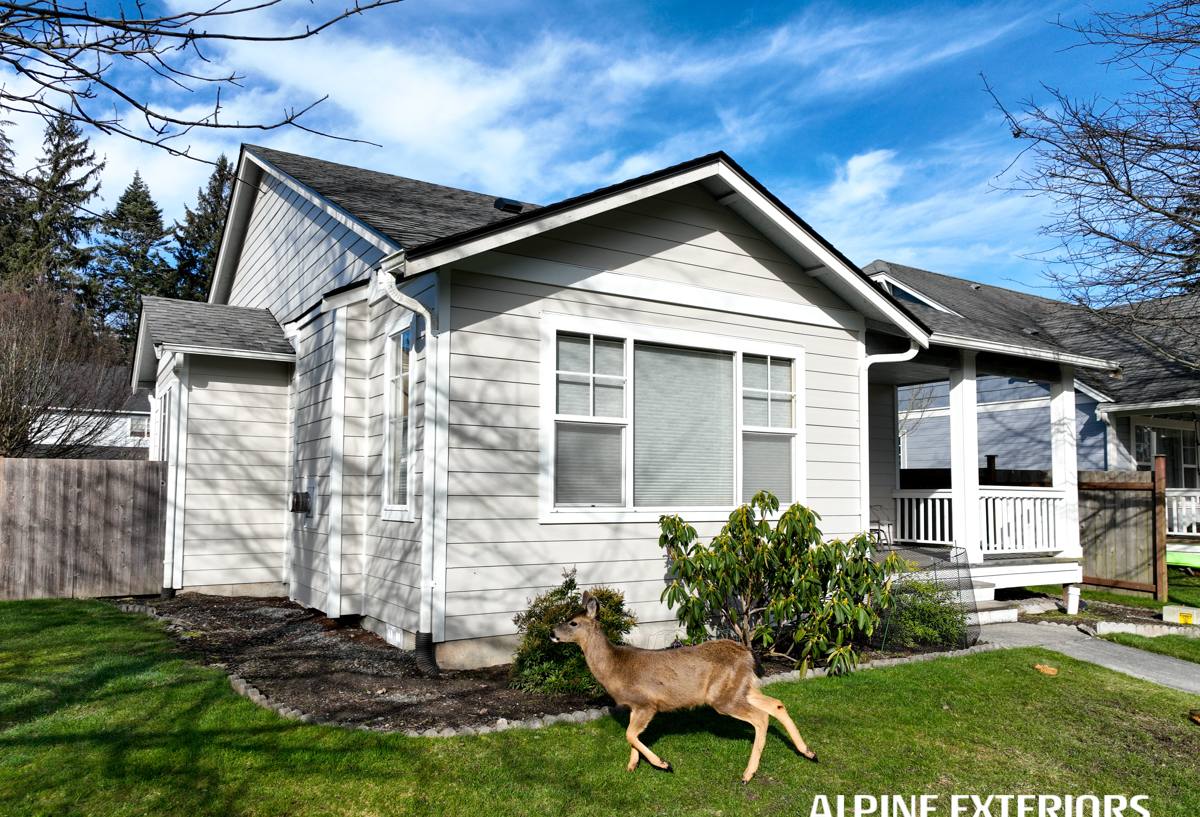
What Driving Rain and Salt Air Actually Do to Siding Over Time
Moisture Intrusion
Wind-driven rain doesn't just wet a wall surface — it works into seams, fastener holes, and butt joints if those details aren't installed correctly. Over time, siding that absorbs and holds water swells, warps, or delaminates, and moisture that gets behind the cladding can sit against sheathing and framing far longer than most homeowners assume, since it's hidden from view.
Salt Air Corrosion
Proximity to Bellingham Bay means airborne salt is a real factor, even a few miles inland. Salt accelerates corrosion of exposed metal fasteners, flashing, and trim, and it can degrade certain paint and coating systems faster than manufacturers' published lifespans suggest. Materials and fastener specs that work fine in a dry, inland climate don't always hold up the same way this close to the water.
Moss, Algae, and Organic Growth
Whatcom County's moss season is long, and it's not just a roof problem. Shaded, damp siding surfaces — especially north-facing walls and areas under tree cover, both common in Barkley — grow moss, algae, and mildew if the material and finish don't resist it well. Beyond the appearance issue, sustained organic growth holds moisture against the siding surface, which compounds the wear described above.
Why We Install Only James Hardie Fiber Cement Siding in Barkley
We made a deliberate decision to install James Hardie fiber cement exclusively, and it's not a marketing position — it's a response to exactly the conditions Barkley homes face. We don't install vinyl, LP SmartSide, Cemplank, Allura, or primed wood siding, because each of those products carries trade-offs in moisture behavior, dimensional stability, or long-term maintenance that we don't think hold up well against this region's climate.
Non-Combustible and Dimensionally Stable
Fiber cement is manufactured from cement, sand, and cellulose fibers. It doesn't burn, and unlike wood-based or engineered-wood products, it doesn't swell or rot when it takes on repeated moisture exposure. That matters directly for a climate where siding stays damp longer than it does in most parts of the country.
ColorPlus Factory Finish
Most Hardie products we install use the ColorPlus finishing process — a factory-applied, baked-on finish that resists fading and chipping far better than field-applied paint. In a climate with this much sun-to-rain cycling and salt exposure, a factory finish holds its color and adhesion longer than a coat applied on-site, and it reduces how soon a homeowner faces a repaint.
Climate-Engineered HZ Product Lines
James Hardie engineers its HZ product lines for specific climate zones, with formulations aimed at regions that see heavy moisture exposure. That's a meaningful distinction from a one-size-fits-all siding product, and it's part of why we consider it the right match for Whatcom County rather than a generic "coastal-adjacent" solution.
Backed by a Strong, Transferable Warranty
Hardie's warranty coverage is transferable to a subsequent homeowner, which matters for resale in a market where buyers increasingly ask what the siding is and when it was installed. It's a meaningful signal of the manufacturer's confidence in the product's long-term performance.
Comparing Siding Materials for Bellingham's Climate
| Material | Moisture Behavior | Maintenance | Typical Longevity Here |
|---|---|---|---|
| James Hardie Fiber Cement | Dimensionally stable, doesn't swell or rot | Low — factory finish resists fading and moss staining | Multiple decades with correct installation |
| Vinyl | Doesn't rot, but can warp or crack in temperature swings and impacts | Low, but color fades and can't be repainted easily | Moderate, shorter in high-wind or impact-prone areas |
| LP SmartSide / Engineered Wood | Wood-based core is more moisture-sensitive if seams or cuts aren't sealed | Moderate — relies heavily on correct field caulking and paint upkeep | Shorter than fiber cement in sustained wet climates |
| Cedar / Primed Spruce | Natural wood, absorbs moisture, prone to rot and insect damage over time | High — regular repainting, sealing, and moss treatment | Shortest without aggressive, ongoing maintenance |
This isn't a claim that other products are poorly made — it's an honest read of how each material's core behavior lines up with a climate defined by long wet stretches, salt-tinged air, and heavy shade. That comparison is the reason we standardized on one product instead of offering several.
Beyond Siding: Protecting the Whole Exterior Envelope
Siding doesn't work in isolation. We also handle roofing, windows, and decks, because a home's exterior performs as a system. Roofing that's past its service life, window flashing that's failed, or a deck ledger that's trapping moisture against the house can all undermine even well-installed siding by feeding water into places it shouldn't be. When we look at a Barkley home, we're looking at how all of those components interact, not just the wall cladding in isolation.
This matters especially at transitions — where siding meets a roofline, wraps a window opening, or ties into a deck ledger board. Those junctions are where most real-world water intrusion problems start, regardless of which siding product is installed.
Our Process for a Barkley Siding Project
- On-site assessment — we look at existing siding condition, moisture damage, trim, flashing, and how the home's exposure (sun, shade, prevailing wind) affects wear patterns.
- Product and color selection — walking through Hardie's plank, shingle, and panel options along with ColorPlus color choices suited to the home's style.
- Removal and inspection of sheathing — once old siding is off, we check for hidden moisture damage before anything new goes up.
- Weather-resistive barrier and flashing details — this is where correct installation either sets a home up to succeed for decades or sets up a callback in a few years.
- Hardie installation to manufacturer spec — proper fastening, clearances, and joint treatment, which affects both performance and warranty validity.
- Final walkthrough — reviewing the completed work and care guidance with the homeowner.
Signs a Barkley Home May Need New Siding
- Visible warping, bubbling, or soft spots when you press on the siding
- Persistent moss or algae staining that returns shortly after cleaning
- Peeling or bubbling paint, especially on north-facing or shaded walls
- Cracked or missing caulking at seams, corners, and trim boards
- Rising energy bills that may point to compromised insulation behind failing siding
- Visible gaps, rot, or discoloration around window and door trim
- Siding that feels consistently damp or shows dark water staining at the base
Any one of these on its own might just need monitoring. Several at once, especially combined with a siding age past 15-20 years, usually means it's worth having someone take a real look.
Why a Local Crew Matters in Barkley
A crew that works throughout Bellingham and Whatcom County day in and day out knows how local exposure — bay proximity, tree cover, prevailing storm direction — actually plays out on real homes, not just in a manufacturer's climate chart. That local knowledge shapes decisions on the job: where extra flashing attention matters, which elevations see the worst weathering, and how to sequence work around this region's rain patterns instead of fighting them. It also means someone is nearby if a warranty question or a post-install concern comes up years down the road, rather than a crew that did one job in the area and moved on.
What Siding Replacement Typically Costs to Plan For
| Cost Factor | Why It Matters in Barkley |
|---|---|
| Home size and wall complexity | More corners, dormers, and trim details mean more labor and material |
| Extent of existing damage | Hidden moisture or sheathing repair adds cost but is essential to address before new siding goes up |
| Siding profile and finish choice | Plank, shingle, and panel options carry different material and labor costs |
| Access and site conditions | Mature trees, slopes, or tight lot lines common in established neighborhoods can affect labor time |
| Flashing and trim upgrades | Bringing older flashing details up to current standards protects the new siding's lifespan |
We don't quote broad numbers without seeing the home — too many of the factors above vary house to house. What we can say honestly is that fiber cement typically costs more upfront than vinyl but requires less repainting and replacement over the life of the home, which changes the real long-term comparison.
If you're weighing your options for a Barkley home, we're happy to take a look and walk you through what we see — no pressure, no obligation. Use the form below to request a free estimate.