 Bellingham Siding
 Siding for Sudden Valley: A Wooded, Lake-Side Corner of Whatcom County
Sudden Valley sits along Lake Whatcom, southeast of Bellingham, and the setting that makes it such a good place to live is the same setting that's hard on exterior materials. Steep, tree-covered lots, close proximity to the water, and a lot of shade from mature timber mean the siding on a Sudden Valley home deals with a slightly different mix of stress than a house out in the open a few miles away. We work throughout Whatcom County, and we've learned that the broader regional pattern, marine air moving inland off Bellingham Bay, driving rain, and a long moss season, shows up in Sudden Valley with its own local twist: less direct wind exposure in some pockets, but more standing humidity, more shade, and more moisture held close to the house by trees and terrain.
That combination is exactly why we install one siding system, James Hardie fiber cement, on every home we side in this area. It's not the cheapest option on paper, and it's not the only product on the market. It's the one we've found actually holds up to a lake-adjacent, heavily wooded environment over the long run.
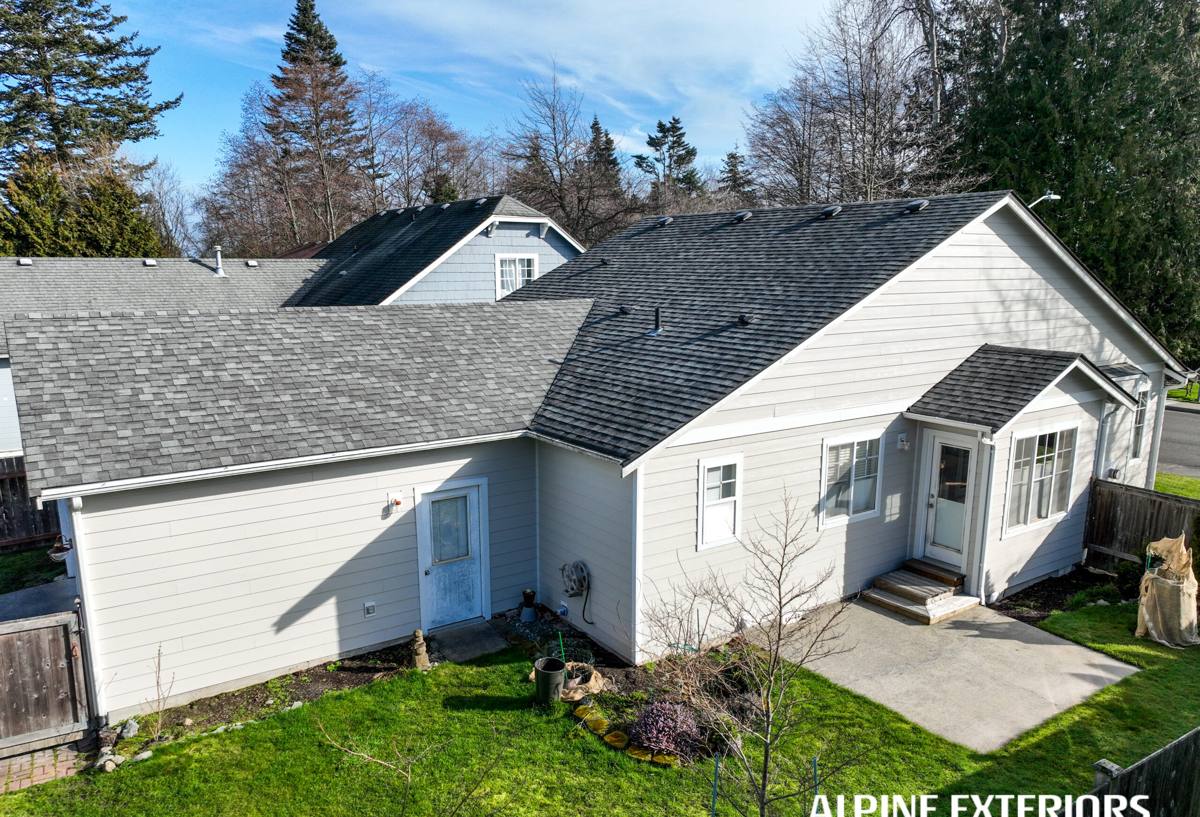
What Sudden Valley's Environment Does to Exterior Materials
Lake Humidity and Persistent Moisture
A home near Lake Whatcom sits in a pocket of higher ambient humidity than a property further from the water, especially on mornings when fog sits over the lake before burning off. That moisture doesn't just fall as rain and drain away; it lingers in the air against exterior walls, and any siding material that's even slightly porous, or that traps moisture against the substrate instead of shedding it, has more opportunities to absorb water here than it would in a drier inland setting.
Heavy Tree Cover and Shade
Sudden Valley's wooded lots are one of the neighborhood's biggest draws, and they're also one of the biggest challenges for siding. Shaded walls dry out slower after rain, sap and organic debris collect in gutters and against trim, and north-facing or heavily shaded elevations can stay damp for days after a storm has passed everywhere else. That's the exact environment moss, algae, and mildew need to establish and spread.
Driving Rain and Hillside Terrain
Like the rest of coastal Whatcom County, this area gets rain that's pushed by wind rather than falling straight down, and Sudden Valley's hilly, sloped lots can funnel and redirect that wind in ways a flat lot wouldn't. Water finds its way into lap joints, trim seams, and wall penetrations from angles that a simple, straight-down rainfall assumption wouldn't account for, which is part of why flashing and house wrap detail matters as much as the siding material itself.
Why We Only Install James Hardie Siding
We don't offer a lineup of siding brands at different price points and let the homeowner choose based on budget alone. We install James Hardie fiber cement, and the reasoning comes from what we've consistently seen on tear-offs and repair calls in exactly this kind of shaded, moisture-heavy setting.
- Non-combustible core: Fiber cement doesn't feed a fire the way wood-based siding can, which matters for household safety and can factor into insurance considerations as well.
- Factory-applied ColorPlus finish: The color coat is cured under controlled factory conditions rather than brushed on at the job site, so it holds up far longer against sustained shade, moisture, and UV cycling than field-applied paint.
- Climate-engineered HZ product lines: Hardie's HZ5 formulation is built for regions with heavy sustained moisture and freeze-thaw cycling, a closer match to Sudden Valley's lake-and-tree environment than a generic national siding spec.
- Dimensional stability: Fiber cement doesn't swell, cup, or warp the way engineered wood products can after repeated wet-season moisture cycles, which matters most on shaded walls that never fully dry between storms.
- Strong transferable warranty: Hardie backs its products with one of the more substantial warranty structures in the industry, provided the installation follows spec.
We don't install LP SmartSide, vinyl siding, Cemplank, Allura, primed spruce, or cedar. Those are legitimate products, and other contractors install them well. But we made a professional decision that in a setting this shaded and this consistently damp, standing behind one system we trust completely serves our customers better than offering a lower-cost alternative that quietly shifts maintenance risk onto them a few years down the line.
What Other Products Trade Off in a Shaded, Lake-Side Setting
LP SmartSide is an engineered wood product with a resin-treated strand core, and it performs reasonably well in drier climates. In a shaded, humid environment where walls stay damp longer between rain events, engineered wood siding is more sensitive to moisture intrusion at cut edges and fastener penetrations than fiber cement is. Vinyl is affordable and low-maintenance in a general sense, but it can warp under direct sun exposure on the lot's more open elevations and trap moisture behind the panel if house wrap and flashing aren't installed with real care, an easy thing to miss and a hard thing to catch once the siding is up. Cedar and primed spruce look great and are genuinely attractive natural materials, but they need ongoing painting or sealing to keep moisture out, and on a shaded lot where walls take longer to dry, that maintenance schedule tends to slip in a way that shortens the material's real-world life.
What a Correct Hardie Installation Actually Requires
The material is only half the job. A James Hardie installation that performs the way it's engineered to needs correct fastening patterns, proper clearances from grade and roofline, joints that are lapped and sealed correctly, and house wrap and flashing that work together as one continuous system rather than separate steps done in isolation. On a shaded, sloped Sudden Valley lot, getting the water-management details right at valleys, deck ledgers, and low-clearance areas matters even more than usual, since those spots simply don't get the sun exposure to dry out quickly if something's off.
Repair vs. Full Replacement
Not every siding issue in Sudden Valley means a full tear-off. Isolated impact damage, a section that failed around a window, or trim that's come loose can often be repaired and matched into existing Hardie siding without redoing the whole house. But when moisture has been tracking behind the wall assembly for a while, particularly on a shaded elevation that's been quietly damp for years, or the existing siding is an older product that's simply reached the end of its service life, a patch usually just postpones a bigger job. We'll walk the property and tell you plainly which situation you're actually in.
Siding Cost Factors in Sudden Valley
| Factor | What It Affects | Why It Matters Here |
|---|---|---|
| Home size and wall complexity | Total material and labor | Multi-level homes built into sloped lots often have more roof intersections and trim detail where water can work its way in |
| Tear-off vs. overlay | Labor scope and substrate access | Tear-off exposes hidden moisture damage that's common under older siding on shaded, damp walls |
| Substrate condition | Repair costs before new siding goes on | Years of trapped moisture behind failing siding can rot sheathing and framing before it's ever visible from outside |
| Site access and lot terrain | Labor time and equipment needs | Steep, wooded lots common in Sudden Valley can add staging, tree clearance, and setup time |
| Trim and color selection | Material cost and finish longevity | ColorPlus factory finishes outlast field-applied paint against sustained shade and moisture cycling |
Real numbers depend on the specific house and lot, which is why we walk the property before quoting instead of pricing off square footage alone.
Signs Your Sudden Valley Home Needs Siding Attention
- Moss, algae, or dark staining that returns quickly after cleaning, especially on shaded or tree-covered walls
- Soft or spongy siding, particularly near grade, under eaves, or around window and door trim
- Peeling paint, bubbling, or visible warping on siding boards
- Cracked, chipped, or missing sections after wind or storm events
- Visible gaps at seams, corners, or trim joints where water can track in
- Walls that still feel damp or discolored well after the rest of the house has dried
Roofing, Windows, and Decks Alongside Your Siding
Siding problems on a wooded, sloped lot rarely start with the siding itself. A roof valley that's shedding water incorrectly, a window that was flashed poorly, or a deck ledger board trapping moisture against the house can all surface as siding damage even though the siding is just where the water finally shows itself. Because we also handle roofing, windows, and decks, we can look at a Sudden Valley property as one connected exterior system and trace a problem back to its actual source instead of re-siding over a leak that's still active underneath.
Why a Local Crew Matters in Sudden Valley
A crew that regularly works this part of Whatcom County knows how lake humidity, heavy tree canopy, and driving rain actually behave on real houses across a full year, not just how a product performs on a spec sheet. That translates into practical decisions on install day: where extra flashing attention pays off, which shaded elevations stay wet longest, and which details are worth the extra time so you're not dealing with a callback two winters later. Sudden Valley's mix of steep terrain, close tree cover, and proximity to the lake isn't identical to more open Bellingham neighborhoods, and a crew with hands-on experience in settings like this accounts for that instead of applying a one-size-fits-all approach.
If your Sudden Valley home needs new siding, repair work, or just an honest second opinion on what's really going on behind an aging wall, we're glad to take a look. Reach out using the form below to schedule a free, no-pressure estimate.