 Bellingham Siding
 Siding in Edgemoor: Built for a Waterfront Microclimate
Edgemoor sits close to Bellingham Bay, tucked among mature trees on a mix of bluff and sloped lots. That location gives the neighborhood some of the best views in Whatcom County, but it also puts homes here in the direct path of everything the Puget Sound weather system throws at the coastline. Salt-tinged air off the bay, driving rain that comes in sideways during winter storms, and long stretches of shade under fir and cedar canopy add up to conditions that are genuinely harder on an exterior than most homeowners realize until they see the damage up close.
We've worked on homes throughout Bellingham and Whatcom County long enough to know that Edgemoor's siding problems tend to look different from what you'd see on a more open, sun-exposed lot across town. Understanding those differences is the first step to choosing a product and an installation approach that actually holds up.
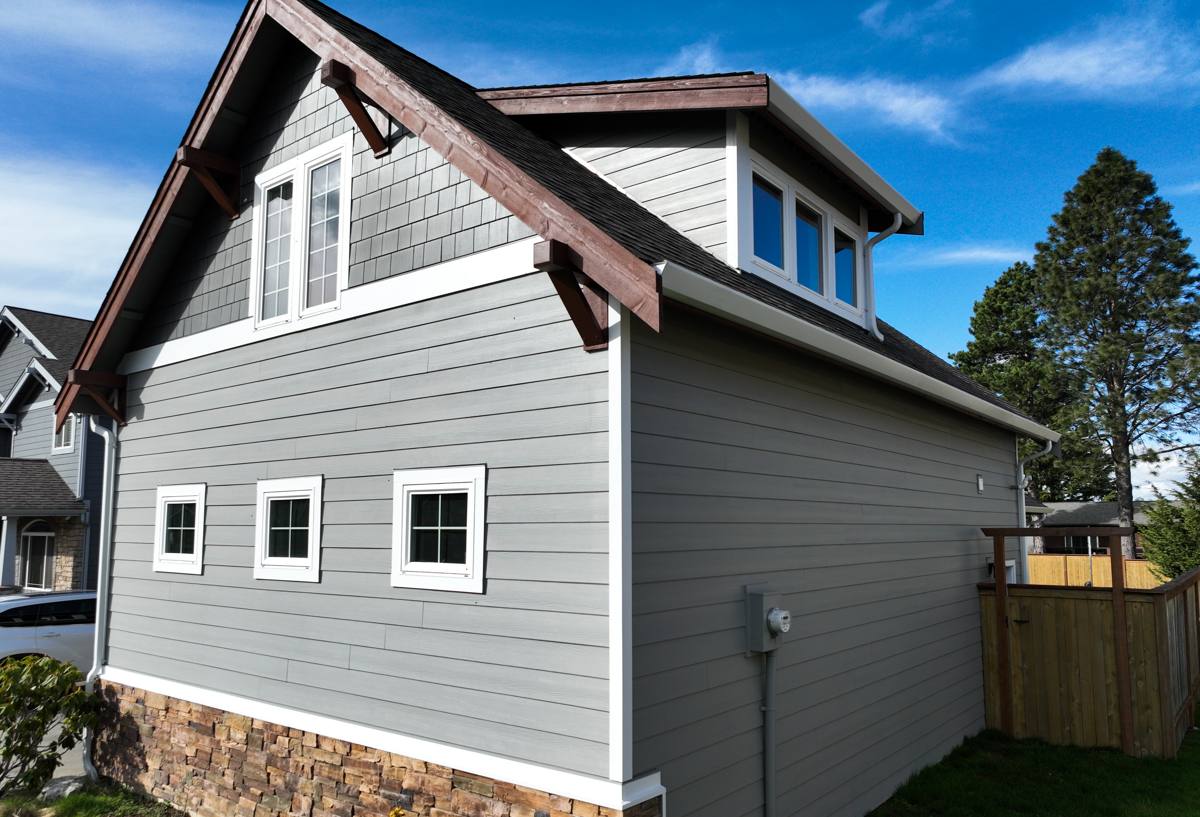
What the Climate Does to Siding Here
Salt Air and Moisture
Homes closer to the water pick up airborne salt that settles on exterior surfaces. Combined with our region's high humidity, this accelerates corrosion of fasteners and hardware, and it can degrade coatings that weren't formulated to handle it. Cheap paint jobs and unsealed cut edges fail faster near the bay than they would a few miles inland.
Driving Rain and Wind-Driven Wetting
Bellingham gets a lot of rain, but the geometry matters as much as the volume. Wind off the water can drive rain horizontally against exterior walls, forcing moisture into seams, laps, and fastener penetrations that would stay dry in a calmer storm. Over years, this is what turns a small installation shortcut into a rotted wall sheathing repair.
Moss, Algae, and Shade
Edgemoor's tree cover is part of what makes it beautiful, but it also means many homes get limited direct sun on at least one elevation. Shaded, damp siding is where moss and algae take hold fastest, and once established they hold moisture against the surface and accelerate whatever decay process is already underway. Our moss season here isn't a few weeks — it's most of the year.
Temperature Swings and Material Movement
Cool, damp winters and warmer, drier summers mean siding materials expand, contract, and absorb or release moisture on a seasonal cycle. Products that don't handle that movement well eventually show it as cupping, warping, or open joints.
Why We Install Only James Hardie Fiber Cement
We made a decision a long time ago to install one siding system: James Hardie fiber cement. We don't install vinyl, LP SmartSide, Cemplank, Allura, or bare wood siding like primed spruce or cedar. That's not a marketing position — it's a practical one, based on what actually performs in this climate over decades, not just the first few years.
Fiber cement is non-combustible, which matters more every year as wildfire smoke and regional fire risk become a bigger part of Pacific Northwest summers. It doesn't feed on moisture the way wood-based products can, and it isn't vulnerable to the impact damage, thermal warping, and seam-gapping that show up on vinyl. Hardie's ColorPlus factory finish is baked on under controlled conditions, which gives it far better resistance to fading and chipping than field-applied paint — an important detail in a neighborhood where salt air is already working against any coating.
Hardie also engineers regional product lines (HZ5 for our climate zone) specifically for moisture and freeze-thaw performance, which is a level of climate-specific engineering the other products on this list simply don't offer.
How Hardie Compares to Other Common Siding Products
| Product | Moisture Behavior | Combustibility | Finish Durability | Typical Warranty |
|---|---|---|---|---|
| James Hardie fiber cement | Dimensionally stable, engineered HZ lines for wet climates | Non-combustible | Factory ColorPlus finish resists fading/chipping | 30-year limited, transferable |
| Vinyl siding | Can warp/gap; traps moisture behind panels if installed loose | Combustible, can melt/deform | Field color only, fades over time | Varies widely, often prorated |
| LP SmartSide | Engineered wood — treated against moisture but still wood-based | Combustible | Factory or field finish, needs maintenance | Varies by product line |
| Primed spruce/cedar | Natural wood, absorbs moisture, prone to rot without upkeep | Combustible | Requires repainting on a recurring cycle | Manufacturer material warranty only |
None of these are junk products — LP SmartSide and cedar both have real fans and legitimate uses. But for a neighborhood like Edgemoor, where salt air, shade, and driving rain stack the deck against wood-based and vinyl products, we've chosen to put our name behind the one system that consistently holds up.
Roofing, Windows, and Decks in the Same Environment
Siding rarely fails in isolation — it's usually one piece of an exterior envelope that's under the same stress. We also handle roofing, windows, and decks, and on Edgemoor properties those systems face the same salt, moisture, and shade issues:
- Roofing: Moss growth and moisture retention under tree canopy shorten roof life if not addressed proactively.
- Windows: Wind-driven rain finds gaps around poorly flashed or aging window units before it finds anything else.
- Decks: Outdoor living spaces near the bay take the same salt exposure as siding, and need materials and fasteners chosen accordingly.
When we quote a siding job, we look at the whole exterior, not just the walls, because a new siding job installed against a leaking window or a failing roof edge doesn't stay new for long.
How We Approach a Siding Job in Edgemoor
Assessment First
Before we talk product or price, we look at what's actually happening on your home — moisture intrusion points, existing damage, shaded elevations, and how the current siding has held up (or hasn't). Sloped and bluff-adjacent lots sometimes need extra attention to drainage and grading around the foundation line, which affects how water moves once it hits the wall.
Installation Details That Matter Near the Water
- Correct fastener type and spacing to resist corrosion in a salt-air environment
- Proper house wrap and flashing details at every window, door, and penetration
- Manufacturer-specified clearances between siding and grade, decks, and roof lines to prevent wicking
- Caulking and joint treatment that matches Hardie's installation specifications, not shortcuts that void the warranty
- Attention to shaded, moss-prone elevations during both prep and finish work
Fiber cement performs the way it's supposed to only when it's installed to spec. A lot of the "siding failures" homeowners blame on the product are actually installation failures — gaps, wrong fasteners, missing flashing — and that's exactly why we control that process ourselves rather than treating installation as an afterthought.
What Homeowners in Edgemoor Should Watch For
If you're not sure whether your current siding is holding up, a few warning signs are worth checking, especially on shaded or water-facing elevations:
- Soft spots or visible warping when you press on the siding
- Persistent moss or algae staining that comes back quickly after cleaning
- Paint that's peeling, bubbling, or chalking faster than expected
- Visible gaps or separation at seams and corners
- Rust streaking from fasteners, especially near the coast-facing side of the home
Any of these can mean moisture is already past the surface. Catching it early is a lot less expensive than dealing with sheathing or framing repair later.
Cost Factors for an Edgemoor Siding Project
Every home is different, but a few factors tend to drive cost more than anything else on projects in this neighborhood specifically:
| Factor | Why It Matters in Edgemoor |
|---|---|
| Existing wall condition | Sheathing or framing repair adds cost if moisture has already gotten in behind older siding |
| Access and lot slope | Bluff and sloped lots can require extra staging, scaffolding, or protection for landscaping |
| Home size and complexity | Trim, dormers, and multiple elevations add labor beyond flat wall area |
| Product line and profile | Hardie offers multiple plank widths, textures, and ColorPlus colors at different price points |
| Tree and shade management | Some jobs benefit from coordinating with an arborist to improve airflow and reduce future moss buildup |
Why a Local Crew Matters
Whatcom County's exterior contractors see a version of this climate every single day, but Edgemoor's specific mix of bay proximity, tree cover, and lot slope isn't identical to a job in Fairhaven, the Puget neighborhood, or out toward Ferndale. A crew that works across Bellingham regularly builds an instinct for which elevations need extra flashing attention, where moss will come back fastest, and how salt exposure changes fastener choices from one part of town to the next. That local pattern recognition is hard to replace with a general specification sheet, and it's part of why we treat every Edgemoor estimate as its own assessment rather than a copy-paste quote.
If your siding is showing its age, or you're planning ahead of a sale or renovation, we're happy to take a look and give you a straightforward, no-pressure estimate. There's no cost to have us walk your property and tell you honestly what we see.