 Bellingham Siding
 Birchwood's Exterior Challenge: A Whatcom County Climate Story
Birchwood is one of Bellingham's established residential neighborhoods, and like the rest of Whatcom County, it sits squarely in a marine climate zone shaped by Bellingham Bay, the Salish Sea, and the wet weather systems that roll in off the Pacific for most of the year. Homes here don't deal with hurricanes or hailstorms. They deal with something quieter and more persistent: months of low-intensity rain, wind-driven moisture, salt-laden air, and long stretches of shade and dampness that never quite dry out. Over years, that combination is harder on an exterior than a single dramatic storm.
When we talk with homeowners in Birchwood about their siding, roofing, windows, or decks, the conversation almost always comes back to the same three things: moisture management, moss and mildew, and how well the materials on the house were actually built to handle a coastal Pacific Northwest climate rather than a generic "all-weather" rating.
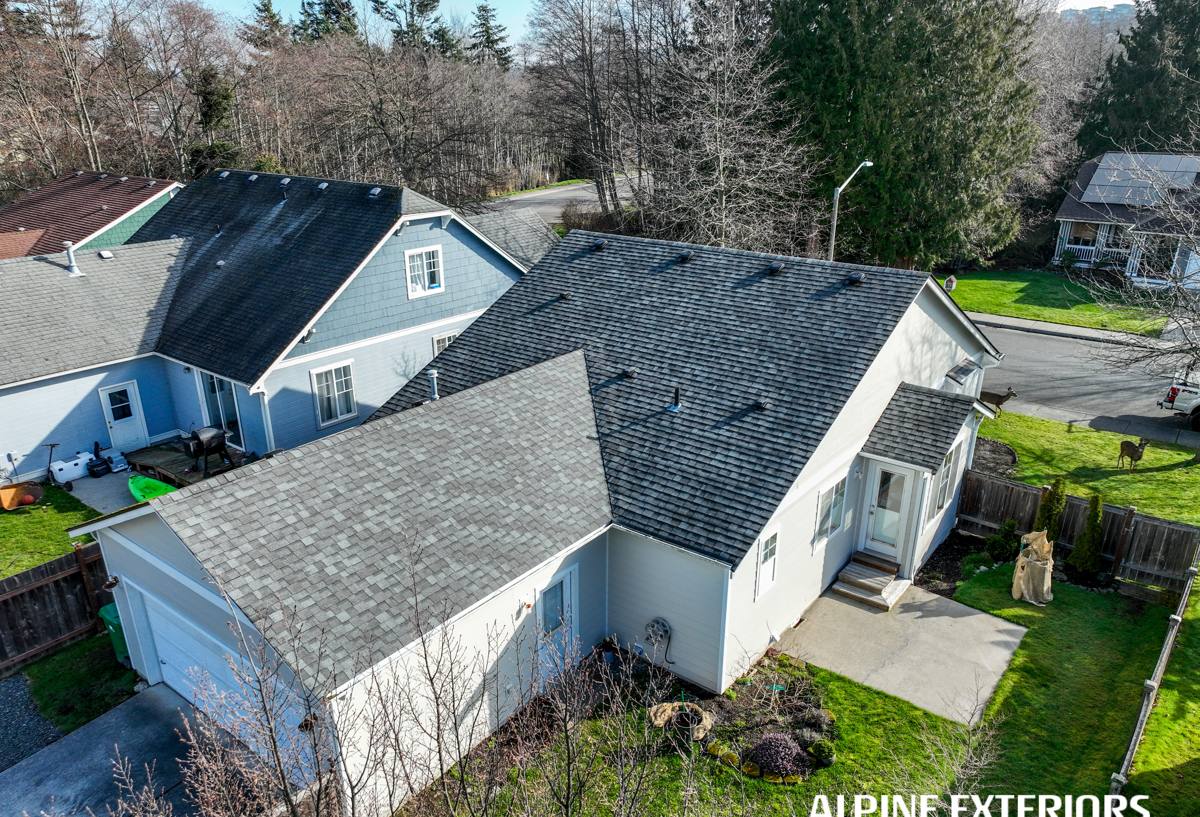
What Salt Air, Driving Rain, and Moss Season Actually Do to a House
Salt Air and Corrosion
Proximity to Bellingham Bay means airborne salt is a real factor, even a few miles inland. Salt-laden moisture accelerates corrosion on fasteners, flashing, and any metal components on the exterior. It also settles into porous or poorly sealed siding materials, holding moisture against the wall assembly longer than a dry-climate home would ever experience.
Driving Rain and Wind-Driven Moisture
Bellingham doesn't just get rain, it gets rain pushed sideways by wind off the water often enough that vertical surfaces, not just roofs, take a real soaking. Siding seams, butt joints, window flashing, and deck ledger connections are where driving rain finds its way in if they weren't detailed correctly the first time. Once moisture gets behind siding or decking, it can sit there for weeks before conditions dry things out.
Moss, Algae, and the Shade Factor
Whatcom County's long moss season is not an exaggeration. Between tree cover, cloudy skies, and consistent moisture, north-facing walls, roof valleys, and shaded decking surfaces grow moss and algae far more readily here than almost anywhere else in the country. Moss holds water against a surface, and on the wrong siding material that means slow saturation, swelling, or paint failure. On roofing, moss lifts shingles and traps moisture at the granule layer. On decking, it turns walking surfaces slick and starts breaking down wood fiber from the surface in.
Why We Standardized on James Hardie Fiber Cement
We install siding on homes throughout Bellingham and Whatcom County, and after years of doing exterior work in exactly the conditions described above, we made a deliberate decision: we only install James Hardie fiber cement siding. We don't install vinyl, LP SmartSide, Cemplank, Allura, primed spruce, or cedar lap siding, even though all of those products have a place in the broader market.
That's not a marketing preference. It's a practical one, built around what actually holds up in a wet, shaded, salt-influenced climate over a 20-, 30-, or 40-year span:
- Fiber cement doesn't rot. Wood-based products, including engineered wood siding, are still organic material at the core. Given enough sustained moisture exposure, they're vulnerable to decay, especially at cut ends, seams, and ground-contact areas.
- It's non-combustible. Fiber cement is made primarily from cement, sand, and cellulose fiber, and it carries a Class 1(A) fire rating. That matters for insurance considerations as much as it does for peace of mind.
- The factory finish (ColorPlus Technology) is baked on, not field-applied. A factory-cured finish resists the fading, chalking, and moisture intrusion at the paint layer that field-painted or primed-only products are more prone to in a climate this damp.
- It's dimensionally stable. Fiber cement doesn't expand and contract with moisture the way wood and some composite products do, which means fewer open seams for wind-driven rain to exploit over time.
- James Hardie engineers regional product lines (HZ5 and similar climate zone-specific formulations) specifically for wetter, more variable climates like the Pacific Northwest, rather than a one-size-fits-all approach.
We're not going to tell you vinyl or engineered wood siding is a bad product across the board. Vinyl is inexpensive and easy to install; engineered wood has a warmer look and lower upfront cost than fiber cement. But when we weigh installation sensitivity, moisture behavior in a marine climate, long-term maintenance burden, and warranty structure, fiber cement is what we're willing to put our name behind. It's the reason we stopped installing the alternatives rather than offering a menu of options with mixed confidence.
How Hardie Siding Compares in Our Climate
| Factor | James Hardie Fiber Cement | Vinyl | Engineered Wood (e.g. LP SmartSide) | Cedar / Untreated Wood |
|---|---|---|---|---|
| Moisture & rot resistance | Excellent — cement-based, does not rot | Good surface resistance, but seams can trap moisture behind panel | Moderate — resin-treated, but vulnerable at cut edges and gaps | Low to moderate without diligent maintenance |
| Salt air / coastal exposure | Strong, especially with HZ5 formulation | Can become brittle and discolor over time | Moderate — coating protects, but breach points are a risk | Weathers quickly without regular treatment |
| Moss & mildew resistance | High — non-porous cement base doesn't feed growth | Surface growth is common in shaded, damp areas | Moderate — organic wood fiber core can support growth if coating fails | Low — organic material is a natural host |
| Fire rating | Class 1(A), non-combustible | Melts and can contribute to fire spread | Combustible wood-based product | Combustible |
| Typical maintenance | Occasional wash, repaint only after decades | Low, but cracks/fades and can't be easily repaired in sections | Regular caulking and coating upkeep required | Frequent staining/sealing needed |
| Realistic lifespan in this climate | 30-50+ years installed to spec | 20-30 years | 15-25 years, climate dependent | 15-25 years with upkeep, less without |
The Full Exterior Picture: Siding, Roofing, Windows, and Decks
Siding doesn't work in isolation. On most Birchwood homes, the exterior envelope is a system: siding sheds bulk water, roofing and flashing manage the water that lands from above, windows are one of the most common leak points if flashed poorly, and decks take direct weather exposure with almost no protection from eaves or overhangs. We handle all four because a weak point in any one of them undermines the rest.
Roofing
Moss growth on roofs is one of the most common calls we get in this area. A roof that's shedding granules or holding moss at the valleys is often also sending moisture down behind fascia boards and into the top course of siding. Addressing roofing and siding together avoids treating the same water problem twice.
Windows
Window flashing integration with siding is one of the most failure-prone details in residential construction, and it's almost invisible until there's a problem. When we replace siding, we check window flashing and pan details rather than just butting new siding up against old, unverified flashing.
Decks
Decks in this region take the brunt of moss, standing water, and UV-cycling between rain events. Ledger board attachment and proper drainage away from the house are the details that most often get skipped on lower-cost deck work, and they're the details that matter most for keeping water away from the siding and framing behind it.
What a Local Crew Brings to a Birchwood Job
Exterior work in Whatcom County isn't the same job as exterior work in a dry climate. A crew that primarily works in drier regions can install a product correctly on paper and still get the details wrong for a marine environment: too little attention to flashing laps, weep paths, and ventilation gaps that matter here far more than they would somewhere with a fraction of our annual rainfall.
A local crew also understands the practical realities of a Bellingham job: navigating tree cover and shaded lots that never fully dry between rain events, sequencing work around the wetter months, and knowing which details on an older Birchwood home are likely to need extra attention before new siding goes on.
Our Process, Start to Finish
- On-site inspection of existing siding, roofing, windows, and decking to identify moisture damage, moss buildup, and failure points before any proposal is written.
- Honest scope discussion — what needs full replacement, what can be repaired, and what's cosmetic versus structural.
- Detailed proposal covering James Hardie product line and color selection, plus any roofing, window, or deck work that's part of the same project.
- Proper tear-off and prep, including checking sheathing condition and flashing details rather than covering up existing problems.
- Installation to manufacturer specification, including correct fastening, clearances, and joint treatment for our climate.
- Final walkthrough to confirm the work matches what was proposed.
A Seasonal Exterior Checklist for Birchwood Homeowners
Between service visits, a few habits go a long way toward protecting siding, roofing, windows, and decks in this climate:
- Keep gutters clear heading into fall so overflow doesn't run down siding seams
- Trim back tree limbs and vegetation that keep walls and decking shaded and damp
- Gently rinse moss and algae off siding and decking surfaces before they build up thick growth
- Check window and door flashing and caulking for gaps at least once a year
- Look at deck ledger boards and fasteners for rust staining or softness after the wet season
- Watch roof valleys and north-facing slopes for moss accumulation, since that's usually where it starts
Ready for a Straight Answer About Your Birchwood Home
If your siding, roofing, windows, or deck are showing signs of what a long Whatcom County wet season does over time, moss, soft spots, fading, or gaps at the seams, it's worth having a local crew take an honest look before those issues get more expensive to fix. We're happy to walk your property, explain exactly what we see, and talk through options without any pressure to sign anything on the spot. Reach out for a free estimate using the form below.