 Bellingham Siding
 Siding Built for Ferndale's Coastal Climate
Ferndale sits close to the water, low-lying and open to weather moving in off the Salish Sea. That proximity to the coast means homes here deal with a mix of conditions that inland Whatcom County neighborhoods don't face quite as hard: salt-laden air, wind-driven rain that hits siding at an angle instead of falling straight down, and a long, damp season where moss and algae get every chance they need to take hold. None of that is unusual for this part of Washington, but it does mean the exterior products and installation details that work fine in a drier climate can fall short here.
We're a Bellingham-based crew that works Ferndale regularly, and the pattern we see on older homes is consistent: siding that looked fine for a decade and then started failing all at once, usually starting at the bottom courses, around window trim, or on the sides of the house that catch the prevailing weather. That failure pattern is almost always moisture-related, and it's the reason we've standardized on one siding product rather than offering a menu of options.
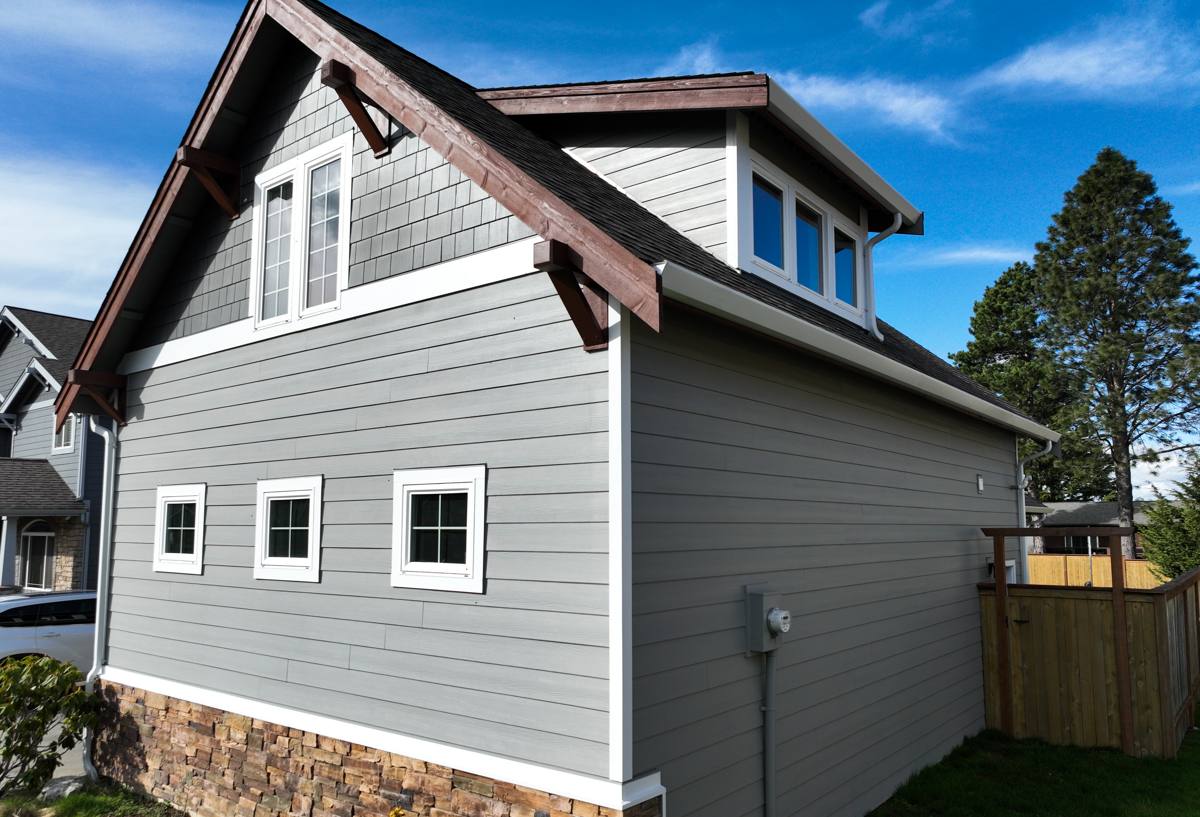
What Coastal Exposure Actually Does to a House
Salt Air and Corrosion
Homes closer to the water pick up airborne salt that settles on siding, trim, and fasteners. Over years, that accelerates corrosion on lower-quality fasteners and metal flashing, and it can contribute to premature breakdown of finishes that weren't engineered to hold up against it. It's a slow process, which is exactly why it gets ignored until the damage is already done.
Driving Rain
Wind off the water doesn't let rain fall straight — it pushes it sideways, into laps, seams, and anywhere a siding product has a weak joint or an installer cut a corner on flashing. Siding that depends on paint or sealant alone to keep water out is more exposed in a wind-driven rain environment than it would be somewhere calmer.
Moss and Algae Season
Whatcom County's wet season runs long, and shaded or north-facing walls in Ferndale can stay damp for weeks at a stretch. Wood-based and wood-fiber siding products absorb that moisture, which is what feeds moss, algae, and eventually rot. Fiber cement doesn't behave the same way, because it isn't an organic material moisture can feed on.
Why We Only Install James Hardie Fiber Cement
We get asked regularly why we don't offer vinyl, LP SmartSide, or primed wood siding alongside Hardie. The honest answer is that we used to see the failures those products produce in this climate specifically, and we made a decision to stop installing products we didn't want to stand behind on a coastal Whatcom County home.
- Non-combustible: James Hardie fiber cement is engineered from cement, sand, and cellulose fiber — it doesn't contribute fuel to a fire the way wood-based sidings can.
- Climate-engineered product lines: Hardie's HZ5 line is formulated for harsher, wetter climate zones, which fits the Pacific Northwest better than a one-size-fits-all product.
- Factory-applied ColorPlus finish: baked-on finish that resists fading and holds up to UV and moisture cycling better than field-applied paint, which matters when a house is going to see this much rain year after year.
- Dimensionally stable: fiber cement doesn't swell and shrink with moisture the way wood-based products do, so it holds paint lines and caulk joints longer.
- Strong transferable warranty: a real warranty backing the product, which counts for something if you sell the house before the siding's service life is up.
We're not saying every other product is worthless — vinyl and engineered wood sidings have their place, and plenty of installers do fine work with them. But we've chosen to specialize in one system we can install correctly and stand behind, rather than spreading our crew across products with different install requirements and different failure points. In a climate like Ferndale's, installation quality matters as much as the product itself, and specializing lets us actually be good at it.
How We Approach a Ferndale Siding Job
Assessment First
Before we talk product or price, we look at what's actually happening on the house — where moisture is getting in, whether there's existing rot under the current siding, how the house is oriented relative to prevailing wind and rain, and what the flashing and water-management details look like at windows, doors, and roof lines.
Water Management Details
The siding itself is only part of the system. Correct installation means proper rainscreen or drainage gap where called for, correctly lapped and sealed flashing, and fastener patterns that meet Hardie's published specs for the exposure the wall actually sees. A lot of siding failures we get called out to inspect trace back to shortcuts in these details, not the material.
Fastener and Trim Choices
Given the salt air exposure this area gets, we pay attention to fastener material and trim compatibility so corrosion doesn't become the weak point in an otherwise solid install.
Siding Product Comparison for Coastal Whatcom County
| Factor | James Hardie Fiber Cement | Vinyl Siding | Wood-Based / Engineered Wood |
|---|---|---|---|
| Moisture behavior | Doesn't absorb or feed organic growth | Doesn't absorb, but seams and gaps rely on lap fit | Absorbs moisture; can swell, delaminate, or feed moss/algae |
| Fire resistance | Non-combustible | Melts/deforms under heat | Combustible |
| Finish durability | Factory-baked ColorPlus finish | Color molded through, but can fade and chalk | Field-applied paint, needs recoating over time |
| Dimensional stability | High — minimal expansion/contraction | Expands/contracts noticeably with temperature | Moderate to low, moisture-driven movement |
| Typical service life when installed to spec | Decades, with proper maintenance | Long-lived but finish degrades over time | Shorter, especially in wet climates |
Beyond Siding: Roofing, Windows, and Decks
Siding doesn't work in isolation — it's one piece of a home's exterior envelope. We also handle roofing, windows, and decks in Ferndale, because a siding job that ignores a failing roof edge or leaking window flashing is just delaying the next call. When we're on site for a siding estimate, we'll flag anything we see with the roof, trim, or windows that's contributing to moisture problems, even if it's outside the original scope.
Decks in a Wet Climate
Decks take the same driving-rain and moss exposure siding does, plus standing water and foot traffic. Material choice and proper drainage/flashing at the ledger board matter just as much here as they do on the walls of the house.
What to Expect From a Local Bellingham Crew
Working out of Bellingham means we're in Whatcom County year-round, not driving up from out of the area for a single job. That matters for a few practical reasons:
- We know what Ferndale's exposure to wind and rain off the water actually does to a house over time, not just in theory.
- We're reachable for a warranty question or a follow-up years after the install, not a crew that's moved on to another region.
- We're familiar with the permitting and inspection expectations in Whatcom County jurisdictions.
- We can speak honestly to what we're seeing on your specific house rather than pushing a generic recommendation.
Questions to Ask Before Hiring an Exterior Contractor
- Are they licensed and insured to work in Washington, and can they show proof?
- Do they specialize in one siding system they install to manufacturer spec, or do they install whatever's cheapest that week?
- Will they explain the water-management details — flashing, drainage gap, fastener pattern — not just the visible siding?
- Do they offer a written, itemized estimate rather than a vague verbal number?
- Are they willing to point out issues with your roof, windows, or trim even if it's not what you called about?
- What does the manufacturer's warranty actually cover, and is it transferable if you sell the house?
Cost Factors for a Ferndale Siding Project
| Factor | Why It Affects Cost |
|---|---|
| Existing damage/rot | Hidden moisture damage found during tear-off adds repair scope before new siding goes on |
| House size and complexity | More corners, dormers, and trim detail means more labor and cut waste |
| Siding profile and finish | Lap width, texture, and ColorPlus finish selections vary in material cost |
| Access and site conditions | Tight lots, landscaping, or multi-story sections affect scaffolding and labor time |
| Trim and flashing scope | Full replacement of trim and flashing (recommended for a proper install) adds material and labor |
If you're weighing a siding project in Ferndale — whether it's a full replacement, storm damage repair, or you're just trying to figure out what's causing moisture issues on your current siding — we're glad to come take a look and give you a straightforward, no-pressure estimate. There's a form below to get started.