 Bellingham Siding
 Vinyl Siding Is a Real Product With Real Advantages
Before explaining why we don't install it, it's worth being straight about what vinyl siding actually does well, because pretending otherwise wouldn't be honest. Vinyl is lightweight, relatively inexpensive to manufacture and install, comes in a wide range of colors and profiles, and doesn't need to be painted. For a lot of markets in the country, especially drier inland regions, it's a reasonable, budget-friendly exterior choice that homeowners live with for years without major complaint. If price per square foot were the only factor that mattered, vinyl would win that comparison against almost anything else on the market.
The problem isn't that vinyl is a bad product in some general sense. The problem is what happens when that specific product meets Bellingham's specific climate, year after year, for the twenty or thirty years a homeowner expects their siding to last. That's the question we ask about every material before we'll put our name on the installation, and it's the question that led us to stop offering vinyl.
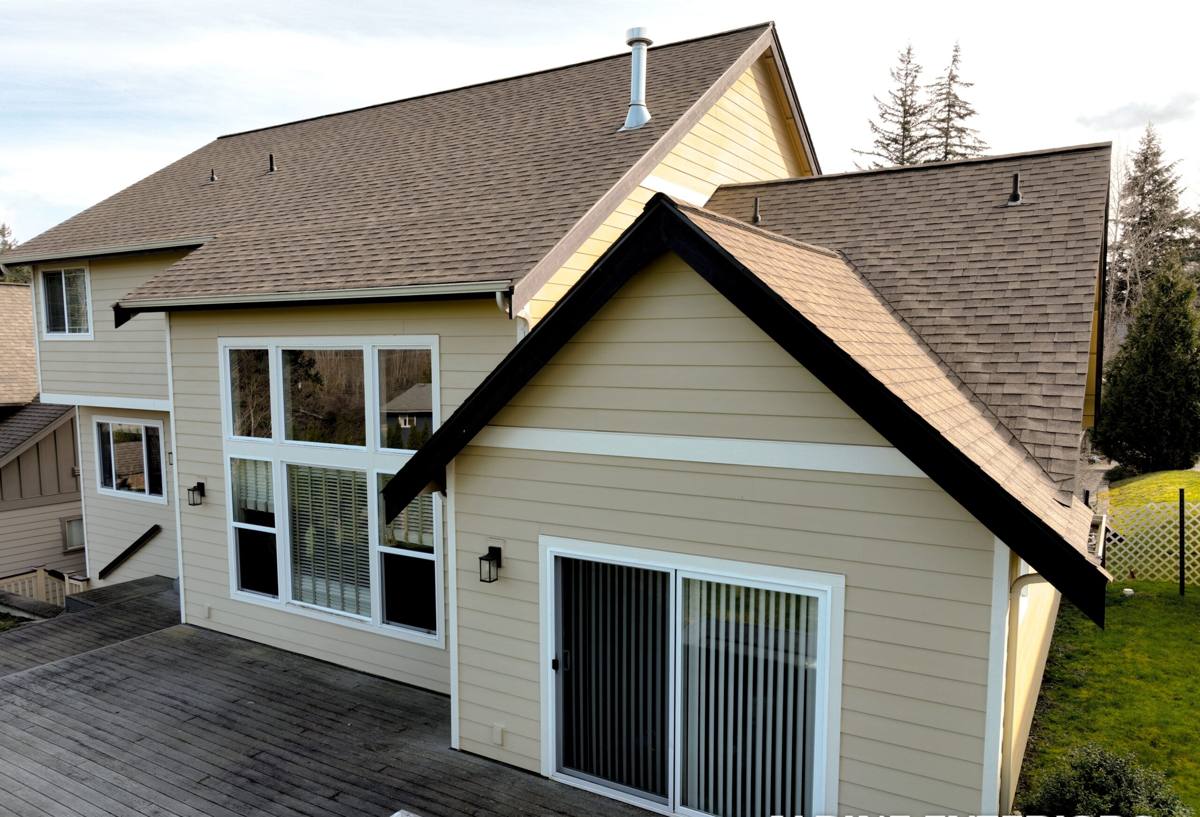
What Bellingham's Climate Asks of a Siding Material
Whatcom County sits on the Salish Sea, and that location shapes almost everything about how exterior materials age here. Salt-tinged marine air moves through Bellingham constantly, not just during storms. Rain arrives wind-driven more often than it falls straight down, which pushes water sideways into seams, laps, and trim details that a calmer climate would never test. And the combination of mild temperatures, consistent dampness, and heavy tree cover gives moss and mildew a season that can run most of the year on shaded, north-facing walls.
None of that is exotic weather. It's just persistent, and persistence is exactly what exposes the weak points in a lower-cost material over a long ownership timeline. A siding product doesn't have to fail in year one to be a poor fit for this climate — it just has to slowly lose ground every wet season until the homeowner is dealing with problems a different material would have avoided.
Where Vinyl Struggles in a Wet Marine Climate
It Manages Moisture by Getting Out of the Way, Not by Sealing It Out
Vinyl siding is designed to be a loose-fitting rain screen. Panels hang on nail hems and are meant to move with temperature changes, which means the system relies heavily on the house wrap and flashing behind it to do the actual water management. That's a workable design in principle, but it puts enormous weight on a layer most homeowners never see and can't inspect. In a climate with wind-driven rain hitting the wall from an angle, any gap in that hidden layer becomes a real path for moisture, and vinyl itself won't tell you it's happening until the sheathing behind it already has a problem.
It Doesn't Handle Impact or Age Gracefully
Vinyl becomes noticeably more brittle in cold weather and can crack from impact — a thrown rock, a ladder bump, hail in a bad year — in ways that are hard to repair invisibly. Replacement panels also fade at a different rate than the surrounding siding, so a patch job a few years after installation rarely blends in. Over a decade or two of Pacific Northwest weather, thermal cycling and UV exposure both take a toll on the material's flexibility and color.
Moss and Mildew Find It an Easy Surface
Vinyl's overlapping panel design creates horizontal ledges and butt joints where moisture sits, and its surface texture gives organic growth something to hold onto. In Bellingham's shaded, damp microclimates — under eaves, behind landscaping, on north walls — that translates into moss and mildew staining that shows up faster and spreads further than it does on a denser, less porous material. Homeowners end up power-washing or treating vinyl siding on a schedule that a different product wouldn't require nearly as often.
Color Is Baked In, Not Layered On — Which Cuts Both Ways
Vinyl's color runs through the material rather than sitting on top of it, so it won't peel or chip the way old painted wood siding does. But that same color is vulnerable to UV fading over time, and because it's a single uniform pigment through a fairly thin panel, sun-exposed elevations can visibly fade differently from shaded ones. Once that fading sets in, there's no repainting your way out of it — the only real fix is replacement.
Fastening and Fit: Why Installation Quality Matters More With Vinyl
Vinyl siding has to be installed with a specific amount of slack in each nail so the panel can expand and contract with temperature swings. Nail it too tight and panels can buckle or warp; nail it too loose and wind — including the gusts that come off the bay — can rattle or even pull panels loose. This isn't a flaw unique to vinyl, but it does mean the product has a narrower margin for installer error than a rigid material does, and small mistakes tend to show up as cosmetic problems (waviness, gapping, panel movement) well before the wall behind it is actually compromised.
Comparing Vinyl Siding and James Hardie Fiber Cement
| Factor | Vinyl Siding | James Hardie Fiber Cement |
|---|---|---|
| Upfront material cost | Lower per square foot | Higher per square foot |
| Moisture management | Relies on the barrier behind it; panel itself doesn't seal | Dense, engineered board with a factory finish designed to shed water |
| Moss and mildew resistance | Textured, jointed surface gives growth something to hold onto | Denser surface and Hardie's climate-specific HZ formulation resist moisture absorption |
| Impact and cold-weather durability | Can crack or become brittle in cold, sharp impacts | Resists impact well; not prone to cold-weather brittleness |
| Color performance over time | Solid-color material that can fade unevenly with UV exposure | ColorPlus factory finish holds color longer with a documented warranty against fading |
| Fire performance | Combustible plastic material | Non-combustible fiber cement |
| Typical lifespan when properly installed | Often replaced within 20-30 years | Commonly performs 30-50+ years with proper maintenance |
None of these are marketing claims about a competitor failing — they're the practical, physical differences between a PVC panel product and an engineered fiber cement board, and they're the reasons the trade-offs land differently once you factor in Bellingham's specific weather.
The Warranty Question
Vinyl siding warranties vary a lot by manufacturer and are frequently prorated, meaning the payout for a failure shrinks the longer you've owned the siding — a warranty that looks strong on paper in year two can be worth very little by year fifteen, right when a marine climate has done the most damage. James Hardie's ColorPlus and substrate warranties are structured differently and are transferable to a new owner if you sell, which matters both for your own protection and for resale. We'd rather stand behind a warranty structure we can explain plainly than one that requires an asterisk.
Why We Standardized on James Hardie Instead
We used to install a wider range of siding products. What changed our minds wasn't a single bad job — it was a pattern, visible on tear-offs and repair calls across Bellingham and the rest of Whatcom County, of moisture, moss, and fading problems concentrated on the same handful of lower-cost materials, vinyl included. James Hardie fiber cement is denser, non-combustible, factory-finished with ColorPlus technology, and available in HZ product lines engineered specifically for regions like ours with heavy moisture exposure. It costs more upfront. It also holds up to exactly the conditions Bellingham throws at a house, which is the only standard that actually matters to us when we're the ones putting our name on the installation.
What to Ask Before You Choose a Siding Material
- Ask what the material is actually made of, not just its brand name — plastic, engineered wood, and fiber cement all behave differently in wet climates.
- Ask how the warranty is structured, and specifically whether it's prorated over time.
- Ask how the material has performed on other homes in Whatcom County specifically, not just in general marketing material.
- Ask what maintenance the material will realistically require in a climate with a long moss and mildew season.
- Ask whether the contractor installs multiple product lines and, if so, why they'd recommend one over another for your specific home and lot.
- Ask what happens to the color and finish after ten, twenty, and thirty years of coastal sun and salt air exposure.
Our Honest Bottom Line
Vinyl siding isn't a scam or a product to be afraid of — it's simply built around a different set of priorities than the ones that matter most in a marine climate with driving rain and a long wet season. We stopped installing it because we kept seeing the same moisture, moss, and fading issues show up on homes in this specific part of Washington, and we didn't want to keep selling a product we knew had a shorter, rougher road ahead of it here. James Hardie fiber cement costs more to install, and we think that cost is easier to justify once you've seen how differently the two materials age on a Bellingham roofline.
If you're weighing siding options for your home, we're glad to walk through what we install, why, and what it would look like on your specific property. Reach out for a free, no-pressure estimate — there's no obligation, and we'll give you a straight answer even if part of that answer is explaining why we won't quote you a product we don't stand behind.