 Bellingham Siding
 Homeowners in Bellingham ask us about LP SmartSide often enough that we think it deserves a straight answer, not a sales brush-off. It's a legitimate engineered wood product with real engineering behind it, a national dealer network, and a lot of installed homes across the country that are doing fine. We don't install it anyway. This page explains what the product actually is, what it does well, and why we made the call to standardize on James Hardie fiber cement instead for homes in Whatcom County.
What LP SmartSide Actually Is
LP SmartSide is an engineered wood siding product, not solid lumber and not fiber cement. It's made from wood strands or wafers bonded with resins under heat and pressure, then treated with a zinc borate additive for fungal and insect resistance and coated with a proprietary primer or overlay called SmartGuard. It comes in lap siding, panel siding, trim, and soffit, and it's lighter and easier to cut than fiber cement, which is part of why some crews prefer working with it.
LP has improved the product significantly since the OSB-based siding failures of the 1990s that damaged the wood-composite siding category's reputation generally. The current SmartSide product is a different formulation with better resin technology and factory coatings, and LP backs it with a warranty that, on paper, looks competitive. We're not disputing any of that. Our concern isn't that the product is fraudulent or that it fails on day one — it's about what happens to any wood-based product over 15, 20, 30 years on a coastal Pacific Northwest home, and what that means for the homeowner who has to live with the maintenance schedule.
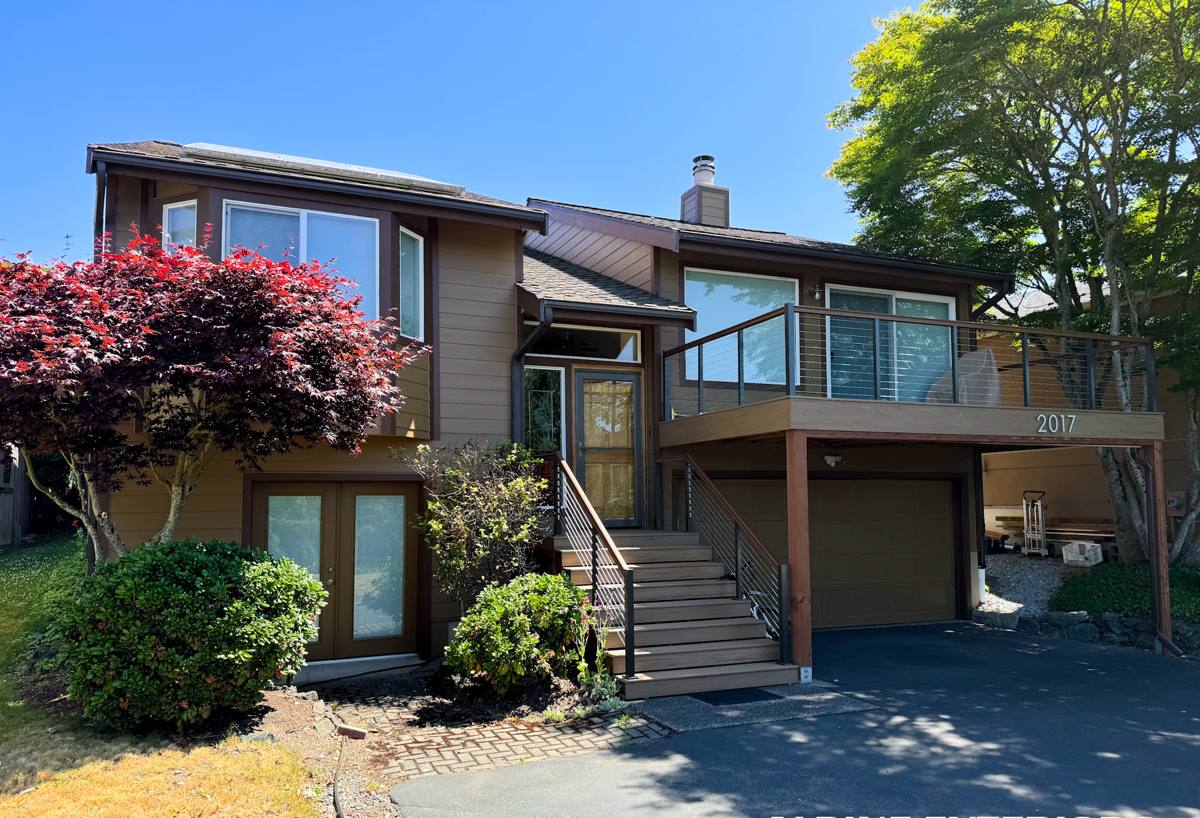
The Core Issue: It's Still Wood
Fiber cement is cement, sand, and cellulose fiber. It doesn't rot, it doesn't feed insects, and it doesn't swell when it absorbs moisture the way wood does. LP SmartSide, no matter how well-engineered, is still a wood-fiber product at its core. The zinc borate treatment and factory coatings are there specifically because wood needs that protection — untreated engineered wood siding would fail fast in our climate. That's a reasonable engineering response to a real vulnerability, but it means the product's long-term performance depends entirely on that protective system staying intact for the life of the siding.
Here's the practical version of that concern: every cut edge, every nail penetration, every seam, and every point where a fastener or flashing detail breaks the factory coating is a place where raw wood fiber can be exposed to moisture. Field-cut edges have to be primed or sealed correctly and kept sealed over decades of expansion, contraction, and weather. In a climate like ours, that's not a one-time install detail — it's an ongoing maintenance obligation for the homeowner, and it's one that's easy to let slide once a house changes hands or a few years go by without inspection.
What Bellingham's Climate Does to That Equation
Whatcom County doesn't get hurricane-force weather, but it gets something arguably harder on siding: long stretches of low-intensity moisture exposure. We get driving rain off the Strait of Georgia and Bellingham Bay, salt-laden marine air along the waterfront and up into neighborhoods that catch onshore wind, and a moss and algae season that runs long because our summers don't get hot and dry enough to fully knock back organic growth the way a drier climate would. Combine damp air, moderate temperatures, and shade from the mature tree cover common in this area, and you get siding that stays damp longer between drying cycles than siding in most parts of the country.
That's a tough environment for any wood-fiber product's protective coating to hold up in for the long haul, especially on north-facing walls, under eaves with poor airflow, or near sprinkler heads and downspouts — all common trouble spots we see on Bellingham homes regardless of siding type. Fiber cement doesn't eliminate moisture exposure, but it removes the failure mode where moisture intrusion leads to fiber swelling, delamination, or rot at the core of the board. With an engineered wood product, a coating breach in a chronically damp spot is the beginning of a maintenance problem; with fiber cement, the same breach is a paint problem, not a structural one.
Installation Sensitivity
Every siding product has installation requirements, but wood-based products tend to be less forgiving of shortcuts specifically because the consequences of a mistake compound over time rather than showing up immediately. Proper LP SmartSide installation requires:
- Field-cut edges primed or sealed with the correct product before installation, not after
- Correct nail placement and depth to avoid overdriving, which can compromise the coating and create a moisture entry point
- Proper clearance from grade, roofing, and decks per LP's published installation instructions
- Caulking and sealant maintained at every joint, corner, and penetration on a regular schedule
- Kick-out flashing and proper drainage details at every roof-wall intersection
None of that is unusual for siding installation in general — Hardie has its own detailed installation requirements too. The difference is what happens when a detail gets missed. On fiber cement, a missed caulk joint or a slightly overdriven nail is a cosmetic or minor repair issue. On an engineered wood product, the same miss can become an entry point for moisture into a wood-fiber substrate, and by the time it's visible — usually as swelling, staining, or a soft spot — the damage is often already done underneath the surface, not just at the surface.
We install high volumes of siding every year, and we know from experience that installation quality varies even among careful crews. We'd rather work with a product where a small miss stays small.
Maintenance Burden Over Time
LP SmartSide requires an active maintenance relationship from the homeowner: periodic caulk inspection and renewal at joints and penetrations, repainting on a schedule (LP's own guidance calls for repainting, typically in the 7-10 year range depending on exposure and coating condition, sooner in harsher exposures), and prompt attention to any coating damage from impact, ladders, pressure washing, or weather. Skip that maintenance in a climate like ours, and the clock on a moisture problem starts running quietly, often behind the siding where it isn't visible until it's advanced.
James Hardie's factory ColorPlus finish is baked on and warrantied against fading and peeling for a much longer window, and because the substrate itself is cement rather than wood fiber, a lapse in caulk maintenance doesn't carry the same structural risk. That difference matters most for the homeowners who don't want siding to be a recurring line item on their to-do list, which in our experience is most homeowners.
Where LP SmartSide Genuinely Makes Sense
We're not going to pretend there's no reasonable case for it. It's lighter, which can reduce structural loading on some builds. It's easier and faster to cut and install, which can lower labor cost. It holds paint well when properly maintained. For a budget-conscious build in a drier climate, with an owner who's committed to the maintenance schedule, it can be a defensible choice. We just don't think Bellingham's marine climate, with its salt air and extended damp season, is the environment where those trade-offs favor an engineered wood product over fiber cement — and since we can only stand behind the work we actually do, we chose to specialize rather than offer a product we'd have reservations about a decade down the road.
Side-by-Side Comparison
| Factor | LP SmartSide | James Hardie Fiber Cement |
|---|---|---|
| Core material | Engineered wood strand, resin-bonded | Cement, sand, cellulose fiber |
| Moisture vulnerability | Coating-dependent; core is wood fiber | Non-combustible, doesn't rot or swell |
| Repainting interval | Roughly 7-10 years, sooner in harsh exposure | Factory ColorPlus finish, long warranty window |
| Cut-edge handling | Requires field priming/sealing every cut | Cut edges are cement; less coating-dependent |
| Weight | Lighter, easier to handle and cut | Heavier, requires proper fastening technique |
| Insect/rot resistance | Zinc borate treated | Inorganic material, not a food source |
| Marine/coastal performance | Workable with strict maintenance discipline | Engineered HZ product lines for moisture climates |
Why We Standardized on James Hardie
After years of installing and repairing multiple siding types across Whatcom County, we made a business decision to install James Hardie fiber cement exclusively. It's non-combustible, it doesn't have a wood-fiber core that depends on an intact coating to resist moisture, and Hardie's climate-engineered HZ5 product line is formulated specifically for the kind of wet, moderate-temperature exposure we get here. The factory ColorPlus finish reduces the repainting burden that comes standard with wood-based sidings, and Hardie's warranty structure is transferable, which matters to homeowners who may sell within the product's lifespan. Specializing in one system also means our crews install it constantly rather than switching between products, which we think shows in the finished work.
If you're weighing LP SmartSide, vinyl, or fiber cement for a Bellingham home, we're glad to walk through the honest trade-offs in person, including what your specific site exposure — waterfront, wooded lot, sun-facing wall — means for either product's long-term performance. Reach out for a free, no-pressure estimate and we'll give you a straight assessment, not a sales pitch.