 Bellingham Siding
 Two Different Materials, One Big Decision
When homeowners in Bellingham start pricing out a siding replacement, they usually run into two very different products wearing similar marketing language: James Hardie fiber cement and LP SmartSide engineered wood. Both are marketed as upgrades over vinyl. Both come primed or factory-finished. Both claim to hold up to Pacific Northwest weather. But they are not the same material, they do not fail the same way, and they do not belong on the same house for the same reasons.
We install James Hardie fiber cement exclusively. We do not install LP SmartSide, and we want to explain why in plain terms — not by trashing the product, but by walking through what it's actually made of, how it performs after ten or fifteen years in a marine climate like ours, and why we'd rather turn down a job than stand behind a material we don't trust on Whatcom County homes.
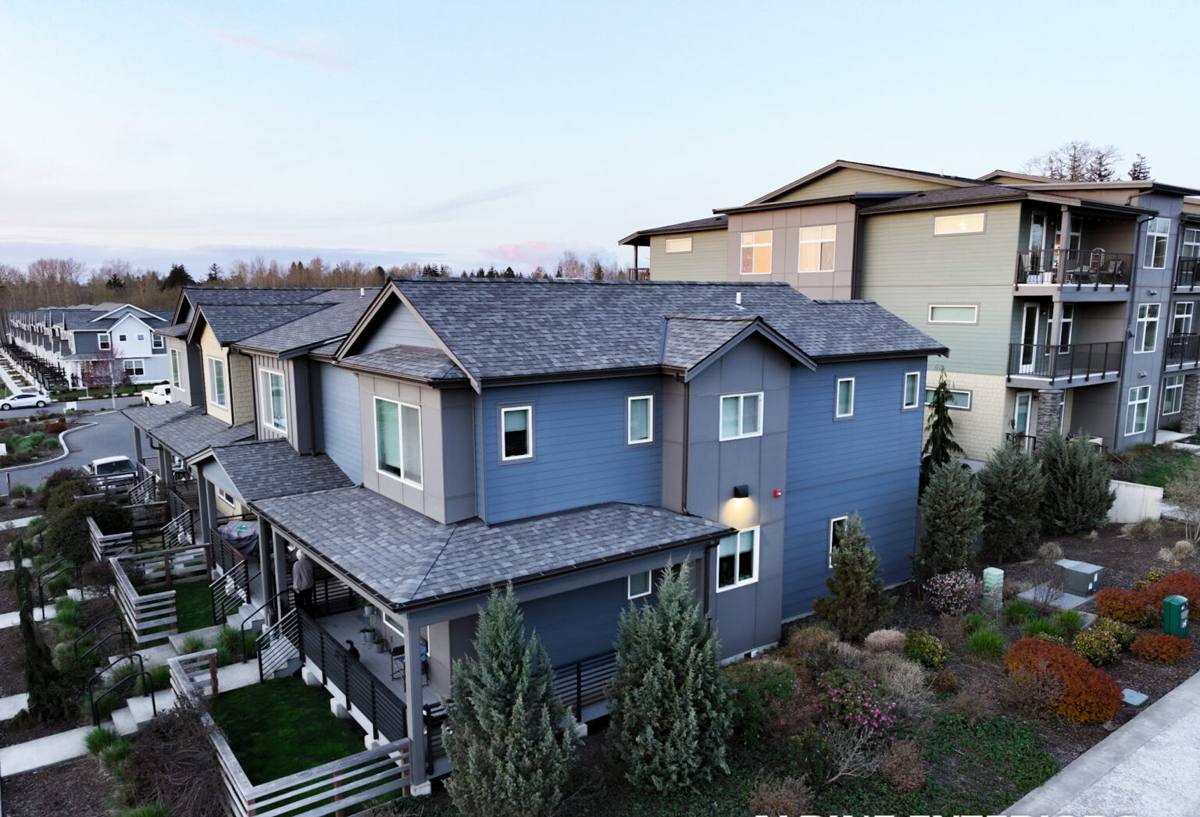
What Engineered Wood Siding Actually Is
LP SmartSide and similar engineered wood products are made from wood strands — not solid lumber, not plywood — bonded together with resin, then treated with a zinc-borate preservative and coated with a resin-saturated overlay to resist moisture. It's essentially a treated, engineered version of OSB (oriented strand board), formed into siding panels or lap boards.
To be fair to it: this is a real improvement over the old untreated hardboard siding that caused so many problems in the 1990s and early 2000s. The zinc-borate treatment does resist rot and insect damage better than raw wood, and the panels are lighter and easier to handle than fiber cement. For a contractor working in a dry climate, or on a budget-driven project, it's a legitimate product.
Why We Don't Think It's Right for Here
The problem isn't the manufacturing — it's the base material. Wood strands, no matter how they're treated or coated, are still wood. Wood swells when it absorbs moisture and shrinks when it dries. In a climate that gets a real dry season, that cycle is manageable. In Whatcom County, where driving rain off Bellingham Bay and the Strait of Georgia can soak a wall assembly for weeks at a stretch, and where many properties barely get a true dry season before the next system rolls in, that swell-shrink cycle happens constantly, and it happens hardest at the most vulnerable point of the product: cut edges.
Every butt joint, every window and door cut, every corner where a saw has exposed the raw strand core is a place where the factory coating no longer protects the wood. Manufacturers require field-applied sealant on every cut edge, every time, with no exceptions, for the warranty to hold. That's not a minor detail — it's a maintenance obligation that falls entirely on correct installation and then on the homeowner keeping up with caulk and paint for the life of the siding.
How Salt Air and Moss Season Change the Math
Bellingham sits on saltwater, and Whatcom County's siding takes a three-part beating that a lot of manufacturers' national warranty language simply wasn't written around: salt-laden air off the bay, long stretches of driving rain, and a moss and algae season that can run most of the year on shaded, north-facing walls under mature trees. None of that is exotic to us — it's just Tuesday in Bellingham — but it's exactly the combination that exposes the weak points in a wood-based product.
- Salt air accelerates the breakdown of exposed wood fiber and softens caulk and sealant faster than in an inland climate.
- Sustained driving rain finds any gap in edge sealant and pushes water into the strand core, where it can wick and swell long before it's visible from the outside.
- Moss and algae hold moisture against the siding surface for extended periods, especially on north and east elevations shaded by cedars and firs — common on Whatcom County lots.
On a fiber cement product, that combination is a cleaning and maintenance issue. On an engineered wood product, it's a durability issue, because the failure mode isn't cosmetic staining — it's moisture getting into the wood itself.
What Fiber Cement Is Made Of — And Why It Behaves Differently
James Hardie siding is made from Portland cement, sand, and cellulose fiber, cured under pressure and heat. There is no wood strand core to swell, no resin binder to break down from UV and moisture cycling, and nothing for insects to feed on. It's dimensionally stable across wet and dry cycles, which matters enormously in a climate where "dry" is relative.
It's also non-combustible, which is worth stating plainly rather than glossing over: fiber cement doesn't contribute fuel to a fire the way any wood-based product does. That's a real, material difference in wildfire-adjacent areas and simply a sound baseline safety feature everywhere else.
ColorPlus Factory Finish
Most of what we install carries Hardie's ColorPlus finish — a factory-applied, baked-on finish that's more consistent and more UV- and fade-resistant than field-applied paint, backed by its own finish warranty separate from the substrate warranty. It also means far less repainting over the life of the siding, which matters in a market where exterior painting labor isn't cheap and scaffolding a two-story house isn't a weekend project.
HZ Climate-Engineered Product Lines
Hardie engineers its formulation by climate zone. Whatcom County falls in a zone where moisture and moderate freeze-thaw cycling both matter, and the HZ10 formulation is built around the wetter, cooler Pacific climate specifically — different moisture-management engineering than what ships to the Southwest or the Southeast. That's not a marketing footnote; it's the reason we spec Hardie's Pacific Northwest formulation rather than a generic national product.
Side-by-Side: What Actually Differs
| Factor | James Hardie Fiber Cement | LP SmartSide Engineered Wood |
|---|---|---|
| Core material | Cement, sand, cellulose fiber | Wood strands, resin binder |
| Combustibility | Non-combustible | Combustible (wood-based) |
| Moisture response | Dimensionally stable, doesn't swell | Can swell at unsealed cut edges and joints |
| Cut-edge maintenance | Standard sealing at install | Mandatory field sealing at every cut, ongoing upkeep |
| Finish | Factory ColorPlus baked-on finish available | Factory primed; field topcoat typically required |
| Insect/rot resistance | Immune (not a food source) | Treated, but still a wood product |
| Typical warranty structure | Long-term, transferable, non-prorated substrate warranty | Limited warranty, often prorated over time |
Installation Sensitivity Matters More Than the Brochure
Neither of these products performs to its warranty if it's installed wrong, but the margin for error is different. Fiber cement is forgiving in the sense that if flashing, gaps, and fastener placement are done to spec, the material itself won't swell or rot regardless of minor installer imperfection elsewhere. Engineered wood has a narrower margin — every cut edge, every seam, every fastener penetration is a potential moisture entry point that needs to be caulked and coated correctly, every time, by a crew that doesn't skip steps on a rainy Tuesday in November.
We'd rather install a material with more tolerance for the realities of a real jobsite in a wet climate than one that depends on flawless field sealing to avoid problems down the road. That's a practical decision about risk, not a knock on any particular crew's skill.
What This Actually Costs Over Time
Upfront, engineered wood siding is generally the less expensive material, and fiber cement carries a higher installed cost. That gap is real and we won't pretend otherwise. Where the math shifts is over the 15-to-30-year window most homeowners actually care about: fiber cement typically needs repainting far less often (especially with a factory finish), doesn't require the ongoing cut-edge sealant maintenance engineered wood does, and carries a warranty structure that tends to hold its value better if the home changes hands. Whether that trade-off is worth it depends on how long you plan to own the home and how much ongoing maintenance you're willing to take on — that's a homeowner's call, and it's a fair one to make either way.
A Practical Checklist If You're Comparing Bids
- Ask what specific product line and climate formulation is being quoted — not just "fiber cement" or "engineered wood" as a category.
- Ask whether the finish is factory-applied or will require field painting, and who's responsible for repainting down the road.
- Ask what the warranty actually covers — substrate, finish, and labor are often separate, and prorated warranties pay out less as the years go on.
- Ask how cut edges and joints will be sealed, and get it in writing if it's a wood-based product.
- Ask how the crew handles moisture management — house wrap, flashing details, and rainscreen gap — since that matters regardless of which siding goes on top.
Why We Only Install One Product
We could carry both products and let price point drive the conversation. We've chosen not to, because we don't want to install something in Bellingham's climate that we'd have to caveat with "just make sure you keep up with the caulking." James Hardie fiber cement, installed to spec with proper flashing and moisture management, is the product we're willing to warranty our labor against for the long haul in Whatcom County's rain, salt air, and moss season. That's the whole reason we standardized on it.
If you're weighing your options for an upcoming siding project, we're happy to walk your home, look at your specific exposure — sun, shade, wind-driven rain, tree cover — and give you a straight answer about what we'd recommend and why. Reach out for a free, no-pressure estimate using the form below.