 Bellingham Siding
 Exterior Work Built for Happy Valley's Conditions
Happy Valley sits close enough to Bellingham Bay and the surrounding hills that homes here take a particular kind of beating year-round. It isn't one dramatic weather event that wears down siding, trim, and roofing in this part of Whatcom County — it's the accumulation of hundreds of gray, damp days, salt-tinged air drifting in off the water, and long stretches where a north-facing wall barely sees direct sun from November through March. We've worked on homes throughout Bellingham's older and newer neighborhoods alike, and Happy Valley's mix of housing stock — from established mid-century homes to newer infill construction — gives us a good sense of what actually fails first and why.
This page walks through what the local climate does to a home's exterior, how we approach siding, roofing, windows, and decks for this specific area, and why we standardized on one siding product instead of offering the usual lineup of options.
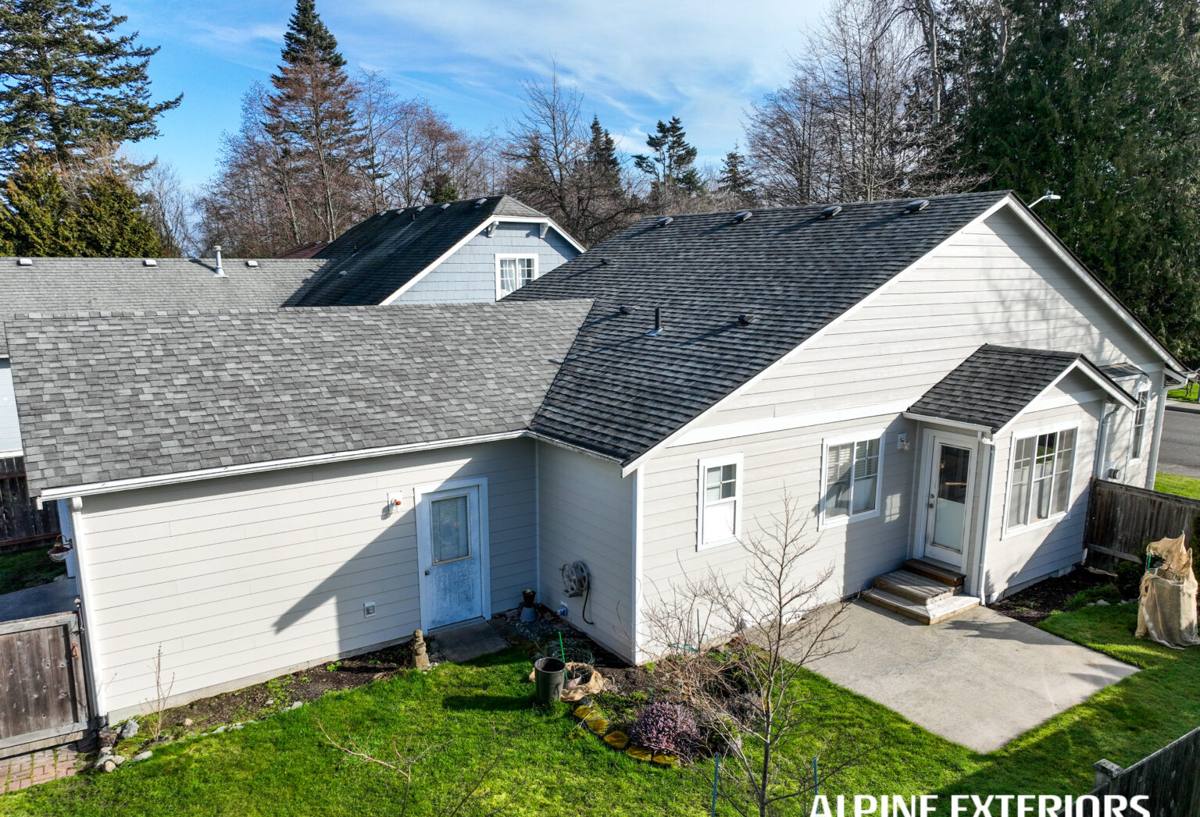
What the Climate Actually Does to a House Here
Salt Air and Slow Corrosion
Proximity to the bay means airborne salt finds its way onto exterior surfaces, fasteners, and trim. It's a slow process — you won't see damage in a season — but over years it accelerates corrosion on lower-grade fasteners and flashing, and it can degrade paint films and caulk faster than you'd expect inland. Materials and hardware that aren't rated for coastal exposure tend to show it first at seams, nail heads, and any spot where two materials meet.
Driving Rain and Wind-Driven Moisture
Bellingham doesn't get the heaviest rainfall totals in the state, but a lot of that rain arrives sideways, pushed by wind off the water. Driving rain finds every gap in flashing, every under-caulked seam, and every place where siding wasn't lapped correctly. It's less about total volume and more about wind-driven intrusion at vulnerable points — which is exactly why installation detail matters as much as the material itself.
Moss, Algae, and the Long Wet Season
Whatcom County's extended damp season, combined with tree cover common in and around Happy Valley, creates ideal conditions for moss and algae growth on roofs, north-facing siding, decking, and anywhere sunlight and airflow are limited. Moss holds moisture against the surface it grows on, which is a problem for wood-based products in particular, and it's a maintenance item homeowners here deal with differently than in drier climates.
Siding: Why We Only Install James Hardie Fiber Cement
We made a deliberate decision to install one siding system — James Hardie fiber cement — rather than offer vinyl, LP SmartSide, or other fiber cement alternatives like Cemplank or Allura. That's not a marketing gimmick; it's a response to what we consistently see fail (and hold up) on homes in this exact climate.
Non-Combustible and Dimensionally Stable
Fiber cement is made primarily from sand, cement, and cellulose fibers. It doesn't expand and contract with moisture the way wood-based siding does, and it's non-combustible, which matters to insurers and homeowners alike. In a climate where a product sits wet for extended periods every winter, dimensional stability isn't a nice-to-have — it's what keeps seams tight and paint film intact over decades instead of years.
ColorPlus Factory Finish
James Hardie's ColorPlus finish is baked on at the factory under controlled conditions, rather than field-painted after installation. That matters here specifically because field-applied paint depends on dry, stable weather windows to cure properly — something Bellingham doesn't reliably offer for large chunks of the year. A factory finish removes that variable and comes with a dedicated finish warranty.
HZ5 Engineering for This Climate
Hardie engineers its HZ product lines for specific climate zones, and our region falls into a category where moisture exposure and cool, damp conditions are the dominant concern. We install the product line matched to that reality rather than a generic version meant for a different part of the country.
How Hardie Compares to Alternatives We Don't Install
| Factor | James Hardie Fiber Cement | Vinyl | LP SmartSide / Wood-Based |
|---|---|---|---|
| Moisture behavior | Dimensionally stable, engineered for wet climates | Can warp, buckle in sustained moisture/temp swings | Wood fiber core can swell if seals fail |
| Fire performance | Non-combustible | Combustible, can melt/deform | Combustible |
| Finish | Factory-baked ColorPlus, long finish warranty | Color molded in, fades over time, not repaintable easily | Field or factory painted, seams need ongoing caulk maintenance |
| Maintenance | Low; periodic wash and caulk inspection | Low but prone to cracking/fading | Moderate; seam and moisture vigilance required |
| Typical lifespan when installed to spec | Multiple decades | Varies widely | Sensitive to installation quality and moisture exposure |
None of these alternative products are inherently bad — vinyl and engineered wood siding both have legitimate uses and reasonable track records elsewhere. We simply concluded that for the moisture and salt exposure common to Bellingham and Whatcom County, fiber cement gives homeowners the best long-term outcome, and we'd rather install one product exceptionally well than several products adequately.
Roofing in a Moss-Prone Neighborhood
Roofing failures in Happy Valley are rarely sudden — they're usually the slow result of trapped moisture under moss growth, degraded flashing at valleys and penetrations, or granule loss that goes unnoticed until a leak shows up inside. We evaluate roof condition alongside siding work because the two systems share flashing details, especially around window heads, transitions, and roof-to-wall intersections. A siding replacement is also a practical time to address any roofing issues at those shared connection points before they're covered back up.
Windows: Sealing Out Wind-Driven Rain
Window replacement in this area is as much about the flashing and sealing detail as it is about the window unit itself. Wind-driven rain exploits poorly integrated window flashing more than almost any other part of the exterior envelope. When we replace windows, we pay close attention to how the new unit integrates with the water-resistive barrier and siding, since that's the detail that determines whether a window performs well through a Bellingham winter or becomes a slow leak source behind the wall.
Decks: Built for Constant Damp Exposure
Decks in Happy Valley deal with the same moss and algae pressure as roofs and siding, plus standing water risk if drainage and board spacing aren't handled correctly at installation. We build and repair decks with attention to ventilation underneath, proper fastener selection for coastal-adjacent corrosion resistance, and material choices that hold up to repeated wet-dry cycling rather than just looking good on install day.
What a Local Crew Actually Adds
A lot of exterior problems in this region come down to installation detail rather than material choice — flashing sequencing, caulk placement, fastener selection, and how laps and seams are handled. Crews who work Bellingham and Whatcom County regularly have already seen how a given detail performs after a few wet seasons, not just on install day. That matters more here than in drier climates, where a marginal installation might not show its weaknesses for a long time.
What to Check Before Hiring Any Exterior Contractor
- Are they licensed and insured to work in Washington State, and can they provide proof without hesitation?
- Do they have manufacturer certification for the specific siding product they're installing (not just general carpentry experience)?
- Will they explain their flashing and moisture-barrier approach in plain terms, not just describe the visible siding product?
- Do they offer a written scope of work and warranty terms before any money changes hands?
- Can they speak specifically to how the local climate — rain, humidity, moss — affects their material and installation choices?
- Are references or past project examples available, and do they primarily work in this region rather than traveling in from elsewhere?
Warranty and Long-Term Value
James Hardie backs its products with a transferable limited warranty, which matters both for homeowners planning to stay long-term and for resale value. A transferable warranty is worth asking about no matter which contractor or product you're considering — it's one of the clearer signals of how a manufacturer stands behind long-term performance rather than just the initial sale.
Planning an Exterior Project in Happy Valley
Whether you're dealing with siding that's showing its age, a roof with persistent moss problems, windows that let in drafts and moisture, or a deck that needs rebuilding, the same principle applies: materials and installation both have to be matched to this specific climate, not a generic set of national standards. We'd rather walk a property, point out what we're actually seeing, and give straight answers than sell a one-size-fits-all package.
If you're weighing options for your home's exterior, we're happy to take a look and talk through what we'd recommend and why — no pressure, no obligation. Reach out for a free estimate using the form below.