 Bellingham Siding
 Why Birch Bay Homes Wear Out Faster Than Homes Inland
Birch Bay sits right on the water, and that changes what a house has to deal with year-round. Homes a few miles inland in Bellingham or Ferndale still get plenty of Pacific Northwest rain, but they don't get the salt air rolling off the bay, and they don't take wind-driven rain straight off the water the way Birch Bay properties do. Salt air is corrosive to metal fasteners and trim, it accelerates the breakdown of certain paints and coatings, and it works its way into small gaps and seams that wouldn't be a problem a few miles inland. Combine that with driving rain that hits siding at an angle instead of falling straight down, and you get exterior materials that are under more constant stress than almost anywhere else in Whatcom County.
Then there's moss. Birch Bay's combination of moisture, shade from mature trees, and a long damp season means moss and algae growth on siding, trim, and roofing is a near-constant maintenance issue for a lot of homeowners. It's not just cosmetic — moss holds moisture against a surface long after the rain has stopped, which is exactly the condition that causes rot, coating failure, and slow water intrusion in materials that aren't built to handle it.
What This Means for Your Siding Choice
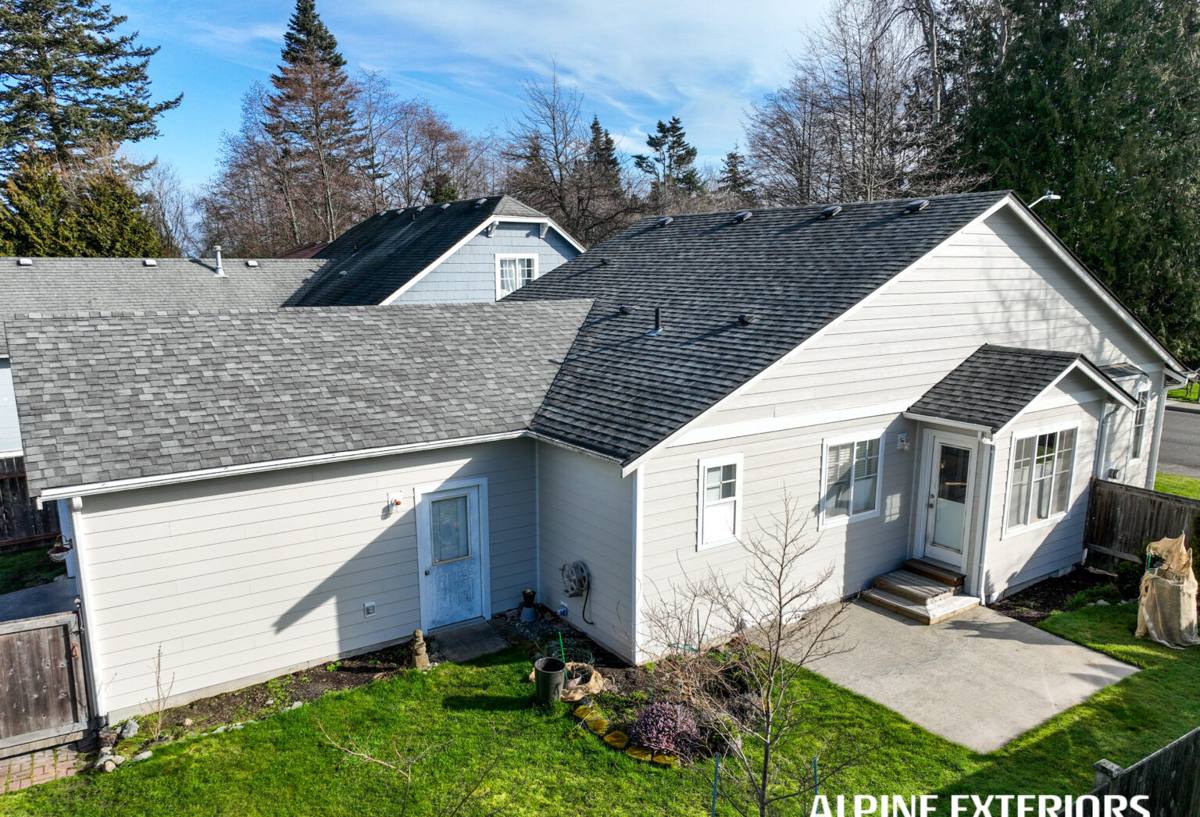
We install only James Hardie fiber cement siding, and Birch Bay is one of the clearest examples of why. Fiber cement is non-combustible and dimensionally stable, but just as important for this location, it doesn't feed moisture the way wood-based products do, and its factory-applied ColorPlus finish is engineered to hold up under UV and coastal moisture exposure far longer than field-applied paint. That matters in a spot where the exterior is getting hit by salt-laden air and repeated wet-dry cycles almost every week of the year.
Why We Don't Install Wood-Based or Vinyl Alternatives Here
Products like primed spruce, cedar, or LP SmartSide are wood-based, and wood-based siding depends heavily on an intact factory or field coating to keep moisture out. In a normal inland climate, a well-maintained coating can do that job for years. On the water in Birch Bay, with salt air, near-constant humidity, and heavier moss growth, any small coating failure — a nick, a seam gap, a spot where caulking has pulled away — becomes an entry point for moisture a lot faster. Once moisture gets behind wood-based siding, it doesn't dry out quickly in this climate, and that's when rot starts. Vinyl siding, meanwhile, can hold up fine against moisture, but it isn't a great match for the wind exposure many Birch Bay properties see, and it doesn't offer the same fire performance or long-term color retention as a factory-finished fiber cement product. These aren't knocks on the products in general — they're honest trade-offs that led us to standardize on one material system we can stand behind on every job, in every part of Whatcom County we work in.
How James Hardie Siding Performs in a Coastal Climate
James Hardie's HZ5 product line is engineered specifically for climates with heavy moisture exposure and freeze-thaw cycling, which fits Birch Bay's weather pattern well. The material itself is cement, sand, and cellulose fiber — it doesn't rot, it doesn't attract insects, and it isn't fuel for the coating failures that plague wood-based siding near salt water. The ColorPlus factory finish is baked on under controlled conditions, which gives it more consistent coverage and better long-term adhesion than paint applied on-site, and it comes backed by a transferable limited warranty that stays with the house if you sell.
What Correct Installation Involves
Fiber cement siding is only as good as its installation, and that's especially true in a high-moisture coastal environment. Proper installation in Birch Bay means:
- Correct rain-screen or drainage plane behind the siding so any moisture that does get past the surface has somewhere to go
- Manufacturer-specified fastener spacing and clearance, using fasteners rated for coastal or corrosive environments
- Proper caulking and flashing details at windows, doors, and trim intersections, since these are the most common points of water entry
- Correct clearance between the bottom of the siding and grade, decks, and roof lines to avoid standing moisture
- Factory-mitered or properly sealed joints rather than gaps that give moss and moisture a place to start
We install to those specifications on every job, not as an upsell but because it's the difference between siding that performs for decades and siding that develops problems in five years, regardless of what brand is on the box.
Roofing, Windows, and Decks in the Same Climate
Siding doesn't work in isolation — the roof, windows, and any exterior decking on a Birch Bay home are dealing with the same salt air and driving rain, and they all affect how the siding performs. A roof with failing flashing or clogged gutters sends extra water down the wall plane exactly where siding is least able to handle sustained moisture. Windows with worn seals let wind-driven rain track in around the frame, which shows up as staining or soft trim near the opening. Decks exposed to the same coastal moisture and moss growth need materials and fastening details that account for standing water and shade, not just sun exposure.
Because we handle siding, roofing, windows, and decks, we look at a Birch Bay property as one exterior system rather than four separate projects. That matters when we're diagnosing a moisture problem — a stain on an interior wall can trace back to a roof valley, a window flashing detail, or a siding seam, and it's easier to get the right answer when one crew is looking at the whole picture instead of pointing between trades.
Moss, Algae, and Long-Term Exterior Maintenance
Moss and algae are a fact of life for exterior surfaces anywhere near the water in Whatcom County, and Birch Bay sees more of it than most. A few practical points for homeowners:
What Helps
Keeping trees and shrubs trimmed back from the siding improves airflow and sun exposure, which slows moss growth. Clearing gutters and downspouts regularly prevents overflow water from running down the siding face, which is one of the most common ways moss gets established on a wall. Gentle rinsing rather than aggressive pressure washing protects both the siding surface and any caulked joints.
Why the Material Matters
Fiber cement's dense, factory-finished surface resists moss staining better than bare or lightly coated wood products, and it can be cleaned without the risk of saturating and swelling the substrate the way wood-based siding can. That's not a claim that moss won't grow on any siding near the bay — it will, given enough shade and moisture — but it means moss and algae are a cosmetic maintenance issue rather than a structural one when the underlying material doesn't absorb and hold water.
Cost Factors for a Birch Bay Exterior Project
Every property is different, but a few factors consistently move the price on siding, roofing, window, and deck work in this area:
| Factor | Why It Matters in Birch Bay |
|---|---|
| Wind and salt exposure on the water side | May call for additional flashing, sealant, or fastener detailing on the bay-facing elevation |
| Existing moisture or rot damage | Hidden water damage behind old siding is more common near the water and adds repair scope before new material goes on |
| Tree cover and shade | Heavier moss growth can mean more surface prep and, in some cases, trimming recommendations before installation |
| Home size and wall complexity | More corners, dormers, and trim details increase both material and labor time |
| Scope — siding only vs. combined roof/window/siding project | Bundling exterior work often reduces redundant setup and access costs compared to separate projects over time |
What to Look for When Hiring a Contractor Near the Water
Coastal-adjacent work has a lower margin for error than inland projects, so it's worth being deliberate about who does the work. A few things worth checking before you hire:
- Ask whether the crew has specific experience with coastal or waterfront properties, not just general siding experience
- Confirm they follow manufacturer installation specifications, especially around flashing, fastener choice, and drainage planes
- Ask how they handle existing moisture or rot damage discovered once old siding comes off
- Check that they're licensed and insured to work in Washington, and ask for that documentation directly
- Ask whether the same crew handles roofing and windows, or if that work gets subcontracted out with less coordination
A local Bellingham-based crew that works this stretch of Whatcom County regularly will have already seen how salt air and moss season affect different siding materials over time, which is worth more than a lower bid from a contractor unfamiliar with coastal conditions.
Getting Started
If you're noticing moss buildup, soft trim, fading, or coating failure on a Birch Bay home, or you're planning ahead for a full exterior refresh, we're happy to take a look and walk you through what we're seeing and why. We'll give you a straightforward assessment of your siding, roofing, windows, or decking — no pressure, no inflated scope. Reach out for a free estimate using the form below.