 Bellingham Siding
 Why Decks in Silver Beach Wear Out Faster Than You'd Think
Silver Beach is one of those Bellingham neighborhoods where the outdoors is part of daily life — decks get used year-round, not just in July and August. That's great for enjoying the property, but it also means the structure underneath your feet is taking a beating almost constantly. Bellingham's marine-influenced climate brings salt-tinged air off the water, long stretches of driving rain, and a moss and algae season that can run from October clear into May. None of that is unique to Silver Beach, but it hits waterfront and near-water properties harder than it hits a deck three miles inland.
The combination matters more than any single factor on its own. Salt air accelerates corrosion on fasteners and metal hardware. Driving rain — the kind that comes in sideways instead of straight down — gets up under boards and into end grain that a vertical rain would never reach. And moss doesn't just look bad; it holds moisture against the wood surface long after the rest of the yard has dried out, which is exactly the condition that leads to rot. A deck built without those three factors in mind will show its age years before it should.
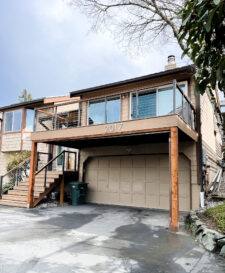
Signs Your Deck Needs Replacement, Not Another Repair
Homeowners often call us for a repair and end up needing a full replacement once we're actually underneath the deck. It's not that we're looking for extra work — it's that surface problems on an older deck are usually a symptom of what's happening in the framing, and framing problems don't stay small.
- Boards that feel spongy or spring underfoot, especially near the house or along the rim
- Persistent moss or dark staining that comes back within weeks of cleaning
- A ledger board (where the deck attaches to the house) that shows staining, gaps, or soft wood
- Rust streaking from screws, bolts, or joist hangers
- Railing posts that wiggle when pushed, which usually means the post base or blocking has failed
- Visible sagging between joists, or a deck surface that no longer sheds water evenly
Any one of these can sometimes be repaired in isolation. Several of them together, on a deck that's already 15-20 years old, usually means the wood has been absorbing moisture for longer than it should have, and replacement is the more honest recommendation.
What a Correct Deck Replacement Actually Involves
A deck replacement isn't just pulling up old boards and screwing down new ones. In a climate like ours, most of what determines whether the new deck lasts 10 years or 30 happens in parts you'll never see once the project is done.
Structure and Framing
We replace or upgrade ledger boards, joists, beams, and posts as needed, and we pay close attention to joist spacing and hardware ratings — undersized framing is a common shortcut on older decks that we don't repeat. Footings get inspected and, where they've heaved, settled, or were never poured to the right depth in the first place, they get corrected.
Flashing and Water Management
This is the step that gets skipped most often on budget deck jobs, and it's the one that matters most here. Proper ledger flashing keeps rain from working its way behind the board and into the house rim joist — a slow leak that can go undetected for years in a wall cavity. We also grade and space decking to let water actually drain instead of pooling on the surface, which is what feeds moss growth in the first place.
Fasteners and Hardware
In an area with salt-laden air, hardware choice isn't cosmetic — it's structural. We use corrosion-resistant, code-rated fasteners and connectors sized for the framing, not whatever happens to be cheapest at the yard that week.
Decking Material Options for a Silver Beach Property
There's no single "best" decking material — there's a best fit for your budget, your maintenance appetite, and how exposed your specific lot is to wind-driven rain and salt air. Here's how the common options actually compare in this climate.
| Material | Moisture & Salt Air Behavior | Maintenance | Typical Lifespan Here |
|---|---|---|---|
| Pressure-treated wood | Resists rot when properly sealed, but end grain and fastener holes are vulnerable if maintenance lapses | Annual cleaning and re-sealing recommended | 10-15 years with upkeep |
| Cedar | Naturally moisture-resistant, ages to a silver-gray patina, but softer and more prone to surface wear near the water | Periodic cleaning; sealing optional depending on desired look | 15-20 years with upkeep |
| Composite decking | Doesn't absorb water the way wood does, resists moss staining better, some early-generation products were more moisture-sensitive at cut edges | Occasional washing; no sealing or staining | 20-25+ years |
| Capped/PVC decking | Best resistance to moisture intrusion and salt exposure; fully sealed board won't take on water at all | Low — occasional rinse | 25-30+ years |
We install both quality wood and composite/capped systems, and we'll tell you honestly which one fits your situation rather than steering you toward whichever costs more. If your lot gets heavy wind-driven rain or sits close to the water, we'll usually recommend leaning toward a capped composite for the walking surface, even if the budget is wood for the framing underneath.
Our Deck Replacement Process
- On-site assessment — we get under the existing deck to check framing, footings, and the ledger connection before quoting anything, so the estimate reflects what's actually there
- Written proposal — materials, scope, and price laid out clearly, with options if you're deciding between decking types
- Demolition and disposal — the old deck comes out, including hardware, and we haul it away
- Framing and flashing — new or corrected structure, proper ledger flashing, code-compliant footings
- Decking, railing, and stairs — installed to spec, with attention to drainage and gap spacing for this climate
- Final walkthrough — we go over the finished deck with you before calling the job done
Railings, Stairs, and Hardware Details That Matter Here
Railings take a different kind of abuse than the deck surface — they get gripped, leaned on, and hit directly by driving rain since they're vertical. We install railing systems with corrosion-resistant post connections and check that guard height and baluster spacing meet current residential code, not just what was there before. Stair stringers get the same flashing and fastener attention as the main structure, since stairs are often the first part of a deck to show rot — they're low to the ground and slower to dry out.
Permits and Code in Bellingham and Whatcom County
Most deck replacement work that's attached to the home, or built more than a couple feet above grade, requires a permit under the residential building code the City of Bellingham and Whatcom County work from. That covers things like footing depth, joist and beam sizing, guardrail height, and stair geometry. We handle the permit process as part of the job rather than leaving it on the homeowner's plate — it's a normal part of doing this work correctly, not an upsell.
Keeping a New Deck in Good Shape Through Whatcom County's Wet Season
A well-built deck still needs some seasonal attention here, especially through the fall and winter moss season. A little consistency goes a long way toward protecting the investment:
- Sweep leaves and debris off the surface regularly in fall — trapped organic matter is what feeds moss and algae
- Rinse or gently wash the deck a couple times a year to keep moss from establishing
- Check that gaps between boards stay clear so water keeps draining instead of pooling
- Inspect railings and stair connections once a year for looseness
- If you have a wood deck, plan on re-sealing on the schedule appropriate to that product — don't wait until it looks dry
- Keep planters and rugs from sitting in one spot for months at a time; trapped moisture under them accelerates wear
Why It Matters to Hire a Crew That Already Works Silver Beach
Deck-building fundamentals don't change from town to town, but the details that make a deck actually last do change with the site. A crew that regularly works Silver Beach and the surrounding Bellingham neighborhoods already knows to spec hardware for salt-air exposure, to take ledger flashing seriously because they've seen what happens when it's skipped, and to plan drainage and board spacing around a moss season that's longer here than in drier parts of the state. That's not something you get from a generic national contractor working from a one-size-fits-all spec sheet — it comes from having replaced decks that failed for climate-specific reasons and building the next one to avoid the same outcome.
If your Silver Beach deck is showing its age — or you just want an honest opinion on whether it needs repair or full replacement — we're happy to take a look and walk you through what we find. Reach out for a free, no-pressure estimate using the form below.