 Bellingham Siding
 Decking in Silver Beach Has to Deal With Water First, Looks Second
Any deck looks good the day it's finished. The question that matters in Silver Beach is what it looks like five winters later, after another stretch of driving rain, another moss season, and another round of salt-laden air working its way into every seam and fastener. Whatcom County's marine climate doesn't give decking a break — it's wet more months than it's dry, and wood-adjacent surfaces here are under constant pressure from moisture, organic growth, and temperature swings that never quite dry things out completely.
Composite decking exists specifically to solve that problem, but only when it's installed correctly. A composite deck built like a wood deck — same joist spacing, same lack of ventilation, same disregard for drainage — will develop the same problems wood does, just more slowly and more expensively. We install composite decking for homes throughout the Bellingham area, including Silver Beach, and our approach starts with the climate, not the material spec sheet.
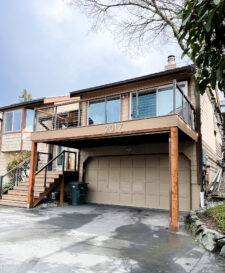
What Silver Beach's Climate Actually Does to a Deck
Three things define decking conditions in this part of Whatcom County, and they compound each other:
- Driving rain. Storms here don't just fall straight down — wind-driven rain gets pushed sideways into ledger boards, fascia, and any gap where water can collect instead of shed.
- A long moss season. Shaded decks, north-facing decks, and decks under tree cover stay damp for weeks at a time. Moss and algae take hold anywhere moisture sits, and once established they hold even more water against the board surface.
- Salt air. Proximity to the water means airborne salt finds its way onto fasteners, flashing, and any exposed metal in the structure. Over time it accelerates corrosion in hardware that wasn't rated for it.
None of these are dramatic on their own. The damage they cause is cumulative — a fastener that corrodes a little faster each year, a board that stays wet two extra days after every rain, a substructure that never fully dries between storms. A correctly built composite deck is designed around that reality from the ground up, not just from the top surface down.
What a Correct Composite Deck Installation Actually Involves
Composite boards themselves are only part of the system. The parts homeowners don't see are what determine whether the deck performs for fifteen-plus years or starts showing problems in five.
Substructure and Framing
Joists and beams need to be rated for ground contact where relevant, properly spaced for the specific composite product being used (composite boards often require tighter joist spacing than wood, especially at angles or stair treads), and set with a slight slope away from the house so water doesn't pool at the ledger.
Ventilation and Airflow
Low-clearance decks and decks close to grade are the ones that stay damp longest in a climate like this. Airflow underneath the deck matters as much as drainage on top — a deck that can't breathe underneath will hold moisture against the joists regardless of what's on the surface.
Fasteners and Hardware
This is where salt air does the most damage if it's overlooked. We use fasteners, joist hangers, and hidden fastening systems rated for coastal and marine-exposure conditions, not standard interior-grade hardware. It costs a bit more up front and it's the difference between hardware that lasts and hardware that's rusting through in a few winters.
Flashing at the Ledger
Any deck attached to the house needs proper flashing where the ledger board meets the siding or rim joist. This is one of the most common failure points on older decks in wet climates — water gets behind the ledger, and by the time it's visible, it's already caused rot in the framing behind it.
Composite vs. Wood vs. PVC Decking: An Honest Comparison
Each material has real trade-offs. We install all three depending on the project, but for most Silver Beach homeowners weighing long-term maintenance against upfront cost, composite lands in the middle for good reason.
| Factor | Pressure-Treated Wood | Composite | PVC / Cellular Vinyl |
|---|---|---|---|
| Upfront cost | Lowest | Mid-range | Highest |
| Maintenance | Annual staining/sealing | Occasional cleaning, no sealing | Minimal cleaning |
| Moss/algae resistance | Poor without upkeep | Good, better with capped boards | Very good |
| Moisture absorption | High — swells, cups, splits | Very low | Essentially none |
| Fastener corrosion risk in salt air | Moderate | Low with rated hardware | Low with rated hardware |
| Typical lifespan (installed correctly) | 10–15 years | 20–30 years | 25–30+ years |
Wood costs less to install but demands the most ongoing work in a climate that punishes neglect quickly. PVC performs excellently in wet conditions but costs more and has a different look and feel underfoot that not every homeowner wants. Composite is the practical middle ground for most Silver Beach properties — low maintenance, strong moisture resistance, and a range of colors and finishes that hold up to UV and salt exposure without fading or chalking the way some painted or stained surfaces do.
Our Process for a Silver Beach Composite Deck
1. On-Site Assessment
We look at sun exposure, shade patterns, drainage slope, proximity to the water, and existing structure condition if this is a replacement. A deck tucked under trees on the north side of the house needs different ventilation and board spacing decisions than one in full sun.
2. Design and Material Selection
We walk through board options — capped vs. uncapped composite, color and grain choices, and hidden vs. face-fastened installation — and explain the real trade-offs of each rather than steering toward whatever has the best margin.
3. Substructure Build or Repair
Framing, ledger flashing, joist hangers, and hardware go in first, built to the moisture and corrosion conditions specific to this area, not a generic spec.
4. Board Installation
Boards are installed with manufacturer-specified gapping to allow for thermal expansion and drainage between boards — undersized gaps are a common cause of cupping and water pooling on composite decks installed by crews unfamiliar with the material.
5. Finish Details and Walkthrough
Fascia, stair treads, railing attachment, and any picture-frame border trim get finished, and we walk the deck with the homeowner before calling the job done.
Maintaining a Composite Deck in This Climate
Composite decking cuts maintenance dramatically compared to wood, but "low maintenance" isn't "no maintenance" in a climate with a moss season this long. A few habits go a long way:
- Sweep debris and organic buildup off the deck regularly, especially in fall and winter — trapped leaves and needles hold moisture against the board surface.
- Rinse the deck a few times a year with a hose and a soft-bristle brush; a pressure washer on too high a setting can damage the board surface, so keep it on a low, wide setting if used at all.
- Check underneath the deck periodically for airflow blockage — stored items, overgrown plants, or debris under low-clearance decks trap moisture against the framing.
- Inspect visible fasteners and railing hardware annually for early signs of corrosion, particularly on decks closer to the water.
- Address any moss or algae as soon as it appears with a mild cleaner rather than letting it establish over a season.
What Composite Decking Costs — and What Drives the Range
Every deck is different, so we won't quote a number without seeing the site, but these are the factors that move the price up or down:
| Factor | Impact on Cost |
|---|---|
| Deck size and shape (straight run vs. multiple levels/angles) | Larger and more complex layouts increase material and labor |
| Board tier (uncapped composite vs. premium capped composite) | Capped boards cost more but resist moisture and staining better |
| Substructure condition | Replacing rotted framing adds cost but is not optional if compromised |
| Height and railing requirements | Taller decks and code-required railing add material and labor |
| Fastening system (hidden clips vs. face screws) | Hidden fastening costs more but gives a cleaner surface |
| Site access | Difficult access or grade changes can add labor time |
Why It Matters That We Already Work in Silver Beach
A crew that hasn't worked this specific area is guessing at joist spacing, hardware ratings, and drainage details that a Whatcom County contractor already knows from experience. We've seen how decks in this part of Bellingham hold up — which shaded spots stay damp the longest, which fastener types actually resist the salt air, and which framing shortcuts show up as problems within a few years instead of twenty. That's not a marketing point, it's the practical difference between a deck built to a generic spec sheet and one built for the conditions it actually has to survive.
We're also here after the job is done. If a warranty question comes up or something needs a look five years down the road, we're a local call, not a call center.
Questions Worth Asking Before You Sign a Contract
- Is the fastener and hardware system rated for coastal or marine exposure?
- What joist spacing will be used, and does it match the composite manufacturer's requirements?
- How will the deck be ventilated underneath, especially at lower clearance points?
- Is the ledger board flashing detail included, or treated as an add-on?
- What's the manufacturer's warranty on the specific board line being installed, and does it cover staining or fading?
- Has this crew installed composite decking elsewhere in Whatcom County?
If you're weighing a new composite deck or replacing an aging wood one in Silver Beach, we're glad to take a look and walk through what your specific site needs — no pressure, no generic quote pulled from a spreadsheet. Fill out the form below and we'll set up a free estimate.