 Bellingham Siding
 Why Decks in Barkley Wear Out Faster Than You'd Expect
Barkley is one of Bellingham's newer, more established residential areas, with a mix of homes built over the last two to three decades. Even on well-built houses, the decks are often original — and a deck that's 15 to 25 years old in Whatcom County has usually taken more punishment than its age suggests. It isn't one dramatic storm that does the damage. It's the steady grind of a marine climate: salt-tinged air drifting in off Bellingham Bay, months of driving rain that never quite lets a deck dry out between soakings, and a moss season that can stretch from October well into May on shaded or north-facing lots.
That combination attacks decks in ways homeowners in drier climates rarely deal with. Wood fibers swell and shrink with every wet-dry cycle, fasteners corrode from the inside out, and moss holds moisture directly against decking boards and framing long after the surface looks dry. By the time boards are visibly cupping or a railing post feels soft, the problem is usually well established underneath.
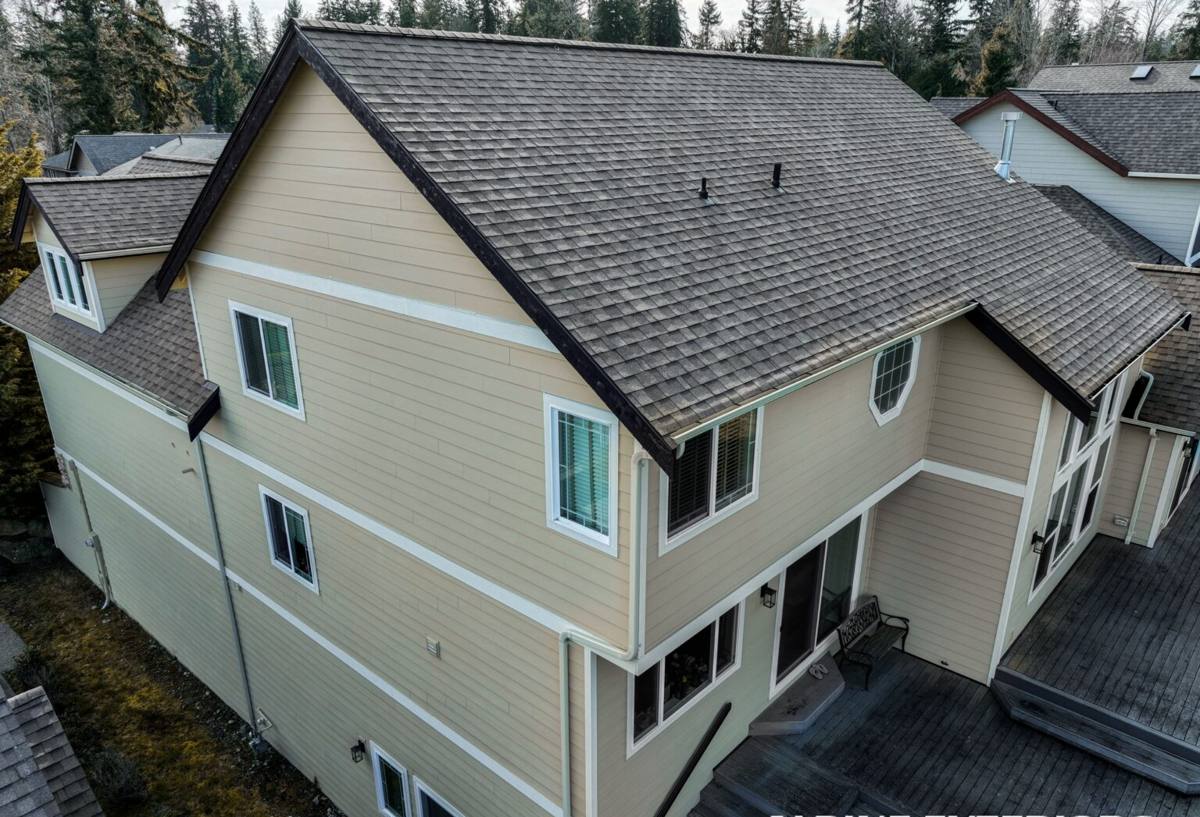
Signs a Barkley Deck Needs Replacement, Not Another Repair
Not every tired deck needs a full teardown. But there's a point where patching individual boards or re-staining year after year stops being a real fix and starts being a way to delay a bigger decision. Here's how we tell the difference on a walkthrough:
- Soft or spongy spots anywhere on the deck surface, especially near the house or at board ends
- Ledger board area (where the deck attaches to the house) shows staining, gaps, or soft wood
- Support posts or beams that feel punky when probed with a screwdriver
- Persistent moss or algae that returns within weeks of cleaning, even in the same spots every year
- Railings that flex or wiggle under normal hand pressure
- Fasteners that are rusted, backing out, or leaving dark streaks on the wood
- A deck built before current Whatcom County ledger-flashing and railing code updates
If it's just a handful of surface boards showing wear on an otherwise sound structure, repair can make sense. If the framing, ledger connection, or footings are in question, replacement is almost always the more honest answer — repeated patch jobs on a failing structure end up costing more over time and don't address the safety issue underneath.
What a Correct Deck Replacement Actually Involves
A deck replacement done right is a structural project, not a cosmetic one. In our climate, the parts you don't see matter more than the decking material on top. The pieces that separate a deck that lasts from one that fails early:
Ledger Board and Flashing
This is where most deck failures in wet climates start. The ledger board bolts the deck to the house, and if it isn't properly flashed to shed water away from the rim joist and sheathing, moisture works its way in behind the siding — often invisibly, for years. Correct flashing detail here is non-negotiable, and it's the single most common shortcut we see on older or poorly built decks.
Footings and Framing
Whatcom County frost depth and soil drainage both factor into footing design. Undersized or shallow footings can shift over time, especially on sites with heavy seasonal rain saturating the soil. Framing lumber, joist spacing, and beam sizing all need to match the actual load — including snow load, which does happen here even if it's not an annual event.
Drainage Beneath the Deck
Ground-level and low-clearance decks trap moisture underneath if there's no thought given to grading or airflow. In a region with our rainfall totals, standing moisture under a deck accelerates rot in the framing from below, often before it shows up on the surface.
Permits and Inspection
Most deck replacements in Bellingham require a building permit, particularly when structural elements like footings, framing, or attachment to the house are involved. Permitted work gets inspected, which is a genuine safety check, not just paperwork — it catches ledger and footing issues before they're buried under decking.
Decking Material Options for a Wet, Mossy Climate
There's no single "best" decking material — there's a best fit for how a homeowner wants to use and maintain the deck. Here's how the common options actually perform in Bellingham's conditions:
| Material | Moisture & Moss Behavior | Maintenance | Typical Lifespan Here |
|---|---|---|---|
| Pressure-treated wood | Absorbs water, needs sealing to resist moss and rot | Annual cleaning, re-stain/seal every 1-3 years | 10-15 years |
| Cedar | Naturally rot-resistant but still absorbs moisture; moss grows on the surface if untreated | Regular cleaning and periodic sealing | 15-20 years |
| Composite (e.g. Trex, TimberTech) | Doesn't rot; moss can still grow on the surface film and needs washing off | Occasional washing, no sealing or staining | 25-30 years |
| PVC/capped composite | Fully moisture-resistant surface; least hospitable to moss growth | Lowest — occasional rinse | 25-30+ years |
Wood costs less up front and has a natural look many homeowners prefer, but it demands real upkeep in this climate — skip a year of sealing and moss gets a foothold fast, especially on shaded portions of a lot. Composite and PVC cost more initially but hold up to our wet-dry cycles with far less maintenance, which is why we see more homeowners choosing them for full replacements rather than repeat wood decks.
Railings, Fasteners, and Hardware
Hardware is where a lot of decks quietly fail years before the decking itself gives out. Standard zinc-coated screws and brackets corrode faster near the coast than most homeowners expect, and once a fastener starts rusting it can stain and weaken the wood around it. On every replacement, we use stainless steel or coated fasteners rated for exterior, coastal-adjacent exposure, along with structural connectors sized to current code for ledger bolts, post bases, and railing attachment. Railings in particular need to meet current height and baluster-spacing requirements — a lot of older Barkley decks were built to standards that have since changed.
Our Deck Replacement Process
- On-site evaluation — We inspect the existing deck's framing, ledger connection, footings, and overall condition, and talk through what you actually want from the new deck.
- Design and material selection — We walk through decking, railing, and hardware options with honest pros and cons for your specific lot, including sun/shade exposure and drainage.
- Permitting — We handle the permit application and coordinate inspections so the structural work is verified, not just assumed.
- Removal and structural rebuild — Old decking, railings, and any compromised framing come out; footings, beams, joists, and ledger flashing get rebuilt to current code.
- Decking and railing installation — New material goes down with proper spacing for drainage and expansion, and railings are set to code.
- Final walkthrough — We go over the finished deck with you and cover any maintenance specific to the material you chose.
What Deck Replacement Typically Costs
Every deck is different, but the biggest cost drivers are consistent. A rough guide to what moves the price:
| Factor | Why It Matters |
|---|---|
| Deck size and shape | Larger and multi-level decks require more material, labor, and structural support |
| Decking material | Composite and PVC cost more upfront than wood but need far less long-term maintenance |
| Height off the ground | Taller decks need more substantial railings, stairs, and structural bracing |
| Ledger and framing condition | Rot found during teardown can require additional framing repair beyond the original scope |
| Site access | Sloped or tight-access lots, common in parts of Barkley, add time for material handling |
| Permit and inspection requirements | Structural replacements typically require permitting, which is a real cost but a real safety check |
We give a firm number after seeing the deck in person — a phone estimate on a structural project isn't honest to either of us.
Questions to Ask Before Hiring a Deck Contractor
A deck is a structural project attached to your house, and the quality of the work underneath the decking matters more than how it looks on day one. Before hiring anyone for a deck replacement in Bellingham, it's worth asking:
- Are you licensed and insured to do structural work in Washington?
- Will this project be permitted, and will you handle the permit and inspections?
- How do you flash the ledger board, and why does that detail matter here?
- What fastener and hardware grade do you use, and is it rated for coastal exposure?
- Do you size footings and framing for our actual soil and load conditions, or use standard minimums everywhere?
- Can you walk me through material trade-offs instead of just recommending the highest-margin option?
A contractor who answers these clearly and specifically, without hedging, is usually one who does this work regularly and takes the structural side seriously.
Why It Matters to Hire a Crew That Already Works in Barkley
Deck-building fundamentals are the same everywhere, but the details that make a deck last in Whatcom County are learned from doing it here repeatedly — how much ledger flashing is really needed for our rain totals, which lots hold moisture and moss longest, what footing depth actually performs on our soils, and how Bellingham's permitting process works in practice. A crew that regularly works Barkley and the surrounding Bellingham neighborhoods has already seen how decks built to out-of-region standards fail here, and builds accordingly from the start rather than learning it on your project.
If your Barkley deck is showing its age or you're planning ahead before a problem gets worse, we're happy to take a look and give you a straight assessment — no pressure, no upsell, just an honest read on what your deck actually needs. Reach out for a free estimate using the form below.