 Bellingham Siding
 Ferndale Roofs Take a Different Kind of Beating
Ferndale sits close enough to Bellingham Bay and the open water of Whatcom County that its roofs deal with a combination of stresses you don't see further inland. Salt-laden air off the water accelerates corrosion on flashing, fasteners, and any exposed metal. Driving rain, often pushed sideways by wind coming off the water, finds its way into gaps that would stay dry in a calmer climate. And because Whatcom County's wet season runs long, moss and algae get months of unbroken growing time on north-facing slopes and shaded valleys.
None of this means Ferndale roofs fail faster than average. It means the failure points are different, and a repair that doesn't account for salt exposure, wind-driven rain, and moss pressure tends to come back a year or two later. We've built our repair approach around what this specific area does to a roof, not a generic checklist.
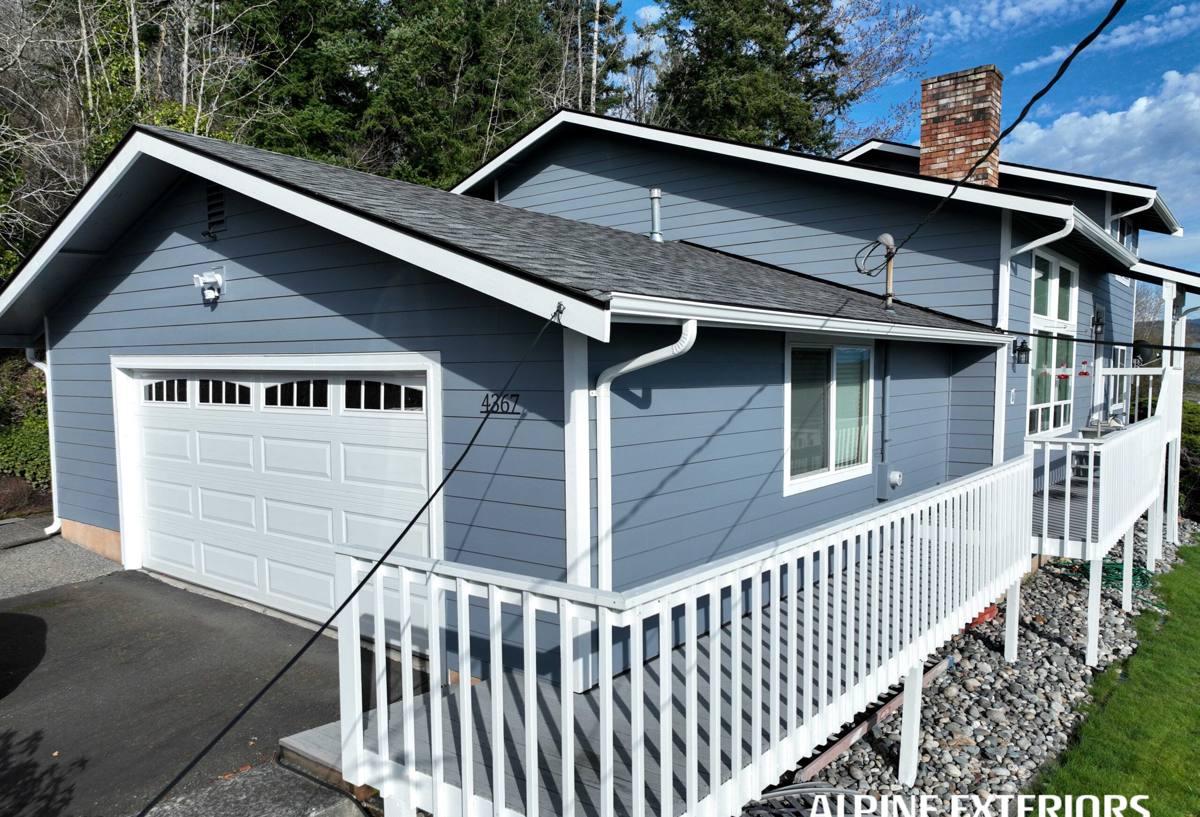
Signs a Ferndale Roof Needs Repair, Not a Full Replacement
Most roofs don't need to be torn off. They need the right sections addressed correctly. Here's what usually points to a repair being the right call:
- A leak that shows up in one consistent spot rather than in multiple rooms
- Missing, cracked, or curling shingles limited to one slope or one area
- Flashing that's rusted, lifted, or pulled away around a chimney, vent, or wall intersection
- Moss buildup in valleys or along the ridge without visible deck sagging underneath
- A roof under 15-20 years old with isolated damage rather than widespread wear
- Granule loss concentrated near one edge, valley, or old repair patch
If instead you're seeing soft or spongy decking across large sections, daylight through the roof deck in the attic, or damage spread evenly across the whole surface, that's usually a replacement conversation. We'll tell you plainly which category your roof falls into — we don't have an incentive to sell a repair when a roof is genuinely done, and we don't push a tear-off when a solid repair will hold.
What a Correct Roof Repair Actually Involves
Flashing and Transitions Come First
Most roof leaks in this area don't start in the field of the shingles — they start at a transition: a chimney, a skylight curb, a sidewall, a vent pipe, or a valley. Salt air corrodes cheaper or thinner flashing faster than it would inland, so when we open up a repair area, we check every piece of metal nearby, not just the section that's obviously failing. Patching shingles over compromised flashing is the single most common shortcut we see, and it's why "repaired" roofs leak again within a season.
Matching Materials, Not Just Covering the Hole
A repair should blend into the existing roof in slope, color, and butt spacing as closely as possible, and it needs to tie into the surrounding courses using correct shingle lacing rather than just laying new material on top of old. Sun and salt exposure fade shingles unevenly, so on older roofs we'll talk with you honestly about how visible a patch is likely to be — sometimes a slightly imperfect color match on a back slope is the practical answer, and sometimes it's worth pulling material from a less visible area to keep the front elevation looking right.
Checking the Deck and Underlayment, Not Just the Surface
Once shingles are pulled back, we inspect the decking underneath for soft spots, delamination, or rot, and we check whether the underlayment is still doing its job. In a climate with this much sustained moisture, we pay particular attention to ice-and-water barrier at eaves and valleys — the areas most likely to see standing water or wind-driven rain get pushed up under the shingle edge.
Ventilation Affects How Long a Repair Lasts
Poor attic ventilation traps moisture, which accelerates moss growth on the underside of the equation you can't see from the ground and shortens shingle life from below. When we're already in a repair area, we check ridge and soffit venting and will flag it if it's contributing to the problem, even if fixing it isn't part of the original repair scope.
Common Ferndale Roof Problems and What We Check
| Problem | What Causes It Here | What We Check | Typical Fix |
|---|---|---|---|
| Moss mats in valleys | Long wet season, shade from trees, slow drying | Valley flashing condition, deck moisture underneath | Moss removal, valley flashing repair or replacement, zinc strip option |
| Rusted or lifted flashing | Salt air corrosion, wind uplift | Metal gauge, fastener condition, sealant integrity | Replace flashing section, re-seal transitions |
| Granule loss / bald spots | Age, sun/wind exposure on specific slopes | Extent and location of wear, shingle age | Section replacement matched to existing coursing |
| Leak at chimney or wall | Flashing failure, not shingle failure | Step flashing, counter-flashing, kickout at wall base | Rebuild flashing assembly, not just re-caulk |
| Wind-lifted shingle tabs | Driving rain and gusts off the water | Sealant strip bond, nail placement | Re-seal or replace affected shingles, correct fastening |
Our Process for a Ferndale Repair Call
- Inspection. We get on the roof (weather permitting) and in the attic, looking for the actual source of the problem rather than just the spot where water showed up inside.
- Honest diagnosis. We explain what we found, in plain terms, including whether this is a contained repair or something larger.
- Written estimate. You get a clear scope and price before any work starts — no surprise add-ons once we're up there.
- The repair itself. We match materials where possible, address flashing and underlayment issues we find, and don't just cover symptoms.
- Cleanup. Old material, nails, and debris get cleared from the roof and the ground around the house.
- Follow-through. If something related turns up after the fact, we want to hear about it — a repair that doesn't hold isn't finished.
Repair vs. Replacement: What Actually Drives the Decision
| Factor | Leans Toward Repair | Leans Toward Replacement |
|---|---|---|
| Roof age | Under 15-20 years, or high-quality material still sound | Near or past expected lifespan for its material |
| Damage location | Isolated to one slope, valley, or penetration | Spread across most of the roof surface |
| Deck condition | Solid, dry decking beneath the affected area | Soft, delaminated, or rotted decking in multiple spots |
| Leak history | First occurrence or a known, single source | Repeated leaks in different locations over time |
| Cost over time | Repair cost is a small fraction of full replacement | Repair costs are stacking up close to replacement cost |
Repairs on an otherwise sound roof are typically a modest cost — usually in the low hundreds to low thousands of dollars depending on scope, materials, and roof pitch/access. Full replacements are a much larger investment and should only be recommended when the roof's overall condition actually warrants it. We'll walk you through where your roof falls before you commit to either path.
Why Hiring a Crew That Already Works Ferndale Matters
A contractor who works this specific stretch of Whatcom County regularly knows which slopes tend to hold moss longest, how much salt exposure to expect based on proximity to the water, and what kind of wind-driven rain patterns to plan flashing details around. That's knowledge you build by working the same area repeatedly, not by reading a manufacturer spec sheet. It also means faster response — we're not adding a long drive and a travel surcharge onto every service call, and we can often get out to look at an active leak sooner than a crew based well outside the area.
Local experience also means we're straightforward about what's realistic. We're not going to recommend a fix that ignores how much rain this area gets or how long moss season actually runs here — we've seen what happens when repairs are done without accounting for that, and it's usually a callback within a year.
Materials and Standards We Hold Ourselves To
For repair work, we use materials that match or exceed what's already on your roof whenever possible, and we don't cut corners on flashing gauge or fastener quality just because it's a repair rather than a full job. In a salt-air, high-moisture environment, the cheapest flashing option is usually the first thing to fail again — so our standard is to use flashing and underlayment that will actually hold up to another decade or more of this climate, not just get you through the next dry season. Where ice-and-water barrier is called for at eaves, valleys, or around penetrations, we install it as a matter of standard practice in this region, not as an upsell.
Keeping a Ferndale Roof in Good Shape Between Repairs
A little maintenance goes a long way toward avoiding repeat repair calls. Between service visits, it's worth keeping up with:
- Clearing gutters and valleys of debris, especially heading into the wet season
- Removing moss buildup before it mats and holds moisture against the shingles
- Trimming back tree branches that keep sections of the roof shaded and slow to dry
- Checking attic ventilation isn't blocked by insulation or debris
- Walking the roofline from the ground after major windstorms to spot obvious lifted or missing shingles
- Scheduling a professional inspection every couple of years, or after any major storm
None of this replaces a proper inspection when something looks off, but it does reduce how often small issues turn into repair calls in the first place.
Get a Straight Answer on Your Ferndale Roof
If you're dealing with a leak, some lifted shingles, or a roof that just needs a second opinion, we're happy to take a look and tell you honestly what it needs — whether that's a targeted repair or something more. Estimates are free and there's no pressure attached; fill out the form below and we'll get back to you to schedule a time to come out.