 Bellingham Siding
 Why Ferndale's Climate Is Hard on Exterior Siding
Ferndale sits close to the water in Whatcom County, which means homes here deal with a combination of stresses that inland siding jobs never see. Salt-laden air moves in off the Strait of Georgia and Bellingham Bay and settles on exterior walls, especially on the sides of a house that face open water or take the brunt of the wind. Add in the driving rain that comes with Pacific storm systems — rain that hits siding at an angle instead of falling straight down — and you have moisture finding its way into every lap joint, corner, and fastener hole that isn't detailed correctly.
Then there's moss. Whatcom County's wet, mild winters and shaded lots (especially on north-facing walls and anywhere trees crowd the house) create a long moss and algae season that can run eight months or more. Moss doesn't just look bad — it holds moisture against the siding surface, which accelerates rot in wood-based products and stains and degrades anything that isn't genuinely resistant to sustained dampness.
None of this is unique to one street or subdivision — it's the baseline climate reality for Ferndale and the surrounding Whatcom County coastline. Siding here has to be chosen and installed with that reality in mind, not treated like it's going on a house in a dry inland climate.
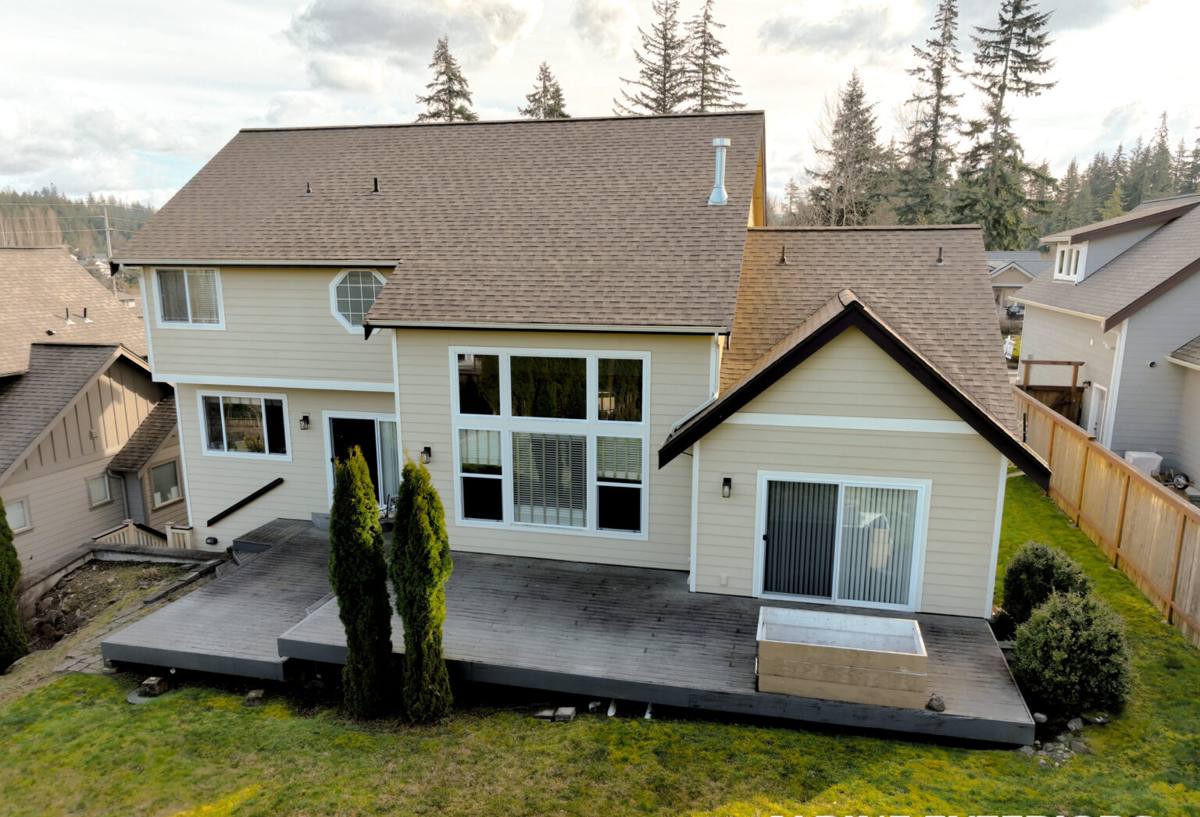
What James Hardie Siding Solves for Ferndale Homes
We install James Hardie fiber cement exclusively, and in a climate like this the reasons are practical, not brand loyalty. Fiber cement is made from cement, sand, and cellulose fiber — there's no wood content to rot, no foam substrate to trap moisture, and no organic material for mold or moss to feed on the way it can with wood-based siding. That matters enormously in a place where a house can go weeks without a real drying stretch during the winter.
James Hardie also engineers its siding by climate zone. The HZ5 product formulation, which is what we specify for Western Washington, is built to perform in the wetter, more temperate conditions found on the coast — as opposed to the HZ10 formulation built for hot, humid, high-UV markets in the South. That distinction matters: a fiber cement product engineered for a different climate zone won't perform the same way here, and it's one more reason we don't treat "fiber cement" as one generic category.
The factory-applied ColorPlus finish is another piece of the equation. It's baked on in a controlled environment rather than brushed or sprayed on-site, which gives it better adhesion and a more consistent, longer-lasting finish than field-applied paint — a real advantage when the siding is going to spend the winter getting hit with salt spray and driving rain rather than a few dry summer months.
Signs Your Current Siding Is Already Losing the Fight
Before we ever talk about a full re-side, it's worth knowing what to look for. A lot of Ferndale homeowners call us after noticing one or two of these and wondering if it's serious:
- Soft or spongy spots when you press on the siding, especially near the bottom courses and around window trim
- Persistent green or black staining that comes back within weeks of being cleaned off
- Paint that's peeling, bubbling, or chalking heavily rather than just fading evenly
- Visible gaps opening up at seams, corners, or where siding meets trim
- Warping, cupping, or boards that no longer sit flat against the wall
- A musty smell near exterior walls inside the house, which can point to moisture already working its way through
Any one of these on its own isn't necessarily an emergency, but in this climate they tend to compound quickly once moisture gets a foothold. Catching it early usually means a simpler, less expensive fix.
What a Correct Hardie Installation Actually Involves
James Hardie siding is only as good as the installation behind it. In a marine climate like Ferndale's, the details that get skipped on a rushed job are exactly the details that cause callbacks two or three winters later.
Moisture Management and Flashing
Everything starts with the water-resistive barrier and flashing, not the siding itself. Every window, door, and penetration needs proper flashing integrated with the barrier so water is directed out and away from the wall assembly rather than trapped behind it. In a house that gets driving rain off the water, sloppy flashing is the single most common cause of hidden rot behind otherwise good-looking siding.
Fastening and Clearances
James Hardie specifies exact nailing patterns, fastener types, and minimum clearances — from the ground, from roof lines, from decks and patios — and those numbers aren't arbitrary. Keeping the bottom edge of the siding clear of grade, hardscape, and roofing helps it stay out of standing water and splash-back, which is a bigger issue on low-lying or poorly drained lots than a lot of homeowners realize.
Joints, Caulking, and Finish Work
Butt joints, corners, and trim intersections need to be treated with the right sealant and gapped correctly per Hardie's installation guidelines — not caulked shut everywhere, which can actually trap moisture rather than let it escape. Touch-up paint at cut edges also matters more here than in a dry climate, since any exposed raw edge is an entry point for the kind of sustained dampness this area gets for months at a time.
Choosing the Right Hardie Product and Finish
James Hardie makes several distinct siding profiles, and the right choice depends on the home's style and exposure, not just personal taste.
| Product | Look | Best fit |
|---|---|---|
| HardiePlank lap siding | Traditional horizontal lap, smooth or cedar-textured | Most single-family homes; the most common choice in this area |
| HardiePanel vertical siding | Clean vertical lines, often paired with battens | Modern builds, accent walls, gable ends |
| HardieShingle siding | Staggered or straight-edge shingle look | Craftsman and cottage-style homes wanting texture without real wood |
| HardieTrim boards | Smooth trim for corners, fascia, window surrounds | Pairs with any of the above for a finished, consistent look |
For color, ColorPlus finishes come pre-matched in a range of tones designed to hold up outdoors, and they carry a separate finish warranty from the substrate warranty. On a wall that's going to face years of salt air and rain, that factory finish is worth the modest cost difference over field-painting primed boards on site.
What Drives the Cost of a Ferndale Hardie Project
We won't quote a price without seeing the house, but the factors that move the number are consistent from job to job:
| Factor | Why it matters |
|---|---|
| Existing siding removal | Tear-off, disposal, and any sheathing repair found underneath add labor and material |
| Wall complexity | Dormers, multiple gables, and cut-up wall planes take more time per square foot than simple rectangular walls |
| Product line and profile | Shingle and panel work generally run more labor-intensive than straight lap siding |
| Trim and detail work | Window surrounds, corner boards, and fascia detail add up on homes with more architectural detail |
| Access and site conditions | Steep lots, limited staging space, or height affect scaffolding and labor time |
| Hidden repairs | Rot or moisture damage found once old siding comes off has to be fixed before new siding goes on |
We flag anything unexpected — like sheathing rot behind old siding — before we proceed, so there are no surprise change orders after the fact.
Our Process, Start to Finish
- Free on-site evaluation of your current siding, wall condition, and problem areas
- Written estimate covering product line, color, tear-off, and any anticipated repairs
- Removal of existing siding and inspection of sheathing and water-resistive barrier underneath
- Repair of any damaged sheathing or framing found before new material goes on
- Installation of house wrap, flashing, and James Hardie siding to manufacturer spec
- Final trim, caulking, touch-up, and a walkthrough so you know exactly what was done
We don't skip step three or four to save time. Covering rotten sheathing with brand-new siding just hides the problem for a few more years — it doesn't fix it.
Why a Crew That Already Works Ferndale Matters
A siding crew that mostly works drier, inland areas doesn't always think about salt exposure, driving-rain orientation, or moss-prone shaded walls as first-order concerns — because in their usual jobs, those factors barely register. Around here they're central to getting the job right. Knowing which wall of a Ferndale house is going to take the worst of the winter weather changes decisions about flashing detail, fastener choice, and where extra attention on caulking and clearances actually pays off.
Familiarity with Whatcom County permitting and typical home construction in this area also keeps a project moving without avoidable delays. It's less about any single trick and more about not having to relearn the local climate on your house.
Maintenance After Installation
James Hardie siding is low-maintenance, not no-maintenance, and that's especially true in a salt-air, moss-prone climate. A yearly rinse-down to clear salt residue and organic buildup, prompt attention to any caulking that starts to crack or pull away, and keeping nearby vegetation trimmed back so walls get some airflow and sun will go a long way. None of this is heavy work, but skipping it entirely in this climate lets moss and grime get a head start that's harder to reverse later.
If you're weighing a re-side or dealing with siding that's already showing its age, we're happy to take a look and give you a straightforward, no-pressure estimate — no obligation, just an honest read on what your house actually needs.