 Bellingham Siding
 Decking That Actually Holds Up in Birch Bay
Birch Bay sits right on the water in Whatcom County, and that location comes with a specific set of problems for anything built outdoors. Salt-laden air off the bay works its way into wood grain and metal fasteners year-round. Driving rain off the water hits decks at an angle, not just straight down, which means water finds its way under boards and into end grain that a south-facing deck inland would rarely see. And the long, wet moss season here — often running from fall through late spring — turns any deck surface that holds moisture into a slip hazard and a maintenance chore. A deck built for a drier climate, or built without these conditions in mind, will show it within a few seasons: graying, cupping, soft spots, and a slick green film that keeps coming back no matter how often you scrub it.
Composite decking, installed correctly, is one of the more sensible answers to this environment. It doesn't mean composite is maintenance-free or immune to the coast — nothing outdoors here truly is — but it removes several of the failure points that make wood decking such a fight in a place like Birch Bay.
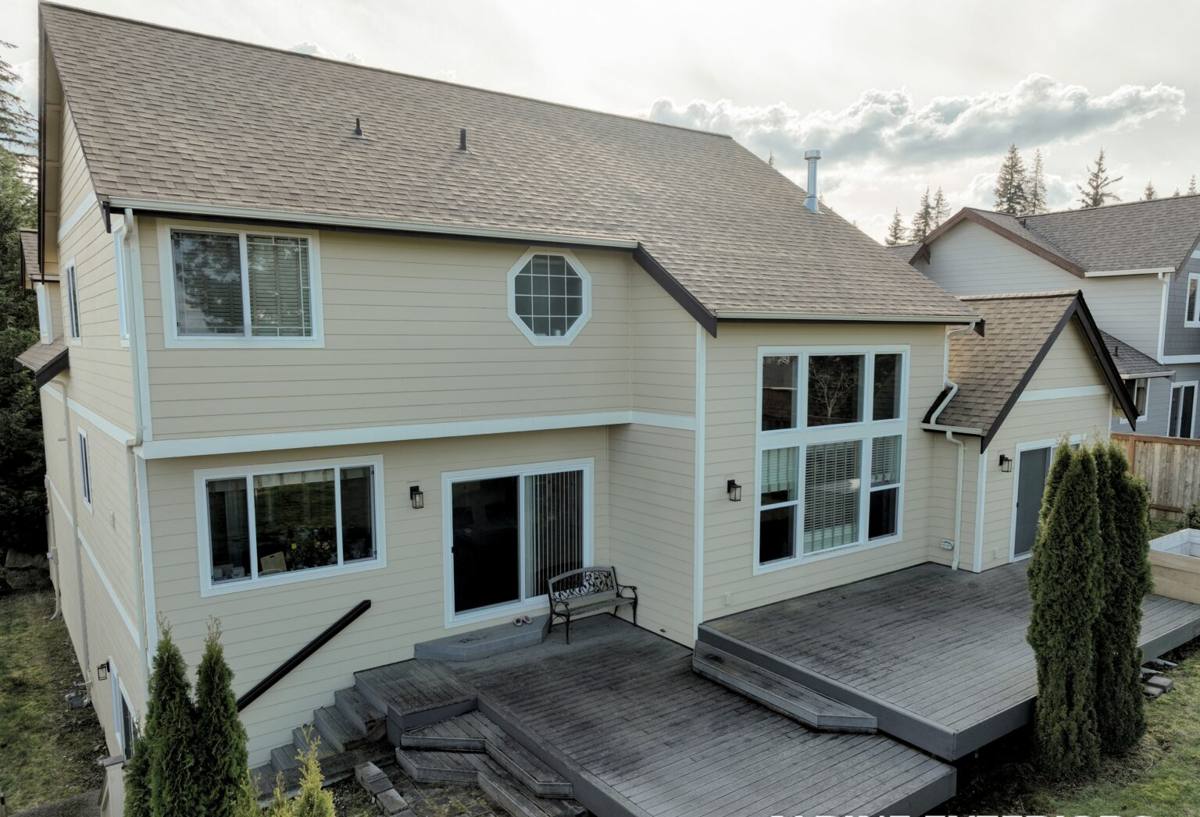
Why Wood Struggles Specifically Here
We're not going to tell you wood decking is bad — a lot of homes in Whatcom County have wood decks that have lasted decades with the right upkeep. But it takes upkeep, and Birch Bay's conditions raise the bar on that upkeep considerably.
- Salt air accelerates corrosion on exposed fasteners and hardware, which can lead to staining and loosening long before the boards themselves fail.
- Wind-driven rain gets under boards and into fastener holes, and that trapped moisture is what actually rots wood — not the rain that runs off the top surface.
- Extended damp periods without much direct sun mean algae and moss get a long window to establish themselves on horizontal wood surfaces.
- Wood that isn't refinished on schedule in this climate weathers unevenly, since some boards sit in more shade or spray than others.
None of this means wood is off the table for every home. It means the maintenance schedule has to be realistic, and a lot of homeowners we talk to in this area are looking for something that asks less of them year after year — which is where composite comes in.
What Composite Decking Does Differently
Modern composite decking is a blend of wood fibers and polymer, capped or fully encased in a protective shell. That shell is the part that matters most for a bay-front or near-water property. It stops moisture from soaking into the board's core the way it does with raw wood, which addresses two Birch Bay problems at once: it reduces the swelling/cupping cycle that constant wet-dry exposure causes, and it gives moss and algae a much harder surface to grab onto compared to open wood grain.
That said, composite isn't a "set it and forget it" material either. Capped composite still needs periodic washing to keep surface grime, pollen, and organic buildup from creating a foothold for moss, especially on shaded sections of a deck near trees or on the north side of a house. The difference is that cleaning composite is usually a rinse-and-scrub job, not a sand-and-reseal job.
Where Composite Still Has Trade-Offs
We'd rather tell you this upfront than have it be a surprise later:
- Composite typically costs more up front than pressure-treated wood, though it usually costs less over 15-20 years once you factor out repeated staining and board replacement.
- Lower-grade or older-generation composite products can still fade or hold moisture at cut ends if they aren't sealed and installed correctly — installation quality matters as much as the product itself.
- Composite gets warm underfoot in direct summer sun more than wood does, though this is a smaller issue in a coastal, often-overcast climate like Birch Bay's than it would be inland.
- Not every composite board is graded for ground-level or fully exposed marine-adjacent installs — matching the product to the specific site conditions is part of doing the job right.
What a Correct Installation Involves
A composite deck is only as good as what's underneath it and how it was fastened. This is where a lot of the long-term problems we get called out to fix actually started — not with the decking material, but with shortcuts in the substructure.
Substructure and Framing
In a damp, salt-air environment, the framing underneath the decking needs the same level of attention as the surface. That means joists and beams rated for exposed or ground-contact use where appropriate, joist tape or a comparable barrier over the tops of joists to keep fasteners from sitting in standing moisture, and hardware — screws, brackets, joist hangers — rated for coastal or high-corrosion exposure. Standard interior-grade hardware will corrode faster here than in a drier inland location, and once hardware starts failing, it takes the deck's structural integrity with it, not just its looks.
Ventilation and Drainage
Composite decking needs airflow underneath it just as much as wood does — arguably more, since trapped moisture under a capped board has nowhere to evaporate to if the underside airflow is blocked. Proper joist spacing, gapping between boards, and grading the ground or surface below the deck so water doesn't pool are all part of doing this right in a wet climate.
Fastening Method
Hidden fastener systems (clips that hold boards from the side, leaving no screw heads on the surface) are generally the better choice for this climate. They reduce the number of penetration points where water and salt air can reach the board's core, and they eliminate the surface screw heads that corrode and stain over time. Face-screwing is sometimes required at borders or picture-frame edges, and in those spots, using coated, coastal-rated fasteners matters.
Flashing and Ledger Connections
Where the deck meets the house is one of the most common places water damage starts, deck or no deck. Proper ledger flashing, keeping the ledger board slightly separated from the house band board, and sealing penetrations correctly all protect both the deck framing and the wall assembly behind it.
Comparing Common Decking Approaches for a Birch Bay Property
| Factor | Pressure-Treated Wood | Capped Composite |
|---|---|---|
| Upfront material cost | Lower | Higher |
| Maintenance in this climate | Annual cleaning, periodic staining/sealing | Periodic rinsing/scrubbing, no staining |
| Moss/algae resistance | Lower — open grain holds moisture and spores | Higher — capped surface sheds more moisture |
| Salt air impact | Accelerates fastener corrosion and weathering | Board itself resists salt exposure; fasteners still need coastal rating |
| Typical lifespan here with upkeep | 10-20 years, upkeep-dependent | 20-30+ years, manufacturer-dependent |
| Appearance consistency over time | Grays and weathers unevenly without refinishing | Holds color more consistently |
This isn't a case of one option being objectively better in every situation — budget, how the deck will be used, and how much upkeep a homeowner wants to take on all factor in. We'll walk through this honestly for your specific property rather than push one material as a default.
Cost Factors Worth Understanding Before You Get a Quote
| Factor | Why It Moves the Price |
|---|---|
| Deck size and shape | More linear footage of framing, fascia, and board cuts; complex angles add labor |
| Height above grade | Taller decks need more substantial framing, footings, and often railing/stair work |
| Substructure condition | Reusing sound existing framing costs less than a full tear-out and rebuild |
| Composite product tier | Board quality, cap technology, and warranty length vary significantly by manufacturer line |
| Fastening system | Hidden-fastener systems cost more in materials and labor than face-screwing |
| Railing and stair complexity | Custom railing, glass panels, or multi-level stairs add material and labor |
| Site access | Waterfront or bluff-adjacent lots can complicate material delivery and equipment access |
Our Process for a Birch Bay Composite Deck
We keep this straightforward because homeowners deserve to know what they're paying for at each step:
- On-site assessment. We look at the existing structure (if there is one), the site's exposure to wind and moisture, drainage, and how the deck will be used.
- Honest product recommendation. We'll walk through composite options and trade-offs for your specific site and budget — not a one-size-fits-all pitch.
- Written estimate. Clear scope, materials, fastening method, and timeline before any work starts.
- Demo and framing. Removal of old decking if applicable, and framing built or reinforced to coastal-exposure standards.
- Installation. Decking, fascia, and railing installed with attention to gapping, ventilation, and fastener choice.
- Final walkthrough. We go over care and cleaning specific to the product installed so you know what upkeep actually looks like going forward.
A Quick Checklist Before You Hire Anyone for This
- Ask specifically how they handle joist protection and fastener corrosion resistance for a coastal or near-water site.
- Ask whether they use hidden fasteners or face-screw, and why, for your deck's layout.
- Ask for the manufacturer warranty terms in writing, not just verbally.
- Ask how they handle drainage and ventilation underneath the deck.
- Confirm they've worked on decks in Whatcom County's coastal communities before, not just inland projects.
- Get the full scope in writing before any demo work begins.
Why Local Experience with Birch Bay Conditions Matters
A deck built to a generic spec sheet and a deck built for this specific stretch of Whatcom County coastline are not the same job, even if the materials on the invoice look identical. Crews that regularly work Birch Bay and the surrounding Bellingham area already know which fastener grades hold up to the salt air here, how to frame for drainage given our rain patterns, and which corners genuinely can't be cut without the deck showing problems in a year or two. That's not something you can fully verify from a brochure — it comes from having done the work in this exact climate, repeatedly, and having seen what does and doesn't last.
If you're weighing composite decking for a Birch Bay property, we're happy to take a look at your site, talk through the trade-offs honestly, and put together a free, no-pressure estimate using the form below.