 Bellingham Siding
 Sudden Valley's Climate Is Harder on Siding Than It Looks
Sudden Valley is a forested, lakeside community tucked into the hills around Lake Whatcom, and that setting cuts both ways. The tree canopy that makes the neighborhood beautiful also means a lot of siding here sits in partial shade most of the day, sometimes full shade on north-facing walls and lots backed up against timber. Shade slows drying. Slow drying means siding stays damp longer after every rain, and in Whatcom County that adds up to a lot of wet days per year.
Zoom out to the broader region and the picture gets more demanding: Bellingham and Whatcom County sit in a marine-influenced corridor where salt-laden air off the Sound, driving wind-borne rain, and a moss season that can run eight or nine months a year all work on exterior materials at once. Sudden Valley trades some of that direct wind and salt exposure for its own version of the same problem — dense shade, still air under the canopy, and moisture that lingers on siding, trim, and fascia instead of blowing off and drying out.
The practical result is the same either way: siding products that tolerate intermittent damp fine in a dry climate can struggle here. Paint fails faster in shaded, damp conditions. Wood-based products swell, delaminate, or invite rot at seams and end cuts. Moss and algae get a longer growing window on anything with texture or porosity for them to grip. None of this is unique to any one street or lot — it's the baseline condition for exterior work in this part of the county, and it's the reason the siding choice and the installation details matter more here than they would in a drier, sunnier market.
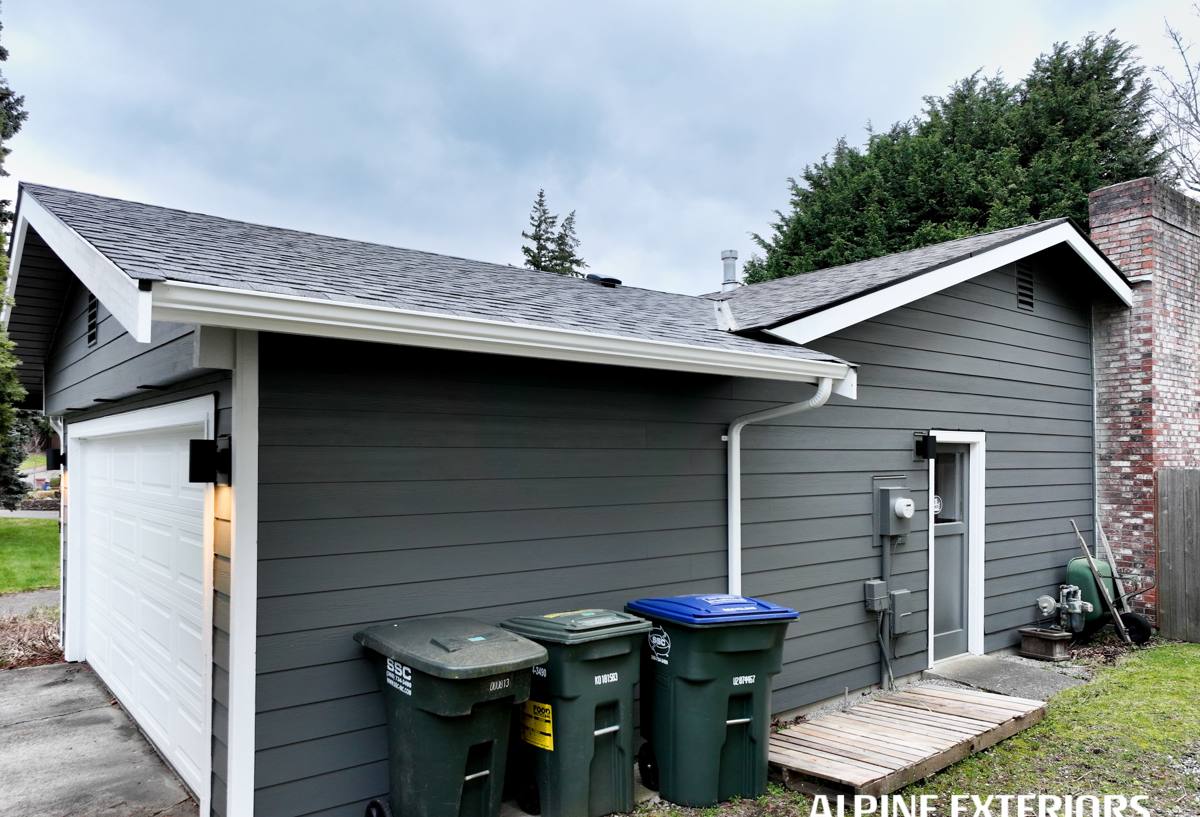
Why We Only Install James Hardie Fiber Cement in This Climate
We install James Hardie exclusively — not vinyl, not LP SmartSide, not cedar or primed spruce, not other fiber cement brands. That's a standing company decision, not a sales pitch for this one page, and it comes down to how materials actually behave in wet, shaded, marine climates like ours.
HZ5 Engineered for the Pacific Northwest
James Hardie makes region-specific product formulations, and the HZ5 line is engineered for climates with more moisture exposure — which is exactly what a shaded, lake-adjacent property in Whatcom County deals with. Fiber cement itself is non-combustible and doesn't swell, rot, or delaminate the way wood-based sidings can when they stay damp for extended stretches. That matters on a lot where a wall might not fully dry out between rain events for weeks at a time.
ColorPlus Factory Finish vs. Field-Painted Siding
Most of what we install uses Hardie's ColorPlus finish — a factory-applied, baked-on finish rather than paint rolled on after installation. In a shaded, damp environment, that difference shows up over time: factory finishes hold color and resist the chalking, peeling, and mildew staining that field-applied paint is more prone to when it doesn't get consistent sun and airflow to cure and dry. It also means touch-up is rare, and when it is needed, Hardie sells matched touch-up product rather than requiring a full repaint.
What a Correct Installation Involves on a Sudden Valley Home
James Hardie siding performs to its rated lifespan only when it's installed to the manufacturer's specifications — and in a damp, shaded climate, the installation details matter more than the product choice itself. A lot of the siding failures we see on older homes here aren't material failures at all; they're installation shortcuts that let moisture in behind a perfectly good product.
Moisture Management Starts Before the First Board Goes Up
Correct installation starts with the water-resistive barrier and flashing, not the siding itself. That means properly lapped house wrap, flashing at every window and door head, kick-out flashing where rooflines meet walls, and a drainage plane behind the siding so any moisture that does get past the surface has somewhere to go besides the sheathing. On a shaded lot where walls stay damp longer, a compromised drainage plane turns a minor moisture intrusion into hidden rot over a few seasons instead of a nonissue.
Fastening, Gaps, and Caulking Details That Get Skipped
James Hardie specifies fastener type, spacing, and placement for a reason — get it wrong and boards can crack, cup, or work loose over time. The manufacturer also calls for a minimum gap at butt joints and trim, plus the right sealant at those gaps, so the material can move seasonally without stressing the caulk line or opening a path for water. These are easy details to shortcut on a bid that's trying to hit a low number, and they're exactly the details that decide whether a job lasts fifteen years or fifty.
Our Process, Start to Finish
We run the same disciplined process on every Sudden Valley job, whether it's a full re-side or a repair after storm or moisture damage.
- On-site inspection. We look at the existing siding, wall assemblies, trim, flashing, and any signs of moisture intrusion or rot before we quote anything.
- Written estimate. A clear scope and price, including product line, color, trim details, and what happens with the existing siding and any sheathing repair.
- Tear-off and substrate check. Once the old siding is off, we can see the sheathing and framing directly — any soft or damaged wood gets addressed before new siding goes on, not covered up.
- Water-resistive barrier and flashing. House wrap, window and door flashing, and drainage details go in to spec before a single Hardie board is hung.
- Installation to manufacturer spec. Correct fastening, gapping, and caulking, following James Hardie's published installation guidelines for our climate zone.
- Final walkthrough and cleanup. We review the finished work with the homeowner and leave the site clean.
Cost Factors for James Hardie Siding in Sudden Valley
Every home is different, and we don't publish blanket per-square-foot pricing because it's misleading without seeing the house. What we can tell you is what actually moves the price up or down on a project in this neighborhood:
| Factor | Why It Affects Cost |
|---|---|
| Condition of existing siding and sheathing | Rot or moisture damage found during tear-off adds repair scope beyond the siding itself |
| Home size and wall complexity | More corners, dormers, and trim detail mean more cutting, fitting, and labor time |
| Access and site terrain | Sloped lots, limited driveway access, and staging around trees near the home affect setup and material handling time |
| Product line and color | Standard ColorPlus colors versus premium colors or textures (lap, shingle, panel) carry different material costs |
| Trim and accessory scope | Fascia, soffit, corner boards, and window trim replaced alongside the siding add to overall scope |
The only way to get an accurate number is a look at the actual house — anything quoted sight-unseen for a Sudden Valley property is a guess.
Keeping Moss and Moisture From Undoing the Work
Good material and correct installation get you most of the way to long-term performance, but a shaded, tree-heavy lot still needs some basic upkeep to keep moss and moisture from building up on any exterior surface, siding included. None of this is difficult or expensive — it's mostly a matter of not letting small things sit.
- Keep gutters and downspouts clear so roof runoff doesn't sheet down over siding or pool at the base of walls
- Trim back branches and vegetation that hold moisture against the siding or block airflow and sun on shaded walls
- Rinse visible moss or algae growth off siding periodically rather than letting it build up over a full season
- Check caulking at trim, window, and door joints yearly and have any cracked or missing sealant redone
- Watch for soft spots, staining, or discoloration near the ground line and at roof-to-wall intersections, where moisture problems tend to show up first
Why a Crew That Already Works Sudden Valley Matters
Siding work in a shaded, hillside, lake-adjacent neighborhood is not identical to siding work on an open, sunny lot across town. A crew that regularly works Sudden Valley has already seen how the tree cover, terrain, and moisture patterns here play out over multiple seasons and multiple homes — which flashing details matter most, where moss tends to establish first, how staging and material access work on sloped or wooded lots. That familiarity shows up in fewer surprises during tear-off and a job that's planned around the actual conditions of the property instead of a generic checklist.
It also matters for permitting and inspection. Neighborhoods and planned communities in this part of Whatcom County sometimes carry their own architectural guidelines in addition to county permitting requirements, and a crew that's done work here before knows to check for that up front rather than discovering it mid-project.
What We Don't Install, and Why That Matters Here
We get asked fairly often about vinyl siding or LP SmartSide, usually because a homeowner got a quote for one of them elsewhere. Both are legitimate products used across the industry, and we're not going to tell you they're junk. But we don't install them, and in a climate like Sudden Valley's the reasons matter.
Vinyl siding is a cladding, not a structural or moisture-managing layer — it relies heavily on what's behind it, and it can warp or become brittle with age and temperature swings. LP SmartSide is a wood-strand product; it performs well when installation and maintenance stay on top of every cut edge and seam, but wood-based products are inherently more exposed to the kind of prolonged dampness a shaded, forested lot produces, and any lapse in maintenance shows up faster than it would with fiber cement. James Hardie's fiber cement composition simply doesn't have that same vulnerability to sustained moisture, which is why it's the one product we stand behind for homes in this environment.
If you own a home in Sudden Valley and you're weighing a full re-side or need to replace storm- or moisture-damaged siding, we're happy to take a look and walk you through what your specific home needs. There's no pressure and no obligation — just a straightforward inspection and a written estimate for James Hardie siding installed correctly for this climate. Use the form below to request your free estimate.