 Bellingham Siding
 Why Silver Beach Decks Wear Out Faster Than You'd Expect
Silver Beach sits along Lake Whatcom's shoreline under heavy tree cover, and that combination is tougher on a deck than most homeowners realize. The mature canopy that makes the neighborhood shady and quiet also means less direct sun to dry wood after a storm, more organic debris collecting between boards, and near-constant humidity rolling off the lake. Add in Bellingham's broader marine climate — the salt-laden air that moves in off Bellingham Bay and the Salish Sea reaches the whole region, Silver Beach included — and you get a setup where decks stay damp longer than they were ever designed to.
Whatcom County's driving rain doesn't help. Wind-blown rain gets up under railings, behind ledger boards, and into fastener holes in ways that straight-down rain never would. Over a few seasons, that moisture cycle — wet, humid, rarely fully dry — is what actually breaks a deck down, more than any single storm.
The Moss Problem
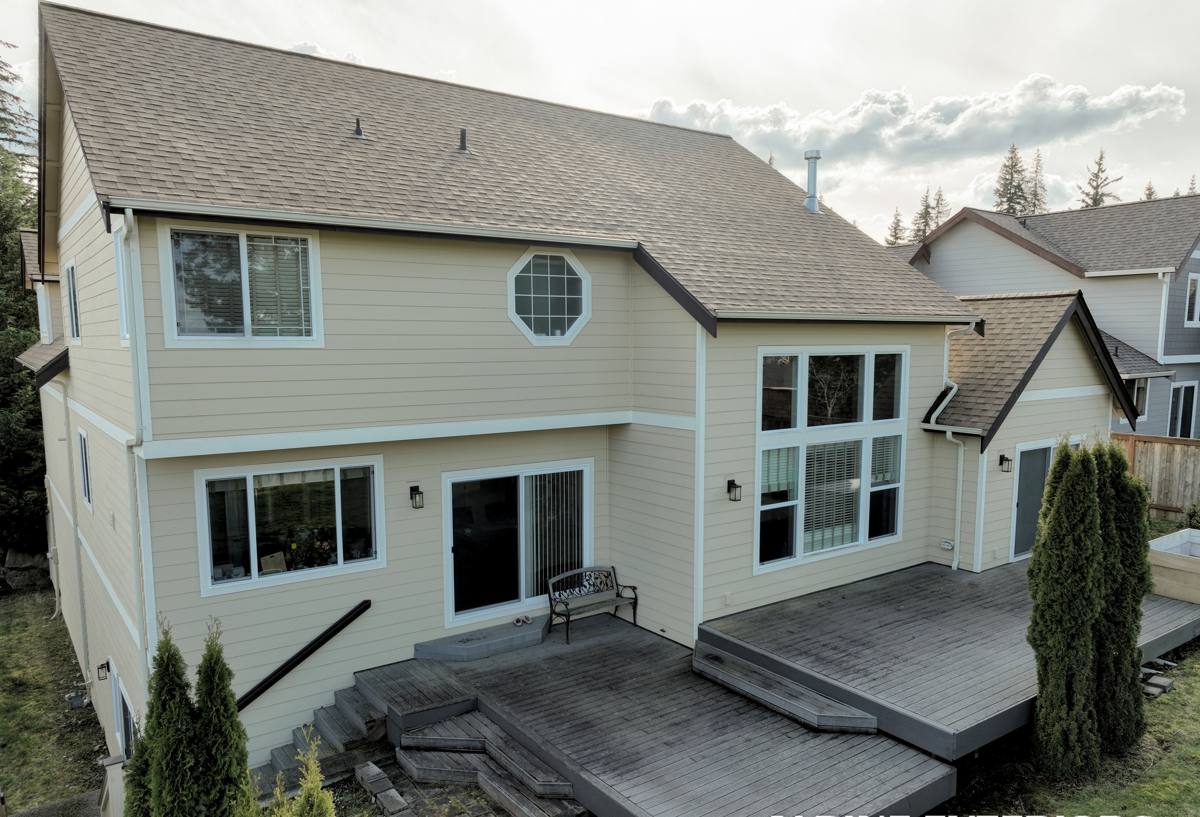
Moss on a deck isn't just cosmetic. It holds moisture directly against the wood or composite surface for weeks at a time, which accelerates rot in wood decking and can stain or degrade the surface layer of composite boards. In shaded, lake-adjacent lots like the ones common around Silver Beach, moss season can run most of the year if a deck isn't cleaned and treated on a regular schedule. By the time moss is visible and thick, it's usually already done some damage to whatever is underneath it.
Signs Your Deck Needs Repair — Not Just a Cleaning
Some deck problems are surface-level. Others mean the structure underneath is compromised. Knowing the difference before you call someone is worth a few minutes.
- Boards that feel spongy, soft, or flex more than neighboring boards when you step on them
- Visible gaps, cracking, or splintering concentrated in shaded or low-airflow areas
- Rust streaks around fasteners, or screws that spin freely instead of biting
- A railing that wobbles or has any give when pushed — this is a safety issue, not cosmetic
- Gaps or separation where the deck's ledger board meets the house
- Discoloration or a persistent musty smell near support posts or under the deck
- Standing water or slow drainage after rain instead of water shedding off the surface
Any one of these on its own might be a simple fix. Several together, especially near the ledger board or support posts, usually mean it's time for a proper inspection rather than a patch job.
What a Correct Deck Repair Actually Involves
A repair that only replaces what's visible from the top often misses what's failing underneath. A repair done right starts with pulling up enough decking or getting underneath the structure to actually see the framing, not guessing at it.
Structural Components We Check First
The ledger board — the piece that attaches the deck to the house — is the single most important structural element and the one most likely to hide water damage behind it. We also check joists for soft spots or rot, post bases for standing water contact, and every connection point for corroded or undersized fasteners. In a climate that stays damp as long as ours does, galvanic corrosion between mismatched metals (like the wrong screws in pressure-treated lumber) is a real and common cause of failure we see in older repairs.
Surface-Level Repairs
Once the structure is confirmed sound, surface repairs — replacing individual boards, resetting loose railings, re-securing stair stringers, fixing flashing at the house connection — go a lot further and last a lot longer. Skipping the structural check and jumping straight to new boards is the most common shortcut that leads to a homeowner calling again in two years.
Wood vs. Composite: What We Recommend and Why
Both wood and composite decking show up throughout Silver Beach and Bellingham generally, and both can perform well here if they're installed and maintained correctly. The honest trade-offs matter more than a blanket recommendation.
| Factor | Wood Decking | Composite Decking |
|---|---|---|
| Moss resistance | Lower — porous surface holds moisture, needs regular cleaning and sealing | Higher — sheds surface moisture better, though buildup in shaded spots still needs cleaning |
| Maintenance | Annual cleaning and periodic sealing/staining required | Occasional washing; no sealing or staining needed |
| Repair approach | Board-by-board replacement is straightforward and matches easily | Board matching can be harder if the product line has changed or faded over time |
| Upfront cost | Generally lower | Generally higher |
| Long-term cost in our climate | Higher if maintenance is skipped — rot repair adds up | Lower ongoing cost, but structural framing underneath still needs the same inspection |
We install and repair both. Where we're selective is on the framing and fastening underneath — that's where corner-cutting causes the failures we get called to fix, regardless of which decking material sits on top.
Repair or Replace? An Honest Way to Decide
Homeowners often assume any visible damage means a full tear-out. That's frequently not true, but it's also not always a simple patch. A few honest questions guide the call:
- Is the damage isolated or spread across the structure? A few bad boards or one soft joist is a repair. Rot at multiple framing points usually isn't.
- Is the ledger board sound? Ledger failure is a safety issue and often the deciding factor toward replacement.
- How old is the deck relative to its expected lifespan? A well-maintained deck near the end of its service life may not be worth repeated repair costs.
- Does the footprint or layout still work for the property? Sometimes a repair is the right technical call, but it's also a reasonable moment to reconsider the deck's size or layout.
We'll always tell you honestly which side of that line your deck falls on, including when a repair is genuinely the better financial decision — we're not trying to sell a replacement a deck doesn't need.
Our Process for a Silver Beach Deck Repair
- On-site inspection — We look at the deck from both the top surface and underneath, checking framing, ledger attachment, posts, and drainage, not just what's visible while standing on it.
- Straightforward assessment — You get a clear explanation of what's failing, what's causing it, and what your realistic options are, including cost ranges for each.
- Structural repair first — Any compromised framing, ledger connection, or fastening gets addressed before anything cosmetic is touched.
- Surface and railing work — Boards, railings, stairs, and flashing details are repaired or replaced to match the existing deck as closely as possible.
- Final check — We walk the deck with you, test railings and stairs under real weight, and confirm drainage is working before we call it done.
Keeping a Repaired Deck in Good Shape
A repair is only as good as the maintenance that follows it, especially in a shaded, lake-humid setting like Silver Beach. A few habits go a long way toward avoiding another call in a year or two:
- Sweep off leaves, needles, and debris regularly — trapped organic material is what feeds moss and holds moisture
- Clean visible moss growth promptly rather than letting it spread through a full wet season
- Check that gaps between boards stay clear so water can actually drain instead of pooling
- For wood decks, keep sealing or staining on a regular schedule rather than waiting until the finish is visibly gone
- Trim back overhanging branches where practical to get a little more sun and airflow onto the deck surface
Why Local Experience in Silver Beach Matters
A deck repair crew that regularly works the Silver Beach area and greater Bellingham already knows how this specific climate behaves — where moss builds up fastest, how driving rain finds its way behind flashing, and which fastener and material choices actually hold up under sustained humidity instead of just looking fine on install day. That's different from general handyman repair work, and it's the difference between a fix that lasts one season and one that lasts the life of the deck.
We're familiar with the building patterns and site conditions common to lake-adjacent, tree-covered lots in Whatcom County, and we bring that same standard to every repair — checking the structure first, being straight with you about what's actually needed, and using materials and fastening methods suited to this specific climate rather than a generic approach.
If you've noticed soft spots, a wobbly railing, moss that keeps coming back, or you just want a second opinion on a deck that's a few years past its prime, we're happy to take a look. Reach out for a free, no-pressure estimate using the form below — we'll give you an honest read on what your deck actually needs.