 Bellingham Siding
 Siding Replacement Built for Barkley's Weather, Not Around It
Barkley sits close enough to Bellingham Bay and the surrounding wetlands that homes here take on a specific mix of punishment: salt-tinged air drifting in off the water, wind-driven rain that finds every gap in a siding system, and a moss season that can stretch from October through May in a shaded, moisture-heavy Whatcom County yard. None of that is unusual for this part of Washington. What it means for siding replacement is that the job has to account for moisture management first and appearance second — because if the water management fails, the appearance fails with it, usually from the inside out where you can't see it until the damage is done.
A siding replacement in Barkley is not the same project as a siding replacement in a dry inland climate. The material, the flashing details, the fastening pattern, and even the finish all need to be chosen with this specific exposure in mind. That's the frame for everything below.
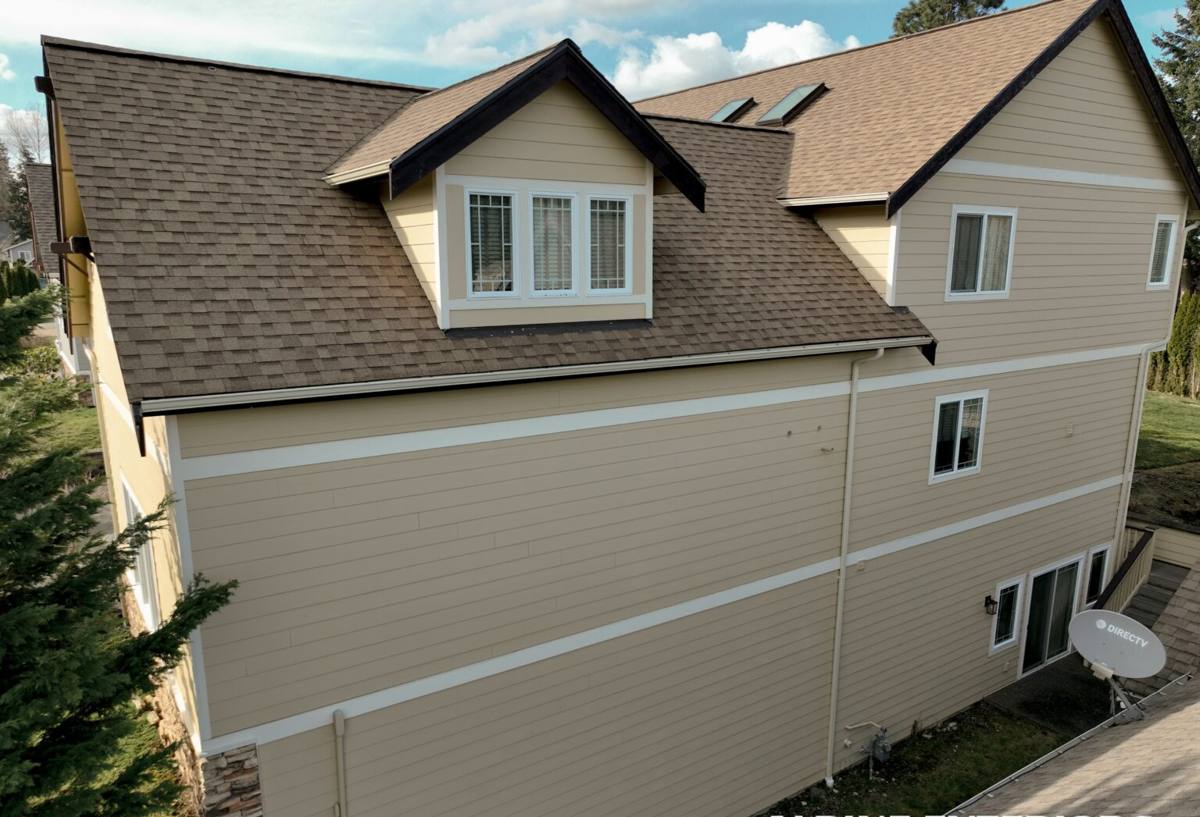
Signs a Barkley Home Actually Needs Siding Replacement
Not every aging exterior needs full replacement — sometimes a section repair or a repaint is genuinely enough. But there are signs that tell us the siding system itself has failed and patching it further is just delaying an inevitable, more expensive tear-off:
- Soft or spongy spots when you press on siding, especially near the bottom courses and around window and door trim
- Persistent moss or black-green streaking that comes back within weeks of cleaning, particularly on north- and west-facing walls
- Visible cupping, warping, or delamination in wood-based or engineered wood panels
- Paint that won't hold — blistering, peeling, or chalking faster than a normal repaint cycle
- Rust staining around fasteners, or fasteners backing out of the panel
- Interior signs: musty smells near exterior walls, peeling interior paint, or soft drywall near window returns
If you're seeing two or more of these, it's worth having someone look at the wall assembly itself, not just the surface — because in this climate, surface problems are usually a symptom of a moisture problem happening behind the siding.
Why Salt Air, Driving Rain, and Moss Season Change the Math
Salt air and corrosion
Proximity to Bellingham Bay means a low but steady dose of airborne salt on exterior surfaces. Over years, that accelerates corrosion on unprotected fasteners and metal flashing, and it can degrade some paint and coating systems faster than the same product would age further inland. Fastener choice and flashing material matter more here than they would in a landlocked Whatcom County community.
Driving rain and wind-driven moisture
Bellingham's storms don't always come straight down — wind off the water pushes rain sideways into wall assemblies, which is a much tougher test for a siding system than vertical rainfall. This is where lap details, caulking practices, and the water-resistive barrier underneath the siding do the real work. Siding that looks fine from the street can still be letting wind-driven moisture behind it at every horizontal lap if it wasn't installed with the right overlaps and gaps.
Moss season
Shaded lots, tree cover, and a long wet season combine to give moss and algae a long runway to establish on north-facing and shaded walls. Moss doesn't just look bad — it holds moisture against the siding surface for extended periods, which is exactly the condition that accelerates rot in wood-based products and breaks down paint film faster than sun-exposed walls experience.
What a Correct Siding Replacement Involves
A siding replacement done right in this climate is really a water-management project that happens to end with new siding on the wall. The sequence matters:
- Full tear-off and inspection — removing old siding to inspect sheathing, framing, and any existing water-resistive barrier for hidden rot or moisture damage before anything new goes on
- Sheathing repair — replacing any compromised OSB or plywood found during tear-off, since covering damaged sheathing just traps the problem
- New water-resistive barrier — installed shingle-style so every layer sheds water downward and outward, never into a seam
- Flashing at every penetration — windows, doors, hose bibs, vents, and any other wall penetration get proper flashing, not just caulk
- Correct fastening — siding fastened per the manufacturer's specification for pattern, spacing, and fastener type suited to coastal exposure
- Proper clearances — siding held off the ground, roofline, and deck surfaces at the manufacturer's minimum gap so splash-back and standing moisture can't wick into the bottom edge
- Sealed and finished trim — corners, trim boards, and joints sealed with a product rated for the exposure, not just whatever's on the shelf
Skip any one of these steps and the new siding can still fail early — often in the same way the old siding did, just with a longer warning period before it shows.
Why We Only Install James Hardie Fiber Cement
We standardized on James Hardie fiber cement siding for every replacement we do, including in Barkley, and we don't install vinyl, LP SmartSide, or other engineered wood or fiber cement alternatives. That's a deliberate call, not a default. Fiber cement is non-combustible and dimensionally stable in a way wood-based products aren't, so it doesn't swell, cup, or delaminate the way engineered wood can when it takes on repeated moisture exposure over years of Whatcom County winters. James Hardie's ColorPlus factory finish is baked on under controlled conditions rather than field-applied, which matters directly for salt-air exposure and moss-prone shaded walls — it holds color and resists the fade and chalking that field-applied paint struggles with in this climate.
James Hardie also engineers specific product lines (HZ5, for example) for harsher, wetter climate zones, which lines up with what a Barkley exterior actually deals with. The backing warranty is transferable and substantial when the product is installed to spec — which is exactly why installation quality is not optional in our process. A great product installed poorly still fails; that's true of any siding material, which is part of why we keep our installation process tight rather than treating siding as a commodity swap.
Our Process for a Barkley Siding Replacement
| Step | What Happens |
|---|---|
| Estimate & assessment | On-site walkaround, moisture and rot check where accessible, honest read on whether it's a repair or full replacement |
| Scope & product selection | James Hardie plank or panel selection, color, and trim package matched to the home and its exposure |
| Tear-off & sheathing check | Old siding removed, sheathing inspected and repaired as needed before anything new is installed |
| Weather barrier & flashing | New water-resistive barrier and flashing installed at every window, door, and penetration |
| Hardie installation | Installed to manufacturer spec for fastening, clearances, and joint treatment |
| Final walkthrough | Trim, caulking, and touch-up review with the homeowner before we call it done |
We're familiar with Barkley's mix of home ages and lot conditions — mature tree cover on some lots, more open exposure on others — and we adjust the moisture-management details of the install to what that specific home is facing, rather than running one generic process on every job.
What Drives the Cost of a Siding Replacement
| Factor | Why It Matters |
|---|---|
| Home size & wall complexity | More corners, gables, and dormers mean more cutting, flashing, and labor time |
| Sheathing condition | Hidden rot found at tear-off adds repair scope — this is common enough in this climate to plan for as a possibility, not a certainty |
| Siding profile & trim package | Lap width, trim detailing, and accent choices affect material and labor cost |
| Access & site conditions | Tree cover, tight lot lines, and multi-story sections affect staging and labor time |
| Existing paint/finish removal | Some tear-offs require more careful handling of old coatings than others |
We give a real, itemized number after we've actually looked at the home — broad national averages don't mean much once sheathing condition and site access are in the picture.
Choosing a Siding Contractor Who Actually Knows This Area
Salt air, moss, and driving rain aren't abstract concepts to a crew that works Whatcom County year-round — they're the reason certain details get done a specific way every time. A contractor who mostly works drier inland regions can still do competent general carpentry, but the moisture-management instincts that keep a Barkley wall assembly dry for decades come from having seen what happens when those details get skipped in this exact climate.
- Ask what water-resistive barrier and flashing approach they use, not just what siding brand they sell
- Ask how they handle hidden sheathing damage if it's found during tear-off
- Ask for their fastening and clearance specs, and whether they follow the manufacturer's published installation instructions
- Confirm licensing, insurance, and whether the warranty is manufacturer-backed and transferable
- Ask how they've handled moss-prone, shaded walls on past jobs in the area
If your Barkley home is showing signs of siding failure, or you'd rather replace it on your own schedule than wait for a problem to force the issue, we're happy to take a look and walk you through what we'd actually recommend. Estimates are free and there's no pressure — the form below gets you started.