 Bellingham Siding
 Deck Replacement in Lynden
Lynden sits far enough inland from Bellingham Bay that people sometimes assume salt air and coastal moisture aren't a factor here. They still are, just in a different form. What hits Lynden decks hardest is the combination of Whatcom County's long wet season, heavy dew from the surrounding farmland, and moss that gets a running start every fall and doesn't let go until late spring. A deck that looks fine in July can be hiding rot, soft framing, or failing fasteners that only show themselves once you know where to look. If your deck is past patching and into replacing, doing it right the first time matters more here than it does in drier parts of the state.
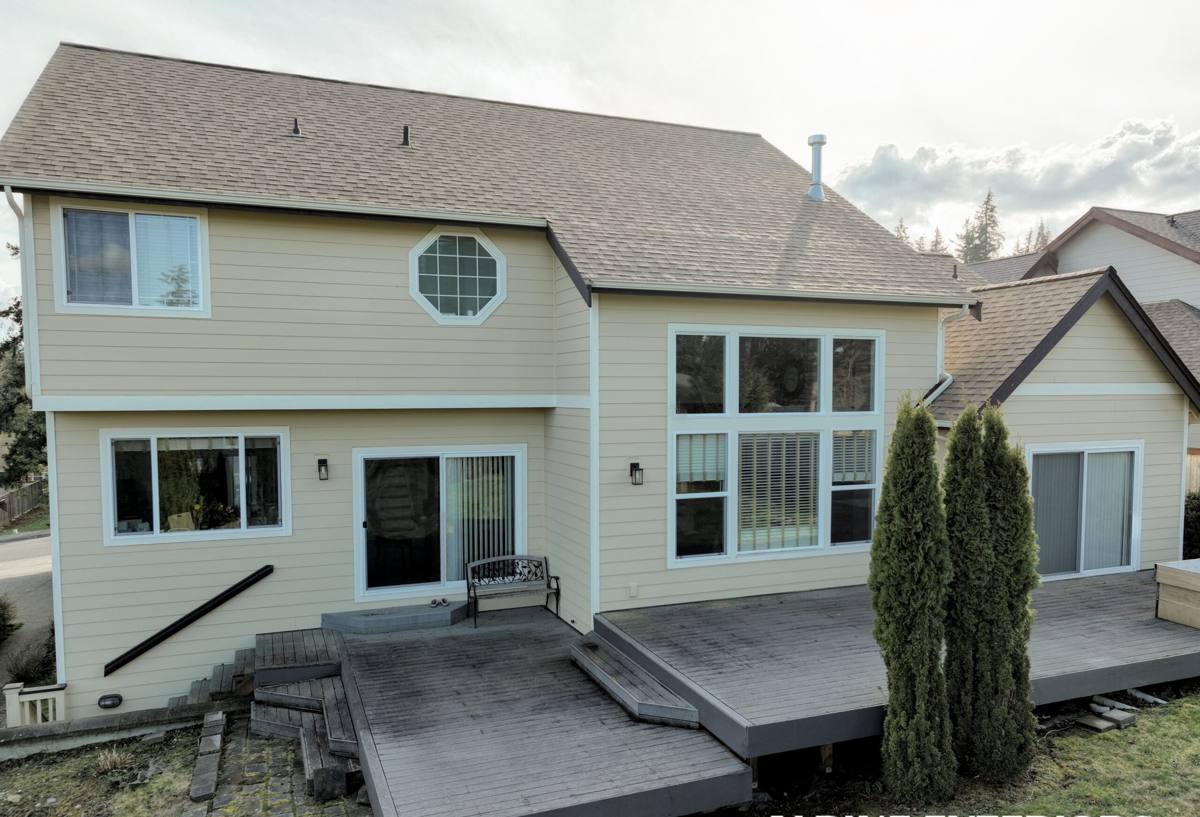
Why Decks Fail Faster in This Climate
Every deck replacement job we do in Lynden starts with the same question: what actually breaks decks around here? It's rarely one dramatic event. It's cumulative moisture exposure over years, working on wood, fasteners, and connections that were never built to handle this much water contact.
Moss and Standing Moisture
Bellingham and Whatcom County get a long stretch of low sun angle, overcast skies, and consistent drizzle from fall through spring. Deck boards that don't get direct sun for months at a time stay damp, and damp wood grows moss. Moss holds water against the board surface long after the rain stops, which is what actually causes rot — not the rain itself, but wood that never gets a chance to dry.
Driving Rain and Wind-Driven Moisture
Storms coming off the Strait and up through the lowlands don't just fall straight down — they drive rain sideways into ledger boards, stair stringers, and the house-to-deck connection. That's the single most common failure point we find on older decks: the ledger board where the deck meets the house, where water has been getting behind flashing (or working with no flashing at all) for years.
Salt-Influenced Air and Metal Fasteners
Lynden is inland, but Whatcom County as a whole still sees enough marine-influenced air that untreated or mismatched metal hardware corrodes faster than it would in a dry inland climate. Corroded joist hangers, nails, and bolts are a structural problem, not a cosmetic one — they're often the actual reason a deck starts to feel spongy or uneven before the boards themselves look bad.
Signs a Repair Won't Cut It
Homeowners often call us for a repair quote and end up needing a replacement conversation instead. Here's how to tell which situation you're actually in before we get there.
- Boards that feel soft, spongy, or flex noticeably when you walk across them
- Persistent moss or dark staining that comes back within weeks of cleaning
- Visible gaps, cupping, or splitting concentrated on the shaded or north-facing side of the deck
- Rust streaks below joist hangers, bolts, or screws
- Any softness or discoloration at the ledger board where the deck attaches to the house
- Railings that wiggle at the post base, which usually points to rotted post connections below the surface
- A deck older than 15–20 years that's never had the substructure inspected, only the surface boards replaced
If it's just a handful of boards on an otherwise sound frame, repair can make sense. If the framing, ledger, or multiple structural connections are compromised, patching individual boards is a short-term fix on a problem that's still moving underneath.
What a Correct Deck Replacement Actually Involves
A deck replacement done right in this climate is not just swapping old boards for new ones. The parts nobody sees are what determine whether the new deck lasts 10 years or 25.
Ledger Board and Flashing
This is where most premature deck failures start in wet climates, so it's where we spend the most attention. Proper flashing at the ledger board keeps water from working its way behind the connection and into the house rim joist. We treat this as a non-negotiable step, not an upsell.
Framing and Fasteners
We inspect and replace any joists, beams, or posts showing rot or insect damage, and we use corrosion-resistant, code-rated hardware throughout — hangers, screws, and structural connectors rated for ground contact and exterior exposure, not standard interior-grade fasteners.
Drainage and Airflow
Decks that sit low to the ground or close to grade need attention to how water drains away from the structure and how air moves underneath to let framing dry out between rain events. This is especially relevant on Lynden properties with flatter lots and less natural drainage slope.
Decking Material Selection
Board choice affects how much moss and moisture maintenance you'll deal with going forward — covered in the comparison below.
Decking Material Comparison for Whatcom County Conditions
| Material | Moss/Moisture Behavior | Maintenance | Typical Lifespan |
|---|---|---|---|
| Pressure-treated wood | Absorbs moisture readily; needs sealing to resist moss and staining | Annual cleaning, periodic re-sealing | 10–15 years with upkeep |
| Cedar | Naturally rot-resistant but still needs finish maintenance in shaded, damp areas | Regular cleaning and refinishing | 15–20 years with upkeep |
| Composite decking | Doesn't absorb moisture into the board itself; moss can still grow on the surface film and needs washing off | Occasional washing, no sealing/staining | 25–30 years |
| PVC/cellular decking | Fully moisture-resistant board; surface moss still needs periodic washing | Low — washing only | 25–30+ years |
There's no universally "right" material — it depends on your budget, how much upkeep you want to take on, and how shaded your deck's location is. What we won't do is install any of these products in a way that ignores the underlying framing and drainage issues just to get a new deck surface down faster. The surface is only as good as what's underneath it.
Our Deck Replacement Process
- On-site assessment: We inspect the existing deck, ledger connection, framing, and posts to determine what's actually failing versus what's just cosmetic.
- Honest scope discussion: We tell you plainly whether you need a full replacement, a partial rebuild, or if repair is a legitimate option — even if that means a smaller job for us.
- Material walkthrough: We go over decking options based on your budget, sun exposure, and how much long-term maintenance you want to take on.
- Permit and code check: Deck replacements involving structural framing typically require permitting through the applicable local jurisdiction — we handle that coordination as part of the job.
- Demolition and framing: Old decking and any compromised framing come out; new structural members, hardware, and ledger flashing go in to current code.
- Decking installation: Boards are installed with attention to spacing and fastening methods appropriate to the material, accounting for wet-season expansion and contraction.
- Final walkthrough: We review the finished deck with you, including basic maintenance guidance specific to the material you chose.
Deck Replacement Prep Checklist
- Clear furniture, planters, grills, and other items off the existing deck
- Note any underlying utilities (gas lines, electrical) that run near or under the deck
- Flag any landscaping close to the deck perimeter that needs protecting during demo
- Confirm access for material delivery and debris removal on your property
- Decide ahead of time whether stairs, railings, or lighting are changing along with the decking
Why a Crew That Already Works Lynden Matters
Deck framing and flashing details that work fine in a dry climate can fail within a few seasons here. A crew that primarily works drier regions may not default to the flashing details, fastener grades, or drainage considerations that Whatcom County's wet season actually demands — not because they're careless, but because it's just not what their normal jobs call for. We work decks and siding throughout Bellingham and the surrounding county, including Lynden, so the moss patterns, the ledger board failures, and the drainage quirks of local lots aren't surprises — they're what we plan for by default.
We're also familiar with the general permitting expectations that apply to structural deck work in this area, which keeps the project moving instead of stalling out on paperwork nobody flagged ahead of time.
Cost Factors Worth Understanding Before You Get Quotes
Deck replacement costs vary widely based on size, material, and how much of the substructure needs rebuilding — we won't quote a number without seeing the deck. What we can tell you is what actually drives the price up or down:
| Factor | Impact on Cost |
|---|---|
| Extent of framing/ledger damage | Hidden rot found during demo is the most common reason estimates shift |
| Decking material chosen | Composite and PVC cost more upfront than wood, less over time |
| Deck size and height off grade | Larger and elevated decks require more structural material and labor |
| Railing and stair complexity | Custom railings, multiple stair sections, or code-driven guard height changes add cost |
| Site access | Backyard decks with limited equipment access can add labor time |
A straight walk-through gives you real numbers instead of a guess based on square footage alone. If you're weighing whether to repair or replace, that same walk-through is the fastest way to get a clear answer.
If your deck in Lynden is showing soft spots, persistent moss, or you're just tired of chasing repairs on something that needs to be rebuilt, we'll come take a look and give you a straight answer — no pressure, no upsell. Fill out the form below for a free estimate.