 Bellingham Siding
 Building Decks That Actually Hold Up in Ferndale
Ferndale sits close enough to the water and low enough in the Nooksack valley that its decks take a different kind of beating than decks built twenty miles inland. Homes here deal with salt-laden air rolling in off the Strait, long stretches of driving rain through fall and winter, and a moss season that seems to start earlier and last longer every year. A deck built without those conditions in mind will look fine for a season or two, then start showing problems fast — soft spots, green film underfoot, corroded hardware, boards that cup or split. A deck built for Ferndale specifically holds its finish, its structure, and its footing for decades instead of years.
This page is about deck building as a standalone project for Ferndale homeowners: what the climate actually does to a deck, what a correctly built one looks like, and how we approach the work from first conversation to final walk-through.
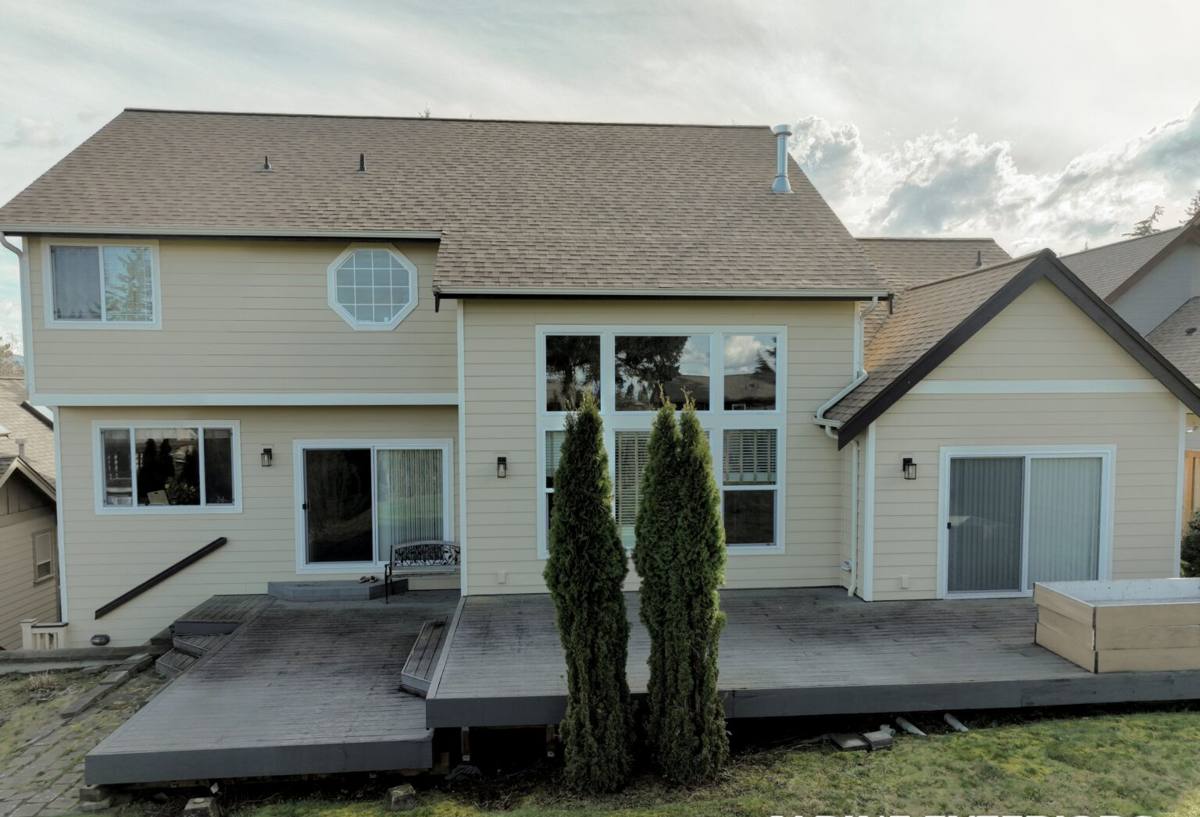
What Ferndale's Climate Does to a Deck
Three things drive almost every deck problem we see in this part of Whatcom County.
Salt Air
Proximity to Bellingham Bay and the Strait of Georgia means airborne salt reaches further inland than most homeowners expect, especially on windy days. Salt accelerates corrosion in any exposed metal — nails, screws, joist hangers, post bases — and speeds up the breakdown of lower-grade finishes. A deck built with standard interior-rated fasteners or an unrated coating will show rust streaks and hardware failure well before the wood itself is a problem.
Driving Rain
Rain in this region doesn't just fall straight down — wind pushes it sideways under railings, into ledger connections, and along horizontal surfaces where it can sit instead of running off. Any deck detail that traps water instead of shedding it becomes a rot pocket. This matters most at the ledger board (where the deck attaches to the house), at post bases, and anywhere two pieces of lumber sit face to face without a gap.
Moss and Sustained Moisture
Ferndale's moss season runs long because the region rarely gets a hard, dry stretch in winter. Moss and algae take hold on any decking surface that stays damp and shaded, and once established they hold moisture against the wood surface around the clock, which speeds rot and makes boards slick and dangerous underfoot. Decks with poor airflow underneath or heavy tree cover overhead are the worst affected.
Choosing Decking Material for This Climate
There's no single "best" decking material — there's a best material for your budget, your maintenance appetite, and how much sun or shade your deck actually gets. Here's how the common options compare specifically for Ferndale's conditions.
| Material | How It Handles Salt Air & Rain | Moss/Algae Resistance | Maintenance |
|---|---|---|---|
| Pressure-treated pine/fir | Good if fasteners and hardware are corrosion-rated; wood itself is chemically protected against rot | Needs periodic cleaning and re-sealing to resist moss buildup | Re-stain or seal every 1-3 years |
| Western red cedar | Naturally rot- and insect-resistant; still needs quality fasteners to avoid corrosion staining | Better natural resistance than pine, but still needs cleaning in shaded areas | Re-stain or oil every 1-2 years to keep color and protection |
| Composite decking | Excellent — non-porous surface doesn't absorb moisture or salt | Still needs occasional washing; algae can grow on the surface film if never cleaned | Periodic washing only, no staining or sealing |
| PVC decking | Excellent moisture resistance, very stable in wet/dry cycling | Low, but not immune — shaded, low-airflow areas can still develop surface growth | Lowest maintenance of the common options |
Our honest take: composite and PVC cost more up front but make sense for homeowners who don't want a recurring re-sealing project. Cedar and quality pressure-treated lumber are a fair choice for homeowners who like the natural look and don't mind the maintenance rhythm. What we won't do is install a premium decking surface over a framing system or hardware package that isn't built to the same standard — the surface is only as good as what's underneath it.
Framing and Structure: Where Deck Failures Actually Start
Most deck problems homeowners eventually call about aren't decking-board problems — they're framing problems that took a few years to show up on the surface. Getting this right is where correct deck building really happens.
The Ledger Connection
Where the deck attaches to the house is the single most important — and most commonly done wrong — connection on the whole structure. It needs proper flashing to keep water from working its way behind the siding and into the house framing, plus correctly spaced, load-rated lag bolts or through-bolts. A poorly flashed ledger is one of the more expensive mistakes to fix later because it usually means opening up siding to repair hidden rot.
Fasteners and Hardware
Given the salt air in this area, we use corrosion-resistant, code-rated fasteners and connectors throughout — joist hangers, post bases, structural screws. Standard interior hardware corrodes visibly within a few years out here and weakens the connections it's supposed to protect.
Footings and Post Bases
Footings need to sit below frost depth and be sized for the actual load of the deck, including snow load and anything permanently heavy like a hot tub. Post bases should hold the post above the decking surface, not buried in a puddle of standing water every winter — a detail that's easy to skip and expensive to regret.
Joist Spacing and Board Direction
Joist spacing needs to match the decking material's span rating — composite and PVC boards often require tighter joist spacing than solid wood to avoid flexing over time. Board direction and layout also affect how water sheds off the surface, which matters more here than in a drier climate.
Our Deck Building Process
We keep the process straightforward and communicate at each stage, since a deck project touches your house's structure and your yard for several weeks.
- On-site consultation: we look at the space, discuss how you'll use the deck, note sun/shade exposure and drainage patterns, and talk through material options honestly, including trade-offs.
- Design and quote: we put together a layout and a clear, itemized estimate — no vague allowances that turn into surprise costs later.
- Permitting: we handle the permit application and coordinate any required inspections with the local building department.
- Site prep and footings: excavation, footing placement, and inspection before any framing goes up.
- Framing: ledger, posts, beams, and joists built to span and hardware to standard, with corrosion-rated fasteners throughout.
- Decking, railing, and stairs: installed per manufacturer spacing and fastening specs, including any code-required railing height and baluster spacing.
- Final walk-through: we go over the finished deck with you, including care and maintenance specific to the material you chose.
Drainage and Airflow: Built In, Not an Afterthought
A deck that sheds water and breathes underneath is a deck that resists moss and rot without constant homeowner intervention. We grade and prep the ground beneath the deck so water doesn't pool, leave enough clearance between the ground and the framing for airflow, and avoid enclosing the underside without ventilation. On lower decks or ground-level platforms, this detail is easy to overlook and is one of the most common reasons an otherwise well-built deck develops a persistent moss or mildew problem within a few years.
Permits and Local Code in Whatcom County
Most new deck construction and many deck replacements require a permit, and requirements can vary depending on deck height, size, and whether it's attached to the house. Railing height, guard spacing, and stair specifications are all governed by code and get checked at inspection. We handle the permit process as part of the project so you're not navigating it on your own, and we build to pass inspection the first time rather than leaving corrections for later.
Maintenance Checklist for Ferndale Deck Owners
Whatever material you choose, a little seasonal attention goes a long way in this climate.
- Sweep debris and standing leaves off the deck surface regularly, especially in fall
- Rinse the surface periodically to prevent moss and algae from establishing, particularly in shaded corners
- Check railing and stair connections annually for looseness or corrosion
- Inspect the ledger flashing area for any signs of staining or moisture behind nearby siding
- Re-stain or re-seal wood decking on the schedule appropriate to the product — don't wait until it's visibly worn
- Keep gutters and downspouts near the deck clear so runoff isn't draining directly onto or under it
- Trim back overhanging branches that keep sections of the deck shaded and damp
What Deck Projects Typically Cost
Every deck is different, but homeowners planning a project appreciate having a rough sense of scale before we walk the site. The table below outlines the main factors that move a project up or down in cost — we'll give you an exact number after seeing your specific site and goals.
| Factor | How It Affects Cost |
|---|---|
| Size and shape | Larger decks and complex shapes (multiple levels, angles) require more material and labor |
| Decking material | Composite and PVC cost more upfront than pressure-treated lumber; cedar falls in between |
| Height above grade | Taller decks need more substantial framing, footings, and often stairs and additional railing |
| Site access and grading | Sloped or hard-to-access sites add labor for excavation and footing work |
| Railing and features | Custom railing styles, built-in benches, or lighting add to both material and labor cost |
Most straightforward residential deck projects in this area land somewhere in the low-to-mid five figures, with simpler ground-level platforms costing less and larger multi-level decks with premium materials costing more. We'll always give you a specific, itemized number rather than a vague range once we've seen the site.
Why Hire a Crew That Already Works in Ferndale
A contractor who works decks all over Whatcom County — not just occasionally, but regularly, in Ferndale specifically — already knows how the local weather patterns behave, which permit questions the local building department typically asks, and which construction details actually matter here versus in a drier inland climate. That local familiarity shows up in fewer surprises during the project and a deck that's built for the conditions it will actually face, not a generic set of blueprints. We're a Bellingham-based crew that regularly works throughout Whatcom County, including Ferndale, and we bring that same climate-specific approach to every deck we build.
If you're planning a new deck or replacing one that's showing its age, we'd be glad to walk the site with you and talk through honest options for your budget and your yard. Reach out below for a free, no-pressure estimate.