 Bellingham Siding
 Edgemoor's Waterfront Setting Is Hard on a Roof
Edgemoor sits close to Bellingham Bay, under a heavy canopy of mature trees, which is a big part of what makes it such a desirable place to live — and also why roofs here wear differently than roofs a few miles inland. Salt-laden air off the water accelerates corrosion on exposed metal fasteners, flashing, and vent stacks. The same tree cover that gives the neighborhood its shade and privacy also means more organic debris landing on the roof and more shaded, damp surface area that never fully dries out between storms.
Add in Whatcom County's long stretch of driving, wind-blown rain — usually heaviest from fall through spring — and you get three separate stressors working on the same roof at the same time: corrosion, moisture retention, and wind-driven water intrusion at every seam and penetration. A shingle roof that would hold up fine in a drier, more open part of the state can fall behind quickly in Edgemoor if it wasn't detailed for these specific conditions.
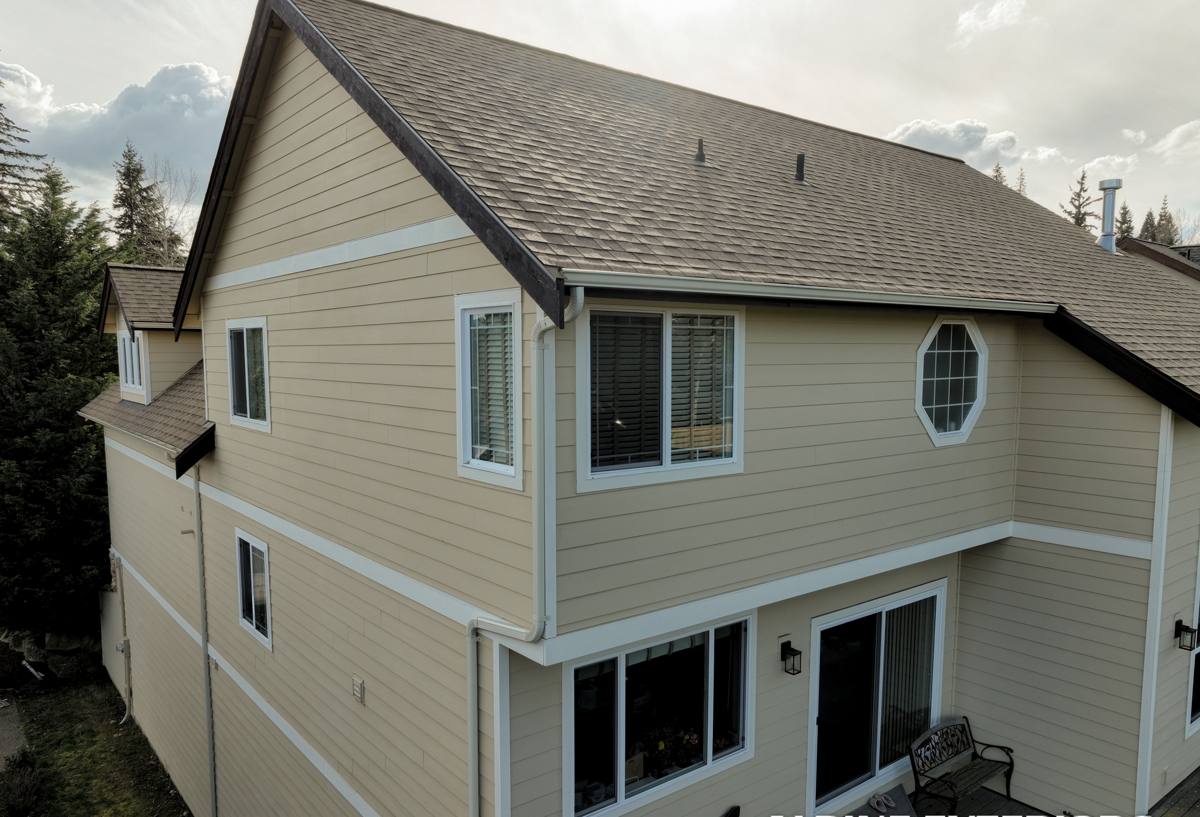
What a Correctly Installed Shingle Roof Includes Here
"Correct" isn't just nailing shingles to plywood in the right pattern. In a wooded, waterfront neighborhood like Edgemoor, a handful of details matter more than they would in a drier climate, and skipping them is usually what shows up as a leak two or three winters later.
Underlayment and Water-Resistant Barrier
A synthetic underlayment (not felt paper alone) gives the deck a second line of defense while the shingles are doing their job, and it matters more here because Bellingham's rain events tend to be prolonged rather than short and heavy. At eaves, valleys, and any low-slope transition, a self-adhering ice-and-water membrane should go down first — not because Edgemoor gets serious ice buildup, but because that same membrane seals around nail penetrations and stops wind-driven rain from working backward under the shingle course.
Ventilation That Matches the Tree Cover
Shaded roofs dry slower. Balanced intake and exhaust ventilation keeps the attic and roof deck from staying damp, which matters for both the wood underneath and the underside of the shingles themselves. Poor ventilation shows up as premature shingle curling and, over time, sheathing rot — problems that have nothing to do with the shingle brand and everything to do with airflow.
Flashing at Every Penetration
Chimneys, skylights, plumbing vents, and roof-to-wall transitions are where the vast majority of roof leaks actually start — not in the open field of shingles. In a salt-air environment, we pay attention to what the flashing is made of and how it's fastened, since the wrong metal or exposed fastener will corrode faster than it should and open a path for water years before the shingles themselves are due for replacement.
Signs an Edgemoor Roof Needs a Look
Most asphalt shingle roofs don't fail all at once — they show warning signs first. In this neighborhood, watch for:
- Moss or algae streaking, especially on the shaded, north-facing slopes under tree cover
- Granules collecting in gutters or at downspout outlets
- Shingles that look cupped, curled at the edges, or have lifted corners
- Dark staining or a "dirty" look that doesn't wash off, which is usually algae rather than surface grime
- Soft spots underfoot near valleys or chimneys (a sign moisture has reached the deck)
- Daylight or water stains visible in the attic near penetrations
Any one of these on its own isn't necessarily an emergency, but ignoring several at once usually means the roof is past the point where a repair alone will hold.
Choosing the Right Shingle for Salt Air and Moss Exposure
Not every asphalt shingle line handles a wooded, waterfront climate the same way. Algae-resistant (AR) granules — copper-infused granules that inhibit the growth of the blue-green algae responsible for those dark streaks — are worth the modest upcost almost everywhere in Whatcom County, and especially under tree cover. Beyond that, the choice usually comes down to lifespan, wind rating, and how much of the shingle's warranty is actually prorated versus full-value.
| Shingle Type | Typical Lifespan | Wind Rating | Moss/Algae Resistance | Best Fit For |
|---|---|---|---|---|
| 3-tab | 15-20 years | Lower (60-70 mph typical) | Only if AR-rated version chosen | Budget-conscious re-roofs, secondary structures |
| Architectural / dimensional | 25-30 years | Higher (110-130 mph typical) | Widely available in AR versions | Most Edgemoor homes; balance of cost and durability |
| Premium / designer | 30+ years | Highest tier available | Standard on most premium lines | Steep or highly visible roofs, longer hold periods |
For most homes in this neighborhood, an architectural shingle with algae-resistant granules is the sensible middle ground — enough wind rating for winter storms off the bay, enough resistance to slow moss and algae growth under tree canopy, and a manufacturer warranty structure that's worth reading closely rather than taking at face value. We'll walk you through what your specific warranty actually covers, since "lifetime" warranties are almost always prorated after the first several years.
Our Process for an Edgemoor Roofing Project
- Inspection. We get on the roof (not just a look from the ground) and check the deck, flashing, ventilation, and shingle condition before recommending repair versus replacement.
- Written estimate. You get a clear scope — materials, tear-off, disposal, and any deck repair contingencies — before any work starts. No surprise change orders for conditions we should have caught up front.
- Tear-off and deck check. Old material comes off down to the deck so we can actually see the plywood or planking underneath and replace any soft or damaged sections, rather than roofing over a problem.
- Underlayment and flashing first. The water-resistant layer and all flashing go in before a single shingle is laid, since that's the layer doing the real work if anything ever gets past the shingles.
- Shingle installation. Installed to manufacturer nailing patterns and exposure specs — the details that actually determine whether the wind rating on the shingle wrapper holds up in a real storm.
- Cleanup and magnetic sweep. Job site and yard cleared of debris and stray fasteners before we consider the project finished.
- Walkthrough and warranty paperwork. We go over what was done, what the manufacturer warranty covers, and what our workmanship warranty covers, in writing.
What Actually Drives the Cost of a Shingle Roof
Every Edgemoor property is a little different, but the same handful of factors tend to move the price up or down on most estimates:
- Roof pitch and access. Steeper roofs and homes with limited driveway or yard access for equipment and disposal take longer and cost more to work on.
- Number of layers to remove. A roof with one existing layer of shingles costs less to tear off than one with two.
- Deck condition. Rot or soft sheathing found during tear-off means replacement plywood — something we flag as a contingency in the estimate rather than a surprise later.
- Shingle tier and AR granules. Architectural and premium lines cost more per square than 3-tab, and algae-resistant versions carry a modest premium over standard granules.
- Flashing and penetration count. Chimneys, skylights, and multiple vent stacks all add labor and material beyond the base square footage.
- Ventilation upgrades. Adding or correcting intake/exhaust venting where the existing setup is inadequate.
A Maintenance Checklist for Edgemoor Homeowners
Between professional inspections, a little seasonal attention goes a long way toward getting the full service life out of a shingle roof in this climate:
- Clear gutters and downspouts at least twice a year — more often if you're under heavy tree cover
- Have moss physically removed rather than pressure-washed, which can strip granules and shorten shingle life
- Trim back branches that overhang the roofline to cut down on shade, debris, and abrasion
- Check the attic after major storms for new staining, daylight, or damp insulation
- Walk the yard after windstorms to check for shingle granules or fragments on the ground
- Schedule a professional inspection every couple of years, or after any major windstorm off the bay
Why It Matters to Hire a Crew That Already Works in Edgemoor
A roofing crew that regularly works this part of Bellingham already knows how tree-shaded, waterfront lots behave differently than a roof out in the open — where moss tends to establish first, how much salt exposure the metal components realistically face, and how Whatcom County's permitting and inspection process works for a re-roof. That's not a small thing when it comes time to warranty a job: a company with a real, ongoing presence in the area is the one that's actually going to be around, and easy to reach, if a question comes up five or ten years down the road. It also means less guesswork on the estimate — we're not learning this microclimate on your roof for the first time.
If you're seeing moss, granule loss, or a roof that's simply getting up in years, we're happy to take a look and give you a straight answer — repair, or replacement, whichever the roof actually needs. Reach out for a free, no-pressure estimate using the form below.