 Bellingham Siding
 Why Lynden Decks Need a Different Approach Than Decks Built Inland
Lynden sits close enough to the Salish Sea and the Nooksack lowlands that decks here take a beating most drier climates never see. Salt-laden air off the coast, driving rain that comes in sideways during winter storms, and a moss season that can stretch from October through April all work against wood and against decking that wasn't built with this specific climate in mind. We've replaced enough failed wood decks around Whatcom County to know that the problems aren't usually about bad carpentry — they're about the wrong material meeting the wrong weather, year after year, until it finally gives out.
Composite decking, installed correctly for this environment, solves most of that. But "composite decking" covers a wide range of products and installation approaches, and not all of them hold up the same way once moss spores and standing moisture get involved. This page is about what actually matters for a composite deck built to last in Lynden.
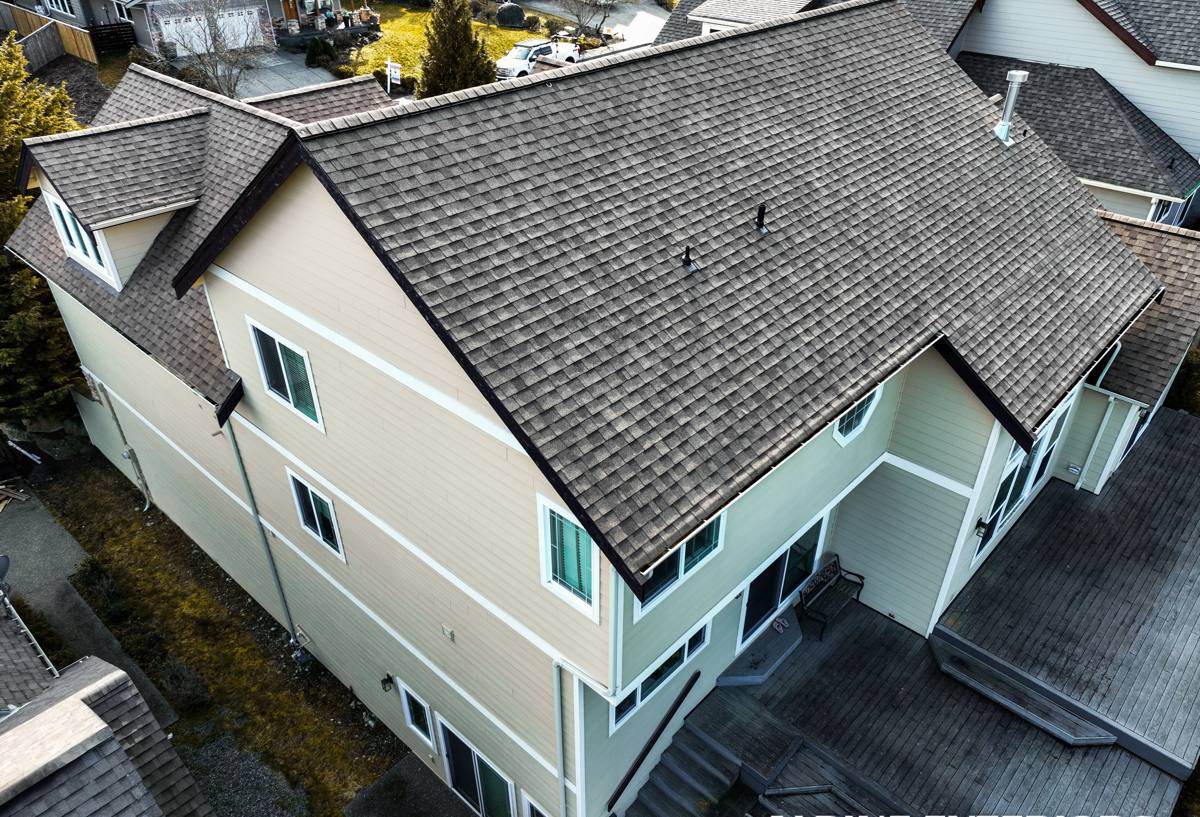
What Bellingham-Area Weather Actually Does to a Deck
Moisture That Doesn't Let Up
Whatcom County gets a long stretch of grey, wet months where a deck surface can stay damp for days at a time. Wood decking soaks that moisture into the fibers, swells, and eventually checks and splinters as it dries and re-wets over and over. Composite boards don't absorb water the way wood does, which is the single biggest reason they perform better here — but the boards still need proper drainage underneath and around them, or you just trade one moisture problem for another.
Moss and Algae Growth
The same damp, shaded conditions that make Whatcom County green also make it a good environment for moss and algae to take hold on any horizontal surface, including deck boards. Cheaper composite products with a smooth, uncapped surface can actually hold moisture and organic debris in a way that encourages growth. Capped composite boards with a textured, engineered surface shed water and resist that buildup far better, which matters a lot more here than it would in a drier region.
Salt Air and Fastener Corrosion
Even well inland from the water, Bellingham's marine air carries enough salt to accelerate corrosion on unprotected metal. Composite boards themselves aren't affected by salt air, but the fasteners, hidden clips, and structural hardware underneath them absolutely are. This is one of the most overlooked failure points on decks built by contractors who don't work this region regularly.
What a Correct Composite Deck Install Involves Here
A composite deck is only as good as what's underneath it. The boards get the attention because they're visible, but the framing, drainage, and hardware decisions are what determine whether the deck is still solid in fifteen years.
- Pressure-treated or engineered framing rated for wet climate exposure, not standard-grade lumber
- Proper joist spacing for the specific composite product being used — composite boards often require tighter spacing than wood
- Stainless steel or coated corrosion-resistant fasteners and hidden fastening systems throughout
- Ventilation gaps and drainage planning underneath the deck so water doesn't pool against framing
- Board gapping set correctly for composite's expansion and contraction in temperature swings
- Flashing where the deck meets the house, so water is directed away from siding and framing, not into it
- A ledger board attachment that's properly flashed and sealed against the structure
Skip any one of these and you can still end up with a deck that looks right for the first year or two before problems show up underneath, where they're expensive to fix.
Choosing the Right Composite Product for This Climate
Not every composite board on the market is built the same way, and the differences matter more in a wet, moss-prone climate than they would somewhere dry. We steer homeowners toward fully capped composite boards — meaning the wood-plastic core is wrapped on all sides in a protective polymer shell — rather than uncapped or partially capped products.
| Feature | Fully Capped Composite | Uncapped / Partially Capped Composite |
|---|---|---|
| Moisture resistance | Sealed on all sides, minimal water absorption | Exposed core can absorb moisture over time |
| Moss/algae resistance | Engineered texture sheds water and debris | More prone to holding moisture where growth starts |
| Fading in low-light, wet winters | UV-stable cap resists color change | Core material can fade or discolor faster |
| Maintenance | Occasional wash-down | May need periodic sealing or more frequent cleaning |
| Warranty structure | Typically longer, stain/fade coverage included | Often shorter or more limited coverage |
| Upfront cost | Higher material cost | Lower material cost |
We won't install a product on a Lynden deck that we know is going to struggle against the moisture load this area gets every winter, even if it saves money up front. That's not a knock on every uncapped product on the market — some homeowners with well-drained, sun-exposed sites do fine with them. It's a judgment call we make based on the specific site, the sun exposure, drainage, and what the deck will actually be dealing with, and we're upfront about that trade-off before you buy anything.
Our Process for a Lynden Composite Deck Project
1. On-Site Assessment
We look at the site itself — sun exposure, drainage, proximity to trees or shade that will hold moisture, and the condition of anything we're replacing. A deck on a shaded, north-facing side of a Lynden property needs different planning than one that gets full afternoon sun.
2. Framing and Structural Plan
If we're replacing an old wood deck, we evaluate the existing framing rather than assuming it's fine to build on top of. Framing that's been sitting under a failing wood deck through several wet seasons often has hidden rot that needs to be addressed before new decking goes down.
3. Product Selection
We walk through composite options with you based on your budget, the look you want, and how the site behaves through the year — not just what's cheapest or what we have in stock.
4. Installation
Framing, flashing, drainage, and fastening get done to spec before a single visible board goes down. This is the part of the job that determines whether the deck is still performing well a decade from now.
5. Final Walkthrough
We walk the finished deck with you, cover basic care and cleaning for the specific product installed, and make sure everything meets what we discussed at the start.
Maintenance Realities for Composite Decking in This Climate
Composite decking is lower-maintenance than wood, not maintenance-free, and that distinction matters more in a moss-prone climate. A homeowner who expects to never touch the deck again after installation is going to be disappointed by moss buildup in shaded corners regardless of how good the product is.
- Sweep off leaves and debris regularly through fall, since trapped organic matter is what feeds moss growth
- Rinse or wash the deck surface a few times a year, more often in shaded areas
- Keep gutters and downspouts near the deck clear so water isn't dumping directly onto the surface
- Check that furniture feet and planters aren't trapping moisture against the boards long-term
- Inspect fasteners and hardware periodically if the deck is more than a few years old
Why Local Installation Experience Matters
A crew that mostly builds decks in drier parts of the state will make reasonable decisions for that climate — and some of those decisions are the wrong ones for a property in Whatcom County. Joist spacing, drainage planning, and fastener selection that would be fine in eastern Washington can leave a Lynden deck fighting moisture problems within a few years. We work on homes throughout the Bellingham area regularly, which means we're making these calls based on what actually happens to decks here, not on generic manufacturer specs written for a national market.
That local knowledge also shapes which products we recommend and which we steer away from. We've seen how different composite lines hold up through several wet Whatcom County winters, and we'd rather tell you that upfront than sell you something that looks good on a showroom sample.
Get a Straight Answer for Your Lynden Property
Every deck site is a little different — sun exposure, existing framing condition, and how the property drains all factor into what we'd recommend. If you're planning a new composite deck or replacing a wood deck that's finally given up, we're happy to take a look and give you an honest read on what it'll take. Reach out for a free, no-pressure estimate using the form below.