 Bellingham Siding
 Why Birchwood Siding Takes More Punishment Than the Spec Sheet Suggests
Birchwood is a quiet, tree-lined residential pocket of Bellingham, and on paper that sounds gentle on a house. In practice, it's not. Whatcom County sits in a marine climate that stacks three separate stresses on top of each other for most of the year: salt-tinged air moving in off Bellingham Bay and the Salish Sea, driving rain that comes in sideways during fall and winter storms, and a moss and algae season that can run eight months or longer under the region's tree cover and persistent damp. Any one of those is manageable. Together, they're exactly the combination that separates siding that looks fine for five years from siding that actually holds up for thirty.
Most siding products aren't designed with all three in mind at once. Vinyl handles rain fine but chalks and warps under UV and temperature swings, and it does nothing to resist moss. Wood and wood-composite products need the moisture kept out perfectly, every year, or they start to swell, cup, and rot from the inside. Salt-laden air accelerates corrosion on fasteners and trim, and constant dampness under tree canopy gives moss and algae exactly the conditions they need to take hold on any porous or textured surface. A siding job in Birchwood has to be engineered for all of that, not just installed and left to the weather.
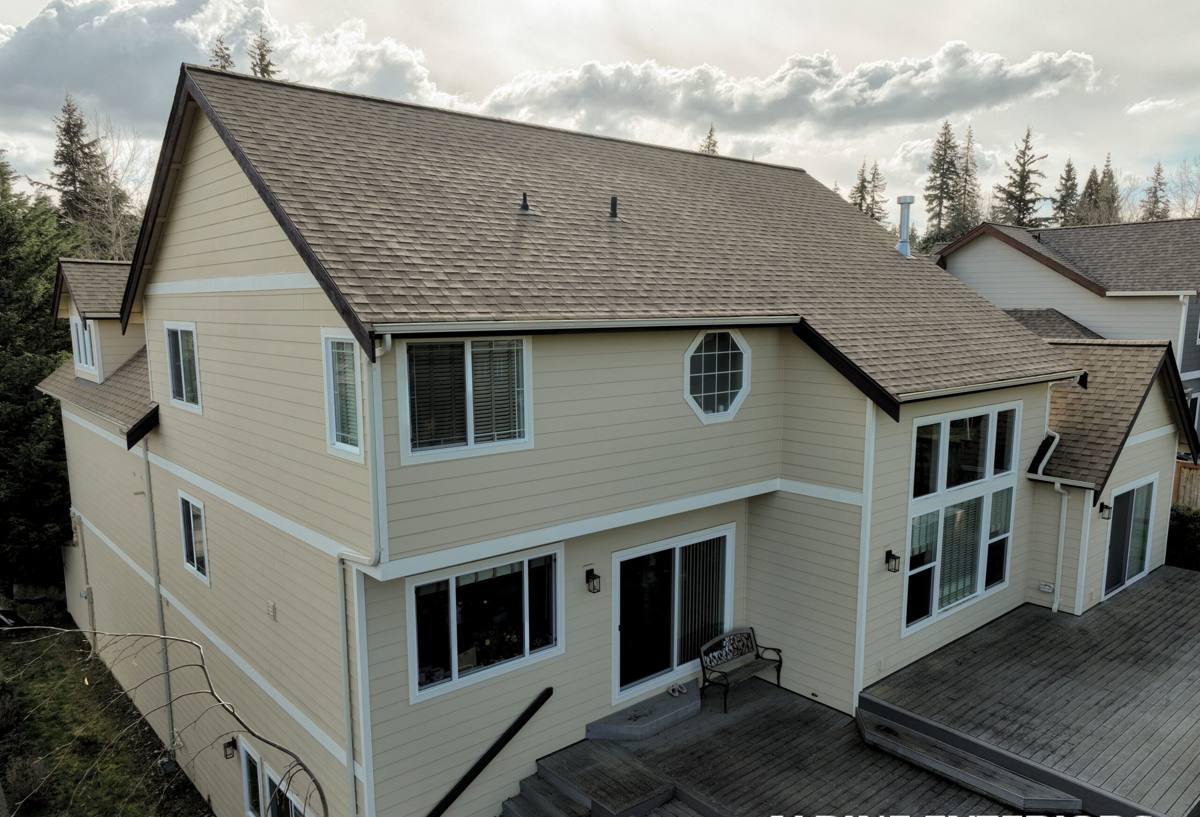
What Fiber Cement Needs to Get Right in This Climate
Moisture Management Happens Behind the Siding, Not On It
The single biggest factor in how well fiber cement siding performs in a marine climate isn't the panel itself — it's what's behind it. A correctly built wall assembly includes a weather-resistive barrier, properly lapped and taped seams, flashed windows and doors, and a drainage plane that lets any moisture that does get past the cladding find its way back out instead of sitting against the sheathing. Skip any of those steps and even the best siding on the market will trap water where you can't see it, and by the time it shows up as a soft spot or a stain, the damage is already done underneath.
Choosing the Right Product Line for Marine Exposure
James Hardie makes climate-specific formulations for exactly this reason. Their HZ5 product line is engineered for regions with freeze-thaw cycles and higher moisture exposure, which describes Whatcom County's winters well — cold, wet, and prone to sudden temperature swings rather than deep, sustained freezes. Using the correct HZ designation for this region isn't a marketing detail; it affects how the fiber cement handles moisture absorption and dimensional stability over decades of Bellingham weather.
Why We Only Install James Hardie in Birchwood
We've made a deliberate decision as a company: we install James Hardie fiber cement siding, and nothing else. Not vinyl, not LP SmartSide, not Cemplank or Allura, not primed spruce or cedar. That's not brand loyalty for its own sake — it's a standard we hold because of what we've seen this climate do to the alternatives.
LP SmartSide is a wood-strand product with real strengths, including impact resistance and workability, but it's an engineered wood product at its core, which means its long-term performance depends heavily on the integrity of its factory-applied coating staying intact everywhere, including cut edges. Cedar and primed spruce are attractive materials with a long track record in the Pacific Northwest, but they're also organic materials that need consistent refinishing to keep moisture and moss from getting a foothold, and Birchwood's damp, shaded pockets are not forgiving of maintenance gaps. Vinyl is low-maintenance in the sense that it doesn't rot, but it's also thin, prone to distortion, and offers essentially no defense against moss growth in its seams and laps. Fiber cement products from other manufacturers exist, but James Hardie's ColorPlus factory finish, engineered HZ climate lines, and warranty backing are, in our professional judgment, the strongest package available for what this region does to a house. Standardizing on one product also means our crews are installing the same system, with the same fastening patterns and clearances, on every job — which is where a lot of siding failures actually originate.
What a Correct Fiber Cement Installation Involves
Fiber cement is not a forgiving material to install badly. It's heavy, it needs to be cut and fastened to spec, and small mistakes in clearance or fastening compound over years of wet weather. A correct installation on a Birchwood home includes:
- Removal of old siding down to the sheathing, with an inspection for hidden rot or water damage before anything new goes up
- A continuous, properly lapped weather-resistive barrier installed per manufacturer specification
- Correctly flashed and sealed windows, doors, and any wall penetrations
- Minimum required clearance between the bottom of the siding and grade, decks, roofs, and other horizontal surfaces to prevent wicking
- Fasteners driven at the correct spacing and depth — not overdriven, which cracks the board, and not underdriven, which leaves it loose
- Properly caulked and painted cut edges wherever field cuts expose raw fiber cement
- Trim and accessory details that shed water away from the wall assembly rather than channeling it inward
Every one of these steps matters more in a climate like Bellingham's than it would somewhere dry. A clearance gap that's an inch too short, or a cut edge that didn't get sealed, might not show a problem for a year or two in Arizona. In Birchwood, with rain most of the fall and winter and damp air the rest of the year, it shows up faster.
Our Process for Birchwood Homeowners
- On-site assessment. We walk the exterior, check the current siding and the condition of the wall assembly underneath where accessible, and look for existing moisture damage, rot, or ventilation issues that need to be addressed before new siding goes on.
- Written estimate. You get a clear scope of work and pricing, including what's included in prep, materials, and finish — no vague allowances that turn into surprise change orders.
- Tear-off and inspection. Old siding comes off, and we address anything we find underneath — soft sheathing, missing flashing, inadequate barrier — before covering it back up.
- Weather barrier and flashing. This is the layer that does the real waterproofing work, and it gets installed to spec, not rushed.
- Hardie installation. Panels or planks go up with correct fastening, clearances, and joint treatment.
- Finish work and cleanup. Caulking, touch-up paint on any field-cut edges, trim details, and a full site cleanup.
- Final walkthrough. We go over the finished job with you before we consider it done.
What Fiber Cement Siding Costs in Birchwood
Every home is different, and we don't quote a job without seeing it, but the factors that drive cost are consistent. This gives you a realistic sense of what moves the number up or down before you get a formal estimate.
| Cost Factor | Why It Matters |
|---|---|
| Tear-off and prep | Removing existing siding and repairing any hidden rot or sheathing damage adds labor before new material even goes up |
| Home size and stories | More square footage and taller walls mean more material, more staging, and more labor time |
| Siding profile | Lap siding, shingle-style panels, and vertical board-and-batten all have different material and labor costs |
| Trim and accessories | Corner boards, window and door trim, and soffit details add to both material and installation time |
| Finish | ColorPlus factory-finished siding costs more upfront than field-painted but eliminates a maintenance cycle |
| Site access | Trees, tight lot lines, decks, and second-story sections common in Birchwood can slow staging and access |
Fiber Cement Compared to Other Siding Options
Here's how the materials most homeowners are weighing actually compare for a marine climate like this one:
| Factor | James Hardie Fiber Cement | Vinyl | Cedar / Primed Wood | LP SmartSide |
|---|---|---|---|---|
| Moisture resistance | High — non-organic, engineered core | Good on its own, poor seam performance | Requires consistent maintenance | Depends on coating integrity at cuts and edges |
| Moss/algae resistance | Strong with proper finish | Weak, especially in seams | Weak without regular treatment | Moderate |
| Salt air durability | Strong | Moderate — can chalk and become brittle | Moderate with upkeep | Moderate |
| Maintenance | Low | Low | High — regular refinishing | Moderate |
| Fire resistance | Non-combustible | Combustible | Combustible | Combustible |
| Typical lifespan | 30+ years with proper install | 20-30 years | Highly variable with maintenance | 20-30 years |
Why Hiring a Crew That Already Works in Birchwood Matters
A siding crew that's worked this neighborhood before knows what to check for before the first board comes off — how much moisture has typically built up behind older siding, where flashing tends to fail on homes of a certain age, and how tree cover and shade patterns in the area affect drying time between rain events. That's not something you can fully substitute with a generic install checklist. It also means we're not learning Whatcom County's permitting requirements or weather windows on your job; we already understand how the local building department handles exterior work and how to sequence a project around the region's rain patterns so the wall assembly isn't left exposed longer than it has to be.
Local experience also shows up in the details that don't make it onto a brochure: knowing which clearance details actually matter on a home backed up against mature trees, or recognizing early signs of moisture intrusion on a style of home common in this part of Bellingham before it becomes a bigger repair.
Maintaining Fiber Cement Siding in a Moss-Prone, Marine Climate
Fiber cement is low-maintenance compared to wood, but "low-maintenance" doesn't mean "no maintenance," especially here. A short routine keeps it performing the way it's supposed to:
- Rinse siding annually to clear pollen, dust, and early moss or algae growth before it establishes
- Keep gutters clear so overflow isn't running down the wall face during heavy rain
- Trim back vegetation and tree limbs that keep sections of the wall shaded and damp longer than the rest of the house
- Check caulking at trim joints, windows, and corners every year or two and re-caulk where it's cracked or pulled away
- Watch for any soft spots, staining, or paint failure at the bottom courses near grade, decks, or downspouts
- Repaint field-cut edges or touch up any chipped finish promptly rather than letting raw material sit exposed
None of this is heavy lifting, but skipping it in a climate that stays damp as much of the year as this one does is how small issues turn into siding replacement a decade earlier than it should have been necessary.
Get a Straight Answer for Your Birchwood Home
If your siding is showing moss, staining, soft spots, or you're just past the point where patching makes sense, we're happy to take a look and give you a straightforward estimate — no pressure, no inflated scare tactics about what's wrong. Fill out the form below and we'll set up a time to walk your property and talk through what your home actually needs.