 Bellingham Siding
 Why Barkley Homes Need More From Their Siding Than the Average House
Barkley sits inside the same demanding weather pattern that shapes exterior work across Whatcom County: salt-laden air drifting in off the water, rain that arrives sideways as often as it falls straight down, and a moss season that runs longer here than in most parts of the state. None of that shows up as a single dramatic event. It shows up years later, as a finish that faded faster than it should have, seams that opened up at the corners, or green staining that keeps coming back on the same shaded wall no matter how many times it's cleaned off.
For siding specifically, that combination is a real test. A product has to hold a factory finish through repeated wet-dry cycling, resist moisture at the seams and cut ends where water actually gets in, and not feed the moss and mildew that thrive on anything shaded and damp for months at a stretch. That's the exact reason we standardized on James Hardie fiber cement and stopped installing anything else. This page is about that one product, on that one job — James Hardie siding, installed correctly, on Barkley homes.
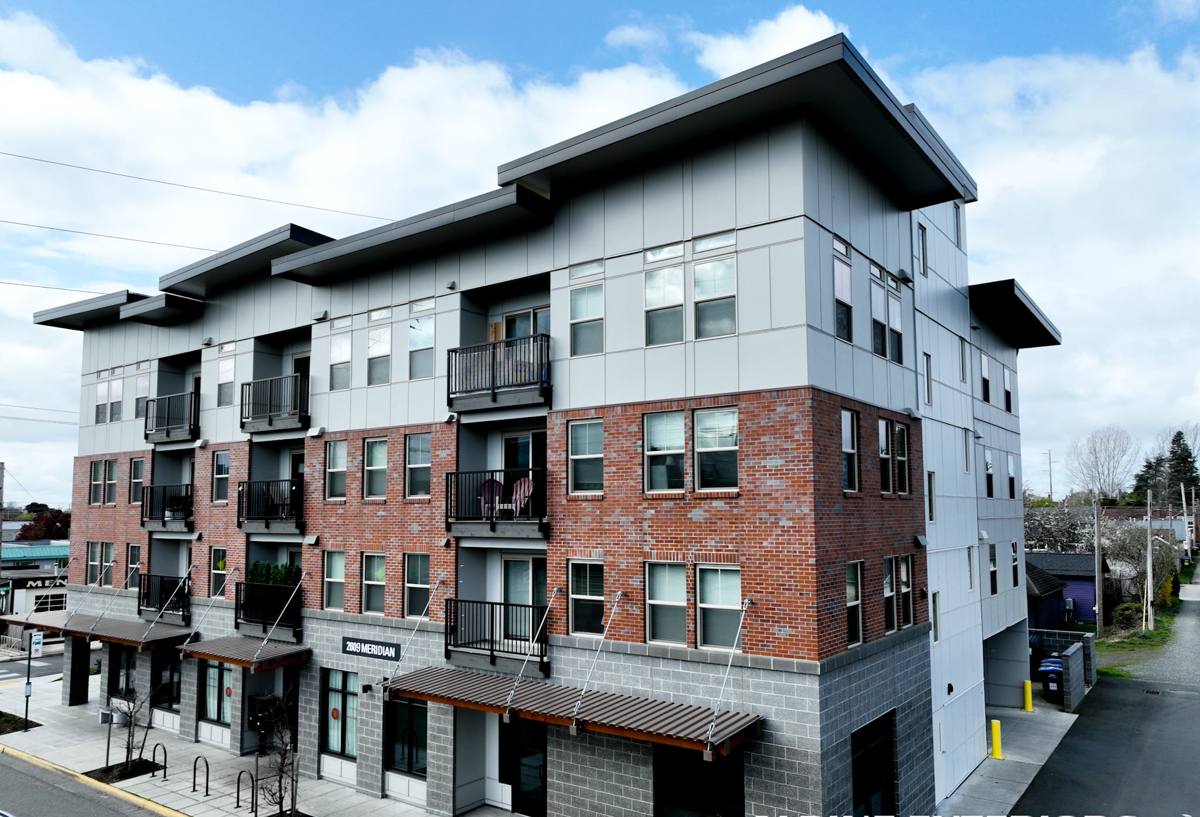
The James Hardie Product System
James Hardie isn't a single board — it's a system of fiber cement products designed to work together, and picking the right pieces for a given home matters as much as the installation itself.
The Core Product Lines
- HardiePlank lap siding: the standard horizontal lap board most homeowners picture when they think of fiber cement siding — available in several width and texture options
- HardiePanel vertical siding: full sheets used for a board-and-batten look or as a modern, clean-lined vertical profile
- HardieShingle siding: individual or panelized shingle profiles for homes that want a shingle-style look without the moisture sensitivity of actual wood shingles
- HardieTrim boards: fiber cement trim used around windows, doors, corners, and fascia so the entire exterior envelope — not just the field siding — is built from the same moisture-stable material
Most Barkley projects end up using a combination of these — lap or panel siding for the main field, with HardieTrim carrying the same durability to every window, corner, and edge where water pressure is actually highest.
ColorPlus Technology
The other half of the system is the finish. James Hardie's ColorPlus Technology is a factory-applied, baked-on finish that goes on before the boards ever reach a job site, under controlled conditions no field-painted surface can match. It's warrantied separately from the substrate against fading and chalking, which matters directly in a climate where UV exposure and constant moisture cycling are exactly what breaks down a lesser finish over time. Hardie boards are also available primed for field painting, but on a coastal, high-moisture property we generally steer homeowners toward ColorPlus for the color retention alone.
HZ5 Climate Engineering: Why the Formulation Matters
James Hardie doesn't manufacture one generic board for the entire country. It engineers different fiber cement formulations for different climate zones, and the Pacific Northwest falls under Hardie's HZ5 engineering — the formulation built for regions with sustained moisture exposure and freeze-thaw cycling, as opposed to the milder, drier-climate formulations used elsewhere. Specifying the correct zone formulation is a small detail most homeowners never think to ask about, but it's part of what "installed correctly" actually means. A board engineered for a dry climate and a board engineered for ours can look identical on the truck and perform very differently ten years into a Whatcom County winter.
What Correct Installation Actually Involves
Fiber cement performs the way it's designed to only when it goes on the way Hardie specifies. That's a longer list of details than most homeowners expect, and skipping any one of them can undercut a product that's otherwise built for exactly this climate.
Fastening and Clearance
Hardie specifies particular fastener types, corrosion resistance, and spacing for lap and panel siding — not a generic nail schedule borrowed from another material. Salt air accelerates corrosion on exposed fastener heads faster than it would inland, so getting this detail right isn't optional trim-level polish; it's what keeps rust streaks from bleeding down the face of the siding within a few years. Clearance above grade, roofing, and hardscape matters just as much: siding installed too close to the ground or a deck surface stays damp longer and is one of the more common causes of early edge deterioration we see on inspections.
Flashing and the Weather-Resistive Barrier
Underneath every Hardie installation is a house wrap or weather-resistive barrier that has to be lapped correctly, and flashing that has to be integrated at every window, door, and penetration so wind-driven rain is directed out and away rather than trapped behind the cladding. In a climate where rain regularly comes in sideways, a flashing detail that would be forgiving somewhere drier becomes the actual line between a wall that stays dry and one that doesn't.
Field Cuts and Painted Edges
Any time a board gets cut on site — at a corner, a window opening, or a butt joint — that cut edge needs to be sealed or field-painted to match, because a raw, unsealed edge is the one place on an otherwise factory-finished board where moisture can get a foothold. It's a step that takes minutes and is easy to skip under time pressure, which is exactly why it's worth confirming with any crew before they start.
Our Process for a Barkley James Hardie Project
- Walk and assess: we look at the existing siding, the sheathing underneath where it's exposed, wall orientation, shade patterns, and any current moisture or moss issues before recommending anything
- Tear-off and substrate check: old siding comes off and we inspect the sheathing and framing underneath for rot or hidden moisture damage before anything new goes on — covering a wet substrate with new siding just hides a problem instead of solving it
- Weather barrier and flashing: house wrap and flashing go in correctly at every window, door, and penetration, lapped to shed water downward and outward
- Hardie installation: boards, panels, or shingles go up with the correct fasteners, spacing, and clearance for this climate, with trim carrying the same standard to every edge
- Finish and seal: any field cuts get sealed or painted, caulk joints are placed only where Hardie specifies rather than as a substitute for proper flashing
- Final walkthrough: we walk the finished job with the homeowner, and warranty registration is handled as part of project close-out
Comparing James Hardie's Siding Profiles for a Barkley Home
Homeowners often come to us already knowing they want fiber cement, but unsure which Hardie profile fits their home. Here's how the main options compare for a typical Barkley property.
| Profile | Best Fit | Local Consideration |
|---|---|---|
| HardiePlank lap siding | Traditional and most craftsman or Northwest-style homes | Most common choice; wide range of textures and exposure widths |
| HardiePanel vertical siding | Board-and-batten or modern exteriors | Fewer horizontal seams for water to track along on exposed walls |
| HardieShingle siding | Homes wanting a shingle-style look without wood's moisture sensitivity | A strong alternative on properties where cedar shingles would otherwise be considered |
| HardieTrim boards | Corners, window and door surrounds, fascia | Keeps the highest water-exposure points on the same durable material as the field |
Choosing Colors and Finishes That Actually Hold Up Here
Color choice on a coastal, high-moisture property isn't purely a style decision. ColorPlus finishes are baked on and warrantied against fading, which matters most on walls that get the most direct sun and salt exposure — those are the surfaces where a lower-quality or field-applied finish shows chalking and color loss first. Darker colors also show dust, pollen, and light surface staining differently than lighter ones in a damp climate, which is worth talking through before committing to a color on the whole house rather than after the crew has already started. We walk homeowners through actual Hardie color samples against their home's orientation and shade pattern, not just a swatch under indoor lighting.
Why a Crew That Already Works Barkley Matters
James Hardie is a well-engineered product on paper, but its real-world performance depends entirely on the installer reading a specific wall correctly — how much direct wind-driven rain it takes on based on which direction it faces, how much shade keeps it damp longer than the wall next to it, and how that should change fastener spacing, clearance, or where extra flashing attention is warranted. A crew that installs Hardie across Barkley and the surrounding Whatcom County area regularly starts recognizing these patterns from one property to the next, rather than treating every home as a first-time guess.
That familiarity also shows up in smaller ways homeowners rarely notice directly: knowing which local walls tend to develop moss first and adjusting ventilation and trim details accordingly, matching touch-up paint accurately years down the line, and giving an honest answer about whether a section of siding needs full replacement or just a targeted repair — because a crew invested in its local reputation has more reason to get that call right than one passing through for a single job.
What to Ask Before Hiring Anyone for James Hardie Siding
- Are they a James Hardie-focused installer, or is Hardie one of several products they install without a strong preference?
- Do they know which HZ climate formulation is correct for a Whatcom County property, and can they explain why?
- Will they inspect and address the sheathing underneath before installing new siding, not just cover it?
- What fastener type and spacing do they use, and how do they account for salt-air corrosion?
- Is the ColorPlus finish warranty separate from the substrate warranty, and do they register both after the job?
- Can they explain how they'll flash and seal your home's specific window and door openings, not just siding in general?
- Are they licensed and insured to do exterior work in Washington State?
The Warranty You Actually Get
James Hardie backs its fiber cement products with a strong, transferable warranty on the substrate, and ColorPlus finishes carry their own separate finish warranty covering fading and chalking. Both are only as good as the installation behind them — manufacturer warranties are written around installation to Hardie's specifications, which is one more reason correct fastening, clearance, and flashing aren't optional details but the foundation the warranty actually rests on. Part of our process is making sure that paperwork is filed correctly when the job wraps up, so the coverage is actually in place if you ever need it.
If you're planning a siding project for a Barkley-area home and want James Hardie installed the way it's meant to be, we're glad to take a look and walk you through what your specific property needs. Reach out using the form below to schedule a free, no-pressure estimate.