 Bellingham Siding
 Why Window Replacement in Sudden Valley Is Different
Sudden Valley sits along Lake Whatcom's shoreline east of Bellingham, tucked into one of the most heavily wooded residential pockets in Whatcom County. That setting is a big part of what makes the neighborhood special, but it also creates conditions that are tougher on windows than what you'll find on an open lot in town. Mature conifer cover means many homes get less direct sun, so glazing, sills, and the siding around window openings stay damp longer after every rain instead of drying out quickly. Whatcom County already runs a long wet season, and the humidity that sits near the lake keeps that moisture around even longer close to shore.
Add in the driving rain that blows through during fall and winter storms off the Salish Sea, and older window assemblies start to show it. A lot of the housing stock in Sudden Valley dates back several decades, and single-pane or early dual-pane units from that era were never built to handle a moss season that can stretch from October into April. Moss and algae here don't stop at the roof and deck — they work into window tracks, weep holes, and exterior trim wherever water isn't shedding and drying the way it should. Salt-tinged marine air moving inland off the bay adds a slow corrosive edge to metal hardware and older aluminum frames on top of all that moisture.
None of this means windows in Sudden Valley need to be exotic or over-built. It means the installation has to get the basics right — flashing, drainage, and material choice — because the margin for error is smaller here than it is on a sunny, open lot a few miles away.
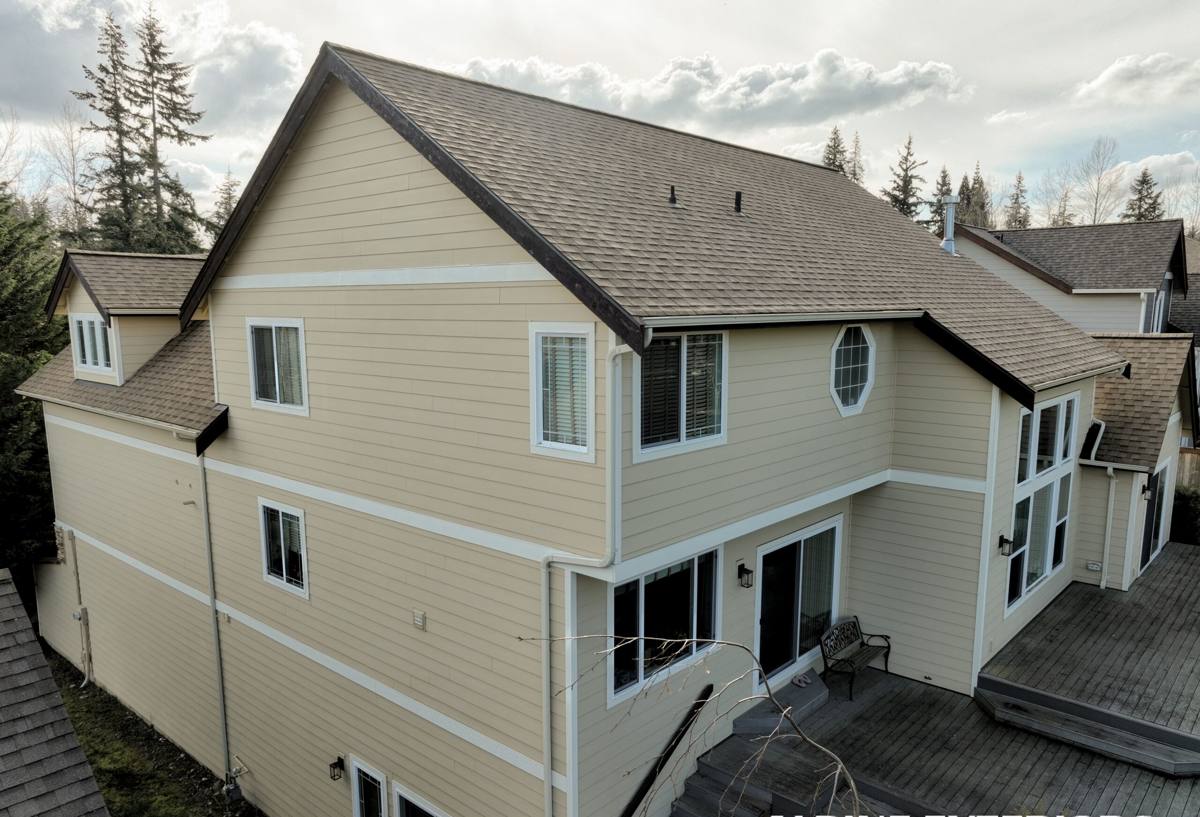
Signs Your Sudden Valley Home Needs New Windows
Most homeowners don't think about their windows until something goes wrong. In this climate, the early warning signs are usually moisture-related. Walk your exterior and check each window against this list:
- Fogging or a milky haze between the panes — a sign the seal has failed and the insulating gas has escaped
- Wood sills or the trim below the window that feel soft, spongy, or show dark staining
- Visible moss, algae, or black streaking in the window track or on the exterior casing
- A draft you can feel near the frame edge on a windy day, even with the window latched
- Windows that stick, won't stay open, or won't lock flush anymore
- Condensation forming on the inside of the glass during cold snaps
- A visible gap or shadow line where the frame meets the siding or trim
- A heating bill that's crept up without any other explanation
Any one of these on its own might just need a repair or a re-caulk. Several of them on the same window, or the same symptom showing up across multiple windows on one side of the house, usually points to a bigger problem underneath — often a flashing detail that was never done correctly to begin with.
What a Correct Window Replacement Job Actually Involves
Tear-Out and Inspection
The old window doesn't just get pulled and swapped. Once it's out, we inspect the rough opening — the framing, the sheathing, and any felt or house wrap around it — for rot, soft wood, or prior water damage that's been hiding behind the trim. In a wet, shaded lot like Sudden Valley, this step catches problems more often than it does on a drier property, and it's the difference between a window that lasts and one that fails again in a few years because it was installed over damaged framing.
Flashing and Water Management
This is the part that matters most and shows the least once the job is done. Every opening gets flashed so that any water that gets behind the siding or trim is directed back out, not into the wall cavity. That means sill pan flashing at the bottom of the opening, properly lapped side and head flashing, and integration with the existing house wrap so water always moves downward and outward — never inward. Skipping or rushing this step is the single most common reason window replacements fail early in a climate like ours.
Insulation and Air Sealing
The gap between the new window frame and the rough opening gets sealed with a proper low-expansion foam or backer rod and sealant — not just caulk smeared over the gap. Overfilling with high-expansion foam can actually bow the frame and cause the window to operate poorly, so this step takes more care than it looks like it should.
Trim and Finish Work
Interior and exterior trim gets reinstalled or replaced, caulked at the right joints, and finished so the whole assembly sheds water the way it was designed to. We also check that the window operates smoothly — opens, closes, and locks without binding — before we call the job done.
Choosing Windows That Hold Up in a Shaded, Wet Microclimate
Frame Material Trade-Offs
There's no single "best" frame material for every home — it depends on your budget, your home's style, and how much upkeep you want to take on. Here's how the common options compare for a property like the ones around Sudden Valley:
| Frame Material | Moisture Tolerance | Maintenance | Typical Cost |
|---|---|---|---|
| Vinyl | Good — won't rot, resists the wet/shade cycle well | Low — occasional cleaning | Lower |
| Fiberglass | Very good — dimensionally stable in temperature and moisture swings | Low | Mid to higher |
| Wood-Clad | Good exterior, but performance depends entirely on how well the cladding and flashing were installed | Higher — interior wood needs periodic attention, cladding needs inspection | Higher |
| Aluminum (older stock) | Poor in this climate — conducts cold, prone to condensation, corrodes over time near salt-tinged air | Higher | Varies |
For heavily shaded, lake-adjacent lots, we generally steer homeowners toward vinyl or fiberglass because they don't depend on a paint or clad finish staying perfect for decades to keep moisture out. Wood-clad windows can still be the right call for a specific look, but we're upfront that they ask more of the homeowner over time — and more of the installer up front, since any flashing mistake behind the cladding is harder to catch later.
Glass and Weatherstripping
A dual-pane, low-E glass package is the standard baseline for this region and makes a real difference in comfort and condensation resistance during cold, damp stretches. Weatherstripping quality matters more than people expect — it's what keeps driving rain and wind-driven drafts out during the storms that come through in fall and winter. Cheap weatherstripping is one of the first things to fail in a climate that cycles between wet and freezing.
Our Window Replacement Process
- Estimate and assessment. We walk the exterior with you, look at each window from outside and in, and talk through what's actually wearing out versus what's cosmetic.
- Measurement and ordering. Once you approve a plan, we take precise measurements for each opening and order the windows to spec — no generic sizing.
- Site prep and protection. We protect flooring, landscaping, and anything nearby before removal starts.
- Removal and inspection. Old units come out, and we check the rough opening for hidden rot or water damage before anything new goes in.
- Installation, flashing, and sealing. The new window is set, flashed, insulated, and sealed following the sequence that keeps water moving out, not in.
- Trim and finish. Interior and exterior trim is finished to match your home.
- Cleanup and walkthrough. We clear debris, test every window with you, and answer questions before we consider the job finished.
What Affects the Cost of Window Replacement in Sudden Valley
Every home is different, and we'll never quote a firm number without seeing the actual windows and openings. That said, these are the factors that most often move the price up or down:
| Factor | Why It Matters |
|---|---|
| Number and size of windows | More openings and larger units mean more material and labor |
| Frame material chosen | Vinyl, fiberglass, and wood-clad all carry different material costs |
| Hidden rot or framing repair | Damaged sheathing or framing found during tear-out needs to be fixed before the new window goes in |
| Site access | Steep driveways, tree cover, or limited staging space on a wooded lot can add time |
| Trim and siding tie-in | Matching existing trim profiles or repairing surrounding siding adds scope |
| Permitting | Depending on scope, local permitting may apply and is factored into the timeline |
We'd rather walk you through these factors up front than surprise you with change orders mid-project. If we find something during tear-out that changes the scope — like rot behind an old window that wasn't visible beforehand — we stop and talk to you before moving forward, not after.
Why Hire a Crew That Already Works in Sudden Valley
A window installer who's worked in Sudden Valley before knows what to expect before they even pull the old unit. They know the housing stock tends to run older, that tree cover means longer dry-out times are a factor in scheduling and sequencing, and that many homes in the community fall under shared association guidelines that can affect exterior changes — something worth checking before you finalize a window style or color if your home is part of that association. That familiarity saves time and avoids surprises.
It also matters for something less obvious: trust. Sudden Valley is a tight-knit community, and a lot of the work that happens there comes from neighbors who've seen a crew's work firsthand rather than an ad. We'd rather earn that kind of reputation by doing the flashing right and showing up when we say we will than by cutting corners to hit a lower number.
Keeping New Windows Performing Through Whatcom County Winters
A correctly installed window should need very little from you, but a few habits go a long way in a shaded, wet setting like this one:
- Keep gutters and downspouts above and beside windows clear so overflow doesn't run down onto the frame and trim
- Trim back vegetation that's crowding a window — better airflow means faster drying between rains
- Rinse window tracks and weep holes periodically so moss and debris don't build up and block drainage
- Check exterior caulk lines once a year, especially after a hard winter, and touch up anything that's cracked or pulled away
- Wipe down interior sills during cold snaps if you notice condensation, so moisture doesn't sit against the wood
None of this is a heavy lift, but skipping it is how a well-installed window ends up with the same moss and moisture problems as the one it replaced.
Let's Talk About Your Windows
If your windows are fogging, sticking, drafty, or just tired-looking, we're happy to come take a look and give you an honest read on what's actually going on — no pressure, no upsell. Fill out the form below for a free estimate, and we'll walk your home the same way we'd walk our own.