 Bellingham Siding
 Siding That Has to Work in South Hill's Climate, Not Just Look Good on Day One
South Hill sits close enough to Bellingham Bay that salt-laden air is a real factor in how exterior materials age, and far enough into the Pacific Northwest's wet season that homes here spend months at a time under damp, low-light conditions. That combination — salt air, driving rain off the water, and a long moss season that can run from fall through spring — is hard on siding. It's hard on the fasteners, hard on the paint film, and hard on any product that isn't dimensionally stable when it gets wet and dries out again, over and over, for years.
We install James Hardie fiber cement siding exclusively. Not as one option among several, but as the only siding system we put on homes. This page is about what that means specifically for a South Hill house: what the climate actually does to siding over time, what a correct Hardie installation looks like in this setting, and why the installation details matter more here than they would in a drier climate.
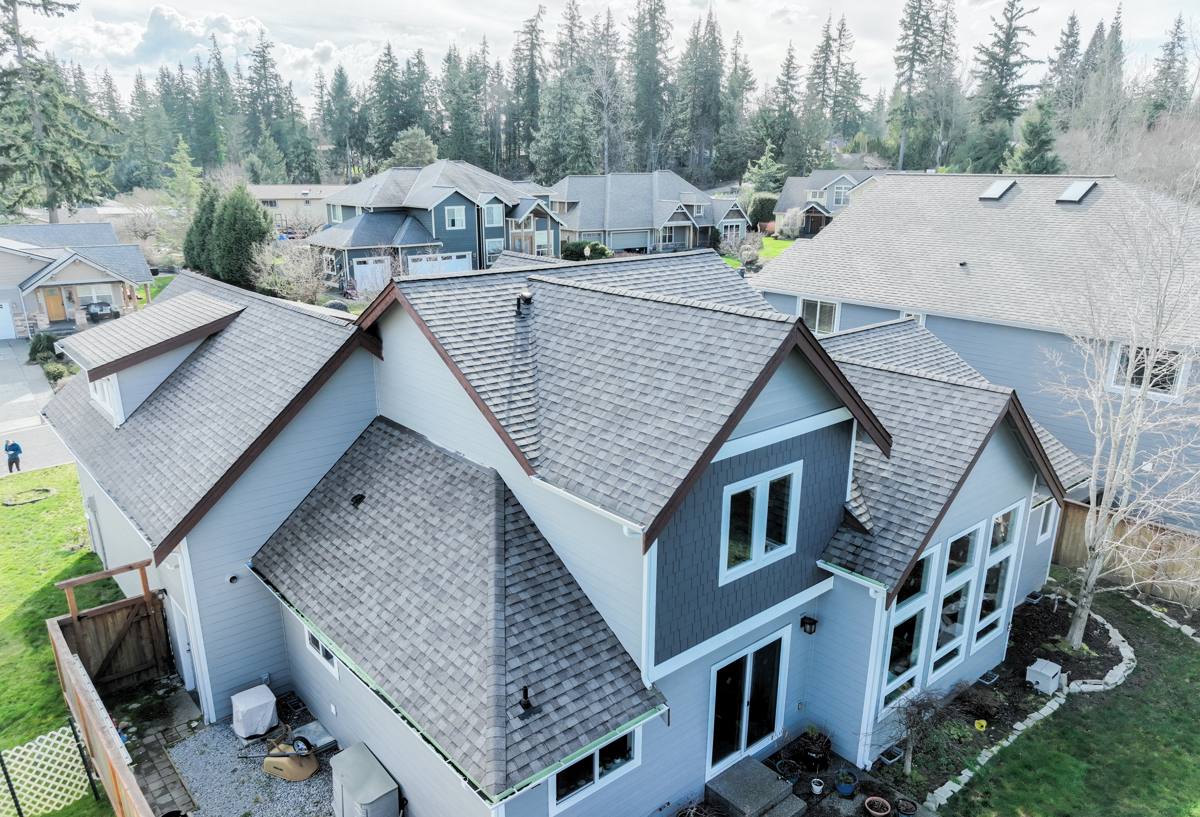
What Whatcom County's Climate Actually Does to Siding
Salt Air and Corrosion
Homes closer to the water deal with airborne salt that settles on exterior surfaces and accelerates corrosion of anything metal — fasteners, flashing, trim edges. Over years, this can undermine even well-installed siding if the wrong hardware or flashing details were used. It doesn't destroy fiber cement itself, but it will find every weak point in the metal components around it.
Driving Rain
Wind off the bay doesn't just drop rain straight down — it drives it sideways into wall assemblies, which puts real pressure on every seam, joint, and penetration in the siding. A house with sloppy caulk lines, missing kick-out flashing, or butt joints that weren't properly backed will start showing water intrusion at those exact spots, sometimes years before it's visible from the street.
The Long Moss Season
Extended damp, shaded conditions are ideal for moss, algae, and mildew growth on exterior surfaces. Products that absorb moisture or lack a durable factory finish tend to host more biological growth over time, which then requires ongoing cleaning and repainting to manage. This is one of the most visible, recurring maintenance headaches for homeowners in this area, and it's largely a function of what the siding is made of and how it's finished.
Why We Install James Hardie and Nothing Else
James Hardie fiber cement is engineered from cement, sand, and cellulose fibers, and it doesn't absorb and swell with moisture the way wood-based products can. That dimensional stability matters directly in a climate like South Hill's, where siding is wet more often than it's fully dry for large parts of the year. Hardie's ColorPlus factory finish is baked on under controlled conditions and backed by its own finish warranty, which means a more consistent, durable color layer than field-applied paint — and a finish that holds up better against the fading and chalking that constant moisture and UV cycling can cause.
Hardie also makes climate-engineered product lines (their "HZ" series) formulated for specific regional conditions rather than one generic formula nationwide. For a house in Whatcom County, that regional engineering is a genuine advantage over a one-size-fits-all product.
We don't install LP SmartSide, vinyl, Cemplank, Allura, primed spruce, or cedar. Each of those has legitimate uses in the right context, but for the conditions South Hill homes actually face — sustained moisture, salt exposure, and heavy moss pressure — we've standardized on one product system because it's the one we're confident holds up to spec, year after year, without the maintenance burden or moisture-related failure points we've seen with the alternatives.
What a Correct James Hardie Installation Involves
The product itself is only part of the story. Most siding failures we get called to look at — regardless of brand — trace back to installation shortcuts, not the material. James Hardie publishes detailed installation specifications, and following them isn't optional if you want the warranty to mean anything.
- Weather-resistive barrier and rainscreen detailing — a properly installed water-resistive barrier, with attention to how it integrates with a drainage plane so incidental moisture behind the siding can escape rather than sit against the sheathing.
- Correct fastener type and placement — corrosion-resistant fasteners driven at the manufacturer-specified location and depth, not overdriven or underdriven, and never through both boards at a joint.
- Proper clearances — minimum gaps at grade, roofline, decks, and other siding-to-hardscape transitions so water isn't trapped against the bottom edge of the board.
- Flashing at every penetration — windows, doors, hose bibs, light fixtures, vents — each one is a place water can get behind the siding if it's not flashed correctly.
- Butt joint treatment — joints caulked and backed per spec, or better yet minimized through smart panel layout, since joints are the single most common failure point in driving-rain conditions.
- Factory-cut and factory-primed edges — any field cuts sealed per Hardie's specifications so the cut edge doesn't become a moisture entry point.
Skipping any one of these doesn't necessarily cause a visible problem right away. It shows up two, five, or ten years later — as a soft spot at a corner board, staining below a window, or a section of siding that's held moisture long enough to host moss and mildew no amount of cleaning will fully remove.
How Our Process Works for a South Hill Project
1. On-Site Assessment
We walk the exterior, note existing moisture damage, evaluate the current water-resistive barrier and flashing (if it's being reused or needs replacement), and check for any structural issues under the current siding before quoting the job.
2. Product and Line Selection
We help you choose the right Hardie board profile (lap, shingle-style panel, or vertical) and color line for the home and the neighborhood, factoring in sun exposure and shading, which affects both fading and moss growth over time.
3. Tear-Off and Prep
Old siding comes off, sheathing gets inspected for rot or damage, and any compromised material is repaired before anything new goes up. This step is where a lot of hidden moisture problems from the old installation get found and fixed.
4. Weather Barrier and Flashing Installation
This is the layer that does the real waterproofing work — the siding itself is the second line of defense. We install the water-resistive barrier and flashing to spec before a single piece of Hardie board goes on.
5. Hardie Board Installation
Installed per James Hardie's published specifications for fastening, clearances, and joint treatment, as outlined above.
6. Final Inspection and Walkthrough
We walk the finished job with you, checking caulk lines, paint touch-ups at any field cuts, and confirming clearances are correct before calling it done.
Why a Crew That Already Works South Hill Matters
Installation specs are the same on paper everywhere, but judgment calls change based on what a house actually faces. A crew that's worked other homes in South Hill and nearby Bellingham neighborhoods knows which orientations catch the worst of the driving rain, which yards stay shaded and damp long enough to need extra attention to moss-resistant detailing, and which older homes in this area tend to have specific sheathing or moisture issues under the existing siding. That local pattern recognition doesn't replace following the manufacturer's spec — it's what tells you where to pay extra attention within that spec.
Cost Factors for a South Hill Hardie Project
Every home is different, but the factors that move the price on a James Hardie project are fairly consistent. We won't quote a number without seeing the house, but here's what typically drives cost up or down:
| Factor | Effect on Cost |
|---|---|
| Extent of tear-off and any rot repair found underneath | Hidden damage repair adds cost but is essential to a lasting install |
| Board profile (lap vs. shingle-style panel vs. vertical) | More detailed profiles and trim work increase labor time |
| Home size and number of stories | More surface area and access complexity increase cost |
| Number of windows, doors, and penetrations | Each one requires flashing work, adding labor |
| ColorPlus factory finish vs. field-painted after install | Factory finish costs more upfront but reduces long-term repainting |
| Site access and property layout | Tight lots or difficult staging areas can add time |
Signs Your South Hill Home Might Need New Siding
- Persistent moss or algae growth that returns quickly after cleaning
- Soft, spongy spots when you press on the siding, especially near the bottom edges or corners
- Visible warping, buckling, or gaps opening up at joints and panel edges
- Paint that's peeling, bubbling, or chalking heavily despite being recently painted
- Staining or discoloration below windows, hose bibs, or other penetrations
- Rising energy bills that suggest the wall assembly isn't sealing the way it should
Any one of these on its own isn't necessarily an emergency, but a few of them together on an older home usually means the siding and the moisture barrier behind it are due for a real evaluation.
What to Expect From Your Estimate
If you're considering James Hardie siding for a South Hill home, we'll come look at the house, talk through what we see, and give you a straightforward estimate — no pressure, no inflated scare tactics about your current siding. If your existing siding still has useful life left, we'll tell you that too. Reach out for a free estimate and we'll walk the property with you.