 Bellingham Siding
 Why Silver Beach Siding Wears Differently Than You'd Expect
Silver Beach homes sit inside one of the more demanding microclimates in Bellingham. The combination of salt-laden marine air drifting in off the water, driving rain that comes in sideways during winter storms, and heavy tree cover that keeps north- and east-facing walls shaded for most of the day adds up to siding that ages faster than the manufacturer's spec sheet suggests. Salt air is corrosive to exposed fasteners and metal trim long before most homeowners notice anything wrong with the siding itself. Driving rain finds its way into any gap at a seam, corner, or trim board, especially on walls that take the brunt of southwest storms. And shade from mature trees means water sits on siding longer after every rain instead of drying off in an hour or two of direct sun.
None of that is unique to one house. It's a pattern we see across this part of Bellingham, and it's the reason a repair here needs to account for more than just the visible damage. A patch that would hold up fine in a drier, sunnier neighborhood can fail within a season or two on a shaded, wind-exposed Silver Beach wall if it isn't done with the local conditions in mind.
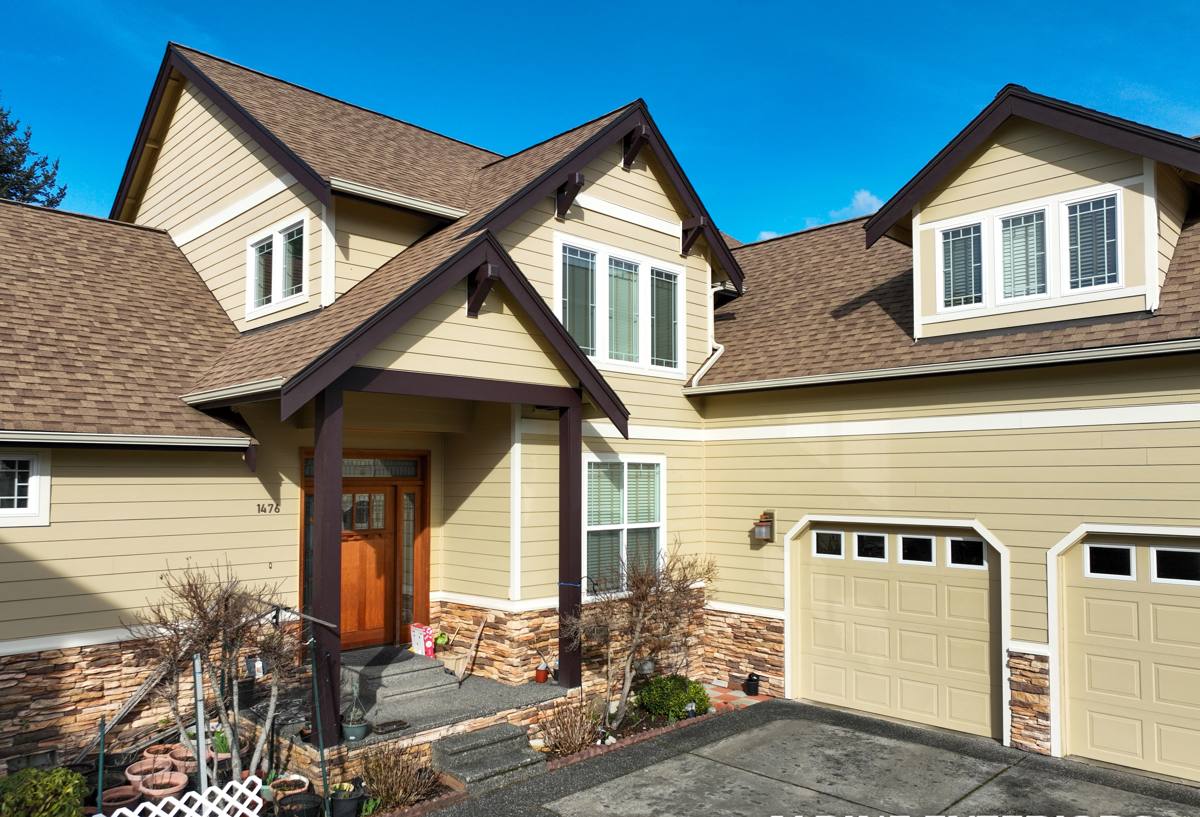
Early Warning Signs Worth a Call, Not a Wait
Siding damage in this climate rarely announces itself all at once. It usually starts small and gets worse quietly, behind the wall, before it shows up as something a homeowner can see from the driveway. Catching it early is almost always the difference between a repair and a much larger project.
- Soft or spongy spots when you press on a board, especially near the bottom edge or around window and door trim
- Paint that's bubbling, peeling, or alligatoring in patches rather than evenly across the whole wall
- Dark streaking, green or black moss growth, or a persistently damp look on shaded sections
- Visible gaps opening up at seams, corners, or where siding meets trim, flashing, or the foundation
- Boards that look warped, bowed, or slightly separated from the wall
- Nail heads popping through the surface or fasteners showing rust staining
- A musty smell near an exterior wall, or a noticeable draft in that part of the house
Any one of these on its own might be minor. Two or three showing up in the same area of the house usually means moisture has been getting behind the siding for a while.
What a Correct Repair Actually Involves
The biggest difference between a repair that lasts and one that fails again in a year or two isn't the patch itself, it's whether anyone bothered to find out why the damage happened in the first place. A board that's rotted or a seam that's failed is usually a symptom, not the root cause. Before we touch a piece of siding, we're looking at where water is actually getting in, whether it's a caulking failure, a flashing detail that was never installed correctly, a nail placed in the wrong spot, or grade and drainage issues at the base of the wall.
Why "Just Caulk It" Doesn't Fix the Real Problem
Caulk is a maintenance item, not a repair strategy. It's meant to seal a joint that's otherwise built correctly, not to hold back water that's finding a path through a structural gap or a missing piece of flashing. Caulking over a symptom without addressing what's behind it usually buys a homeowner one more wet season before the same spot fails again, often worse than before because the moisture had somewhere new to travel while it was sealed in.
A correct repair means removing the damaged material, checking the condition of the water-resistive barrier and sheathing underneath, correcting whatever let water in, and only then installing new siding matched to what's already on the wall. If the sheathing underneath is compromised, that gets addressed before anything new goes back up. Skipping that step is how a $600 repair turns into a $6,000 one two years later.
Repair or Replace: How We Make That Call
Not every damaged section needs a full re-side, and not every homeowner needs to be sold one. We look at how localized the damage is, what's happening structurally behind it, and how the rest of the siding on the house is holding up before recommending either path.
| Situation | Usually a Repair | Usually a Replacement |
|---|---|---|
| Extent of damage | Isolated to one or two sections or walls | Spread across multiple walls or the whole exterior |
| Underlying sheathing | Sound once the leak source is fixed | Soft, rotted, or compromised in several areas |
| Age of existing siding | Still well within its expected service life | Nearing or past the end of its useful life |
| Cause of damage | A single identifiable failure point | A systemic issue, like a failed original installation |
| Color and product match | Existing ColorPlus finish or profile still available | Discontinued color or profile with no reasonable match |
We'll always tell you honestly which category your situation falls into, including when a repair is genuinely the right call and a full replacement would be overkill.
Why Every Repair We Do Uses James Hardie Fiber Cement
We install and repair with James Hardie fiber cement exclusively. We don't work with vinyl, LP SmartSide, Cemplank, Allura, primed spruce, or cedar, and that standard applies to repair work the same as new installs. It's a deliberate choice, not a brand preference for its own sake.
In a climate like this one, the products differ most in how they handle water and time. Vinyl expands and contracts with temperature swings and can crack or warp at fastener points over the years, which matters when you're trying to patch a section decades after the original install. Engineered wood products like LP SmartSide are wood-based and depend heavily on an intact factory coating and correct field sealing at every cut edge; once that coating is compromised in a repair area, the underlying material is exposed to exactly the kind of sustained moisture this neighborhood gets. Cedar and primed spruce need ongoing paint and sealant maintenance to keep water out at all, and that maintenance burden only grows with age. James Hardie fiber cement is non-combustible, dimensionally stable, and factory-finished with ColorPlus coating that's baked on rather than field-applied, which matters enormously for a repair: a matched Hardie patch weathers at the same rate as the surrounding siding instead of aging visibly differently within a year or two.
If your home currently has a different siding product and the damaged section needs work, we'll be straightforward with you about the trade-offs of patching that material versus what it would take to convert the affected area to fiber cement. We won't tell you a vinyl or wood repair is a problem it isn't, but we also won't install something we don't stand behind for the long term.
Our Process for a Silver Beach Repair Call
- Free on-site assessment. We look at the damage in context, not in isolation, checking nearby trim, flashing, and grade for related issues before recommending anything.
- Diagnose the moisture source. If there's any sign water got behind the siding, we identify where and confirm the extent before quoting the work.
- Written scope and estimate. You get a clear explanation of what's being repaired, why, and what it costs, with no pressure to upsell into a full replacement you don't need.
- The repair itself. Damaged material comes out, the wall assembly underneath is checked and corrected as needed, and new James Hardie material goes in matched to your existing color and profile.
- Final walkthrough. We show you exactly what was done and what to watch for going forward, especially in a shaded or exposed area that's more prone to future wear.
What Drives the Cost of a Siding Repair
Repair costs vary more than replacement costs do, because so much depends on what's found once the damaged material comes off the wall. A few factors consistently move the price more than homeowners expect.
| Factor | Why It Matters |
|---|---|
| Hidden sheathing damage | Rot found behind the siding has to be addressed before new material goes up, adding labor and materials |
| Wall accessibility | Second-story walls, tight side yards, or areas requiring staging cost more to access safely |
| Color and profile matching | Matching an older ColorPlus color or a discontinued plank profile can take extra sourcing time |
| Extent of the affected area | A single board is a different scope than a full corner or wall section |
| Root cause corrections | Fixing a flashing or grading issue that caused the damage adds work beyond the siding itself |
We won't know your exact scope until we've had eyes on the damage, but we'll always walk you through which of these factors are in play before any work starts.
Why Hiring a Crew That Already Works This Neighborhood Matters
Siding repair done right depends on understanding how a specific wall behaves over a full year, not just how it looks on the day of the estimate. Crews that regularly work Silver Beach and the surrounding Bellingham neighborhoods have a working sense of which walls take the worst of the winter storms, how much shade slows drying on a given exposure, and where moss and moisture problems tend to start first in homes of a similar age and construction. That local pattern recognition shortens the diagnosis and reduces the chance of a repair that addresses the symptom but misses the cause.
It also means faster response when something needs attention and a contractor who's easy to reach again if a question comes up after the work is done. For a repair, where the quality of the diagnosis matters as much as the quality of the patch, that local familiarity is worth more than it sounds like on paper.
If you're seeing early signs of siding trouble on a Silver Beach home, or you already know there's a spot that needs attention, we're glad to take a look and give you a straight, no-pressure assessment of what it needs. Use the form below to request a free estimate.