 Bellingham Siding
 Why Sudden Valley Puts Extra Demands on Siding
Sudden Valley sits in a pocket of Whatcom County that behaves differently than a lot along the water or out in the open sun. Homes here are tucked into tree cover near Lake Whatcom, and that canopy changes everything about how siding ages. Shade means slower drying times after rain. Slower drying means more days per year where wood-based siding, house wrap, and even paint film are sitting damp instead of shedding water and moving on. Add in the lake's own humidity and the morning fog that settles into low, wooded lots, and you get a microclimate that's harder on exterior materials than a straightforward "rainy Pacific Northwest" description would suggest.
Marine air off Bellingham Bay and the greater Puget Sound region also reaches inland through this county more than people expect, especially in winter storm patterns. It doesn't hit Sudden Valley the way it hits a waterfront property, but it's part of why fasteners, flashing, and trim hardware throughout Whatcom County need to be corrosion-resistant, not just weather-resistant. Combine that broader regional exposure with Sudden Valley's local shade-and-moisture profile, and you end up with siding conditions that are genuinely tougher than the county average, not easier just because the lots aren't on open water.
The Moss Problem Specifically
Moss doesn't just grow on roofs. On siding, it establishes in seams, behind trim, at butt joints, and anywhere caulking has started to fail or water is slow to drain. In a heavily wooded community like Sudden Valley, moss season isn't a few weeks — it's most of the year. Once moss gets a foothold, it holds moisture directly against the substrate underneath the paint or finish, which is exactly the condition that causes rot in wood-based products and accelerates finish failure on anything not engineered to handle sustained dampness.
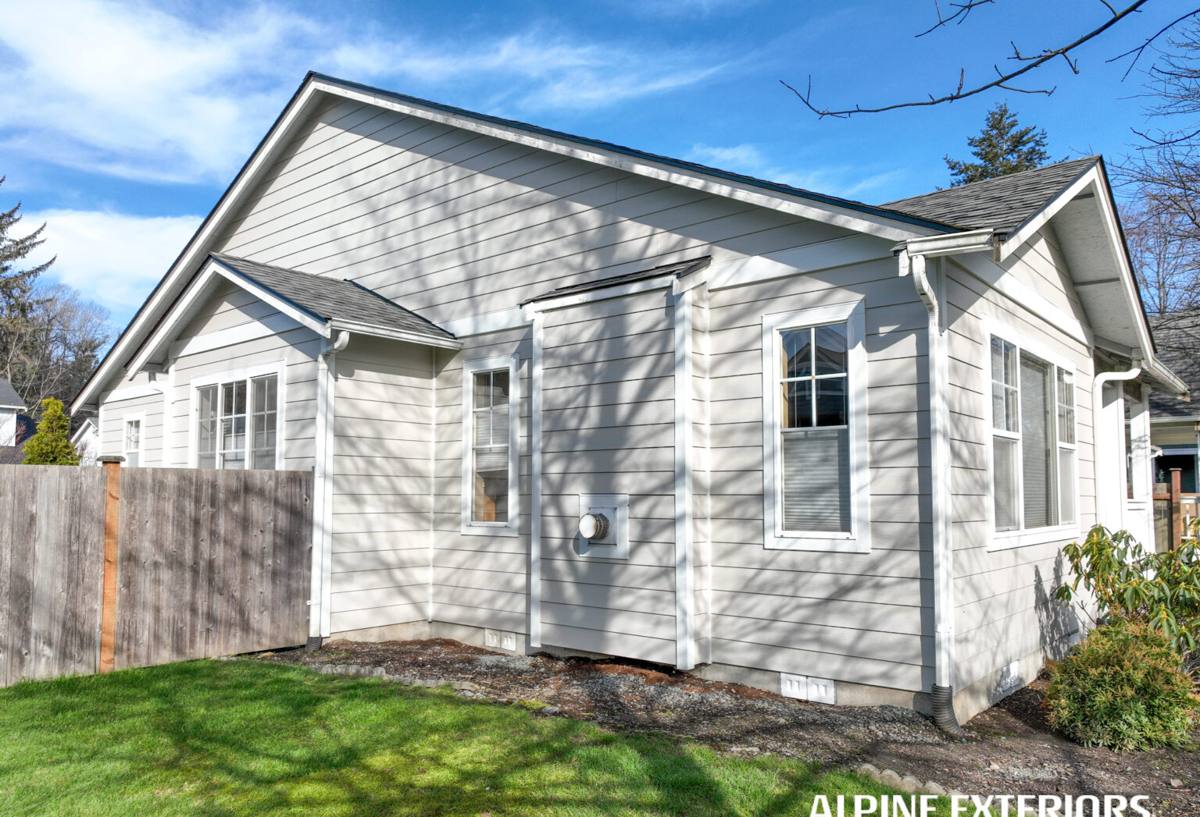
How to Tell Your Siding Is Actually Due
Homeowners in shaded, lake-adjacent lots often assume streaking or green discoloration is just a cosmetic nuisance to pressure-wash away. Sometimes that's true. Other times it's the first visible sign that the siding underneath is losing its ability to shed water. A few checks worth doing before you decide whether you're looking at a cleaning job or a replacement job:
- Press a screwdriver tip gently into siding near the bottom courses, corners, and under windows — if it sinks in or feels soft, that's rot, not just surface grime
- Look for boards that have visibly cupped, bowed, or separated at the seams
- Check for paint that's bubbling or peeling in sheets rather than just fading evenly
- Note any siding that stays visibly damp or dark for days after a rain, even when nearby areas have dried
- Look behind gutters, downspouts, and at roof-to-wall transitions for staining or soft trim — these are common leak points that show up as siding damage
- Check whether moss or algae keeps returning within a few months of cleaning, which usually points to a moisture problem, not just a growth problem
If you're seeing more than one or two of these, it's worth a proper inspection before more of the wall assembly is compromised. In a wooded, shaded lot, damage that starts small tends to spread faster than it would on a sunnier, more exposed home.
What a Correct Replacement Actually Involves
Siding replacement isn't just pulling off old boards and nailing up new ones. In a moisture-heavy, shaded setting like Sudden Valley, the parts you don't see afterward matter more than the parts you do.
Water Management Comes First
Before any new siding goes up, the wall needs a water-resistive barrier installed correctly — lapped the right direction, sealed at seams, and integrated with flashing at every window, door, and penetration. This is the layer that actually keeps water out of the wall assembly; the siding itself is the second line of defense, not the first. On a shaded lot where surfaces stay damp longer, gaps or shortcuts in this layer show up as problems years sooner than they would on a drier property.
Flashing and Drainage Detail
Every horizontal trim piece, window head, and butt joint needs to shed water outward, not trap it against the wall. This is also where a rainscreen or drainage gap behind the siding earns its keep — it gives any moisture that does get past the surface a path to drain and dry instead of sitting against the sheathing. In a community with heavy tree cover and slower drying conditions, that drainage gap isn't a luxury upgrade; it's the difference between siding that lasts decades and siding that starts failing from the back side within a few years.
Fastening and Clearances
Correct fastener type, spacing, and depth affect how well the siding holds up to the swelling and drying cycles that come with fluctuating moisture. Ground clearance and gaps at decks, patios, and grade also matter more here — anywhere soil or mulch sits close to the wall becomes a moisture and pest entry point, and shaded, damp lots make that worse.
Why We Install James Hardie and Nothing Else
We standardized on James Hardie fiber cement siding for every project we take on, and in a place like Sudden Valley that decision isn't theoretical — it's about what actually survives a shaded, humid, moss-prone lot without constant upkeep.
Fiber cement doesn't feed rot the way wood-based products can. It's not a food source for moss or fungus, and it holds up to repeated wet-dry cycles without swelling, cupping, or delaminating the way engineered wood products can when a seal gets compromised. Hardie's factory-applied ColorPlus finish is baked on under controlled conditions, which gives it better adhesion and fade resistance than field-applied paint — a real advantage in a spot where surfaces stay damp longer and paint film is under more stress. Hardie also builds climate-specific HZ product lines engineered for exactly this kind of high-moisture, freeze-thaw Pacific Northwest exposure, rather than a one-size-fits-all formulation.
It's also non-combustible, which matters given Whatcom County's dry-season wildfire risk in wooded, tree-lined communities — a real consideration for a lot surrounded by fir and cedar canopy. And the transferable warranty backing the product is a meaningful protection for a material investment meant to last the life of the home, not just the first owner.
We won't install LP SmartSide, vinyl, Cemplank, Allura, or primed spruce and cedar siding. Each of those has legitimate uses somewhere, but none of them hold up the way we require for the conditions we see on jobs in this area, and we'd rather turn down work than install something we don't stand behind.
Material Comparison for a Lot Like This
| Factor | Wood-Based / Engineered Wood | Vinyl | James Hardie Fiber Cement |
|---|---|---|---|
| Moisture in shaded, low-drying conditions | Vulnerable to swelling and rot if seal fails | Doesn't rot, but can trap moisture behind panels | Resists moisture damage; won't feed rot or mold |
| Moss and algae resistance | Provides organic surface for growth to anchor | Growth sits on surface, harder to fully clean from seams | Non-organic surface; growth cleans off without damaging substrate |
| Finish durability in constant shade | Field-applied paint stresses faster in damp conditions | Color is through-body but can fade and chalk | Factory-baked ColorPlus finish built for sustained UV and moisture exposure |
| Fire exposure (wooded lots) | Combustible | Can soften and deform under heat | Non-combustible |
| Typical warranty structure | Varies by manufacturer, often shorter | Varies, sometimes prorated | Long-term, transferable |
Cost Factors on a Sudden Valley Job
Every home is different, and we don't quote sight unseen, but the factors that actually move the price on a job in this neighborhood tend to be the same handful every time:
| Factor | Why It Matters Here |
|---|---|
| Extent of hidden moisture damage | Shaded, slow-drying walls more often need sheathing repair once old siding comes off |
| Access and site layout | Wooded lots, slopes, and driveway access affect staging, dumpster placement, and equipment reach |
| Trim and detail complexity | Homes with more window trim, corners, and roof-to-wall transitions require more flashing and labor |
| Siding profile chosen | Lap width, texture, and trim style all affect material cost per square foot |
| Drainage gap / rainscreen inclusion | Adds labor and material but pays off directly in a lot with slower drying conditions |
How Our Process Works
We start with an in-person walk-around, not a guess from a photo — moisture damage in a shaded lot often isn't visible from the street. We check trim, corners, penetrations, and anywhere water has historically pooled or lingered before we ever talk numbers. From there we give you a written scope: what's being removed, what the water-resistive barrier and flashing plan looks like, which Hardie product and profile fits the home, and a realistic timeline.
During the job, we protect landscaping and driveways, manage debris daily rather than letting it pile up over a wooded lot, and walk you through the wall assembly once old siding is off and before anything new goes on — that's the point where hidden rot or flashing issues actually get found, and you should see it, not just take our word for it. Many communities in this area, including private and HOA-governed neighborhoods, have their own exterior design guidelines; we handle that coordination as part of the process so it doesn't become your problem to manage.
Why Local Experience in This Neighborhood Matters
A crew that mostly works open, sunny lots will make different assumptions than one that regularly works shaded, lake-adjacent properties. Knowing where moss tends to establish first, how long a wall assembly actually takes to dry between rain events here, and what gaps in ground clearance and drainage look like on a mature, tree-covered lot isn't something you get from a general specification sheet — it's something you learn by doing the work in this specific kind of setting repeatedly. That's the difference between a siding job that looks right for a season and one that's still performing correctly a decade from now.
If your Sudden Valley home is showing signs of wear, or you just want an honest read on whether you're looking at a repair, a partial re-side, or a full replacement, we're happy to take a look. The estimate is free, there's no pressure, and you'll get a straight answer about what your home actually needs — use the form below to get started.