 Bellingham Siding
 Siding Repair in Ferndale: A Different Job Than New Installation
A repair call is not a small version of a full re-side. It's a diagnostic job first and a construction job second — figuring out how far damage actually extends, whether the framing behind it is still sound, and whether a patch will hold up or just buy a year or two before the same spot fails again. In Ferndale, that diagnosis has to account for conditions that are harder on siding than in most inland towns: salt-tinged air moving in off the water, wind-driven rain that hits walls sideways instead of falling straight down, and a moss season that runs long enough to keep shaded walls damp for most of the year. A repair that doesn't account for all three tends to fail again, sometimes faster than the original damage took to show up.
We install and repair James Hardie fiber cement siding exclusively. That standard shapes how we handle repair calls too — including the honest conversation we have with homeowners whose existing siding is a different product entirely.
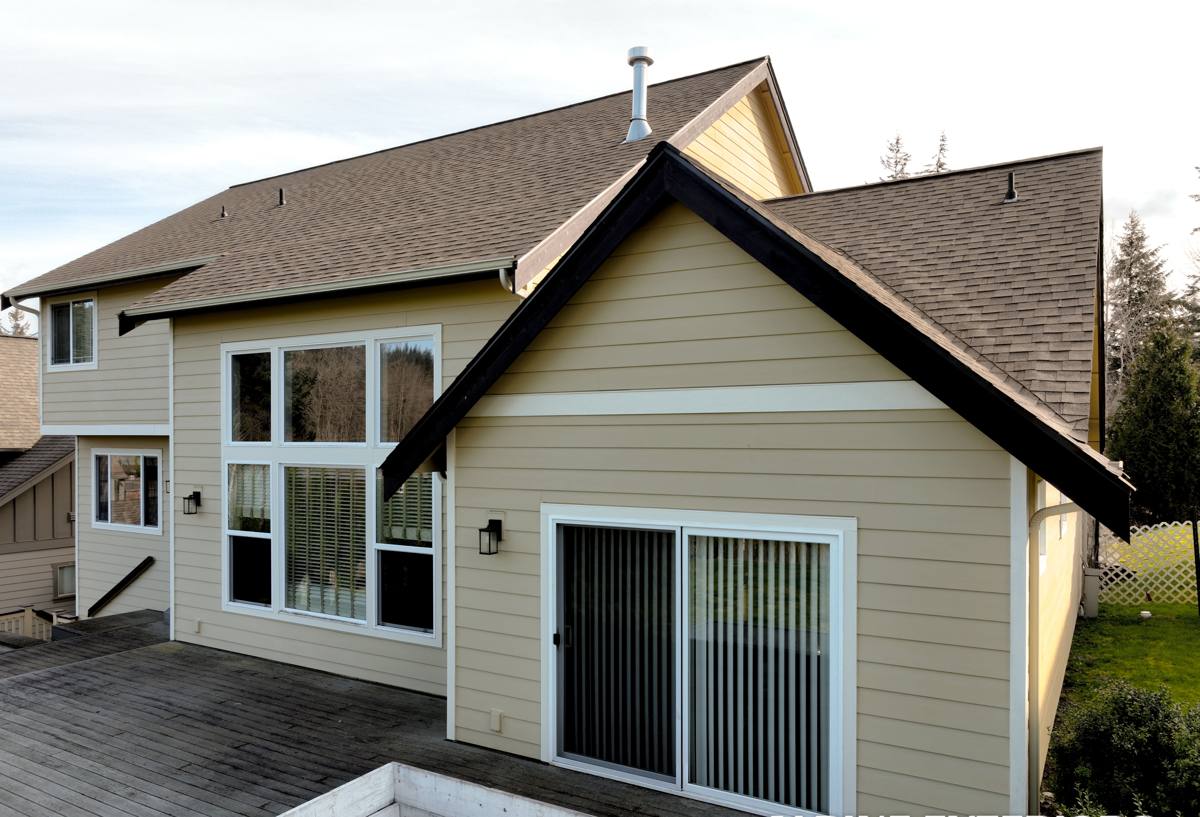
What's Actually Damaging Ferndale Siding
Wind-Driven Rain and Storm Impact
Straight-down rain is easy for most siding to shed. Rain that arrives sideways, pushed by wind off the water, is a different problem — it gets driven into laps, trim joints, and any gap in caulking that's started to fail. Storm systems moving through Whatcom County can also throw debris that cracks or dents individual panels, which is a more straightforward repair but still needs to be matched correctly to avoid a visible patch.
Salt Air and Fastener Corrosion
Homes anywhere near Ferndale's coastline pick up a steady dose of salt-laden air, and salt accelerates corrosion in fasteners, flashing, and metal trim faster than it would in a drier inland climate. A corroding fastener loses holding strength and can create a small gap right where it penetrates the siding — a slow leak point that's easy to miss during a quick visual check but shows up clearly once you're looking at the substrate underneath.
Moss, Mildew, and Trapped Moisture
Mild temperatures and consistent moisture keep moss and mildew active across most of the year on north-facing and shaded walls. Beyond looking bad, organic growth holds water against the siding surface longer than it would otherwise sit there, which extends every wet cycle the material and the fasteners underneath it go through. Repair calls tied to moss are often less about the moss itself and more about what months of trapped moisture did to the wall behind it.
Repair or Replace? How We Make That Call
Not every damaged section needs a full re-side, and not every re-side call actually needs one — sometimes a targeted repair is the honest answer, and we'll say so even when a bigger job would be more profitable for us. The call usually comes down to how far the damage has spread and what condition the substrate is in once we open up the area.
- How many separate areas of the wall are affected, and whether they're isolated or spread across multiple elevations
- Whether the sheathing and framing behind the damaged siding are still sound once probed and opened up
- How old the existing siding is and how much service life it likely has left
- Whether a color and profile match is realistically achievable for a clean patch
- Whether the underlying cause — a flashing gap, a caulk failure, a fastener issue — is a one-time event or a recurring condition that will keep damaging new material too
A repair that goes back onto a wall assembly with an unresolved moisture problem underneath it is a repair that's going to fail again. We won't recommend patching over a cause we haven't actually fixed.
What a Correct Siding Repair Involves
Material choice matters in a repair, but so does everything around it. Cutting out damaged siding without checking what's behind it, or nailing new material back on without correcting the flashing or caulk detail that caused the failure in the first place, is how repairs turn into repeat service calls. A repair done right addresses the cause, not just the visible symptom, and matches the surrounding material closely enough that the patch doesn't stand out.
James Hardie's factory-applied ColorPlus finish is one of the reasons we standardized on the product, but it does add a wrinkle on repair jobs: an exact color match depends on which ColorPlus shade was originally installed and whether it's still in current production. On newer installations this is usually straightforward. On older Hardie siding, or siding installed by another contractor before a color was retired, we'll walk you through the realistic options — a close factory match, a full-elevation replacement to keep the color uniform, or a field-applied touch-up in situations where a perfect match isn't achievable and a visible seam is the honest trade-off.
Repairing Non-Hardie Siding: What We'll Tell You Honestly
Plenty of Ferndale homes we get repair calls for aren't wearing Hardie siding at all — they're vinyl, LP SmartSide, cedar, or primed spruce installed by a previous owner or a different contractor. We'll still repair minor, isolated damage on those products where it makes sense: a cracked vinyl panel, a section of trim, storm damage that hasn't spread. What we won't do is pretend a patch solves a problem the material itself is prone to. Wood-based products that are cupping or delaminating at cut edges, or vinyl that's warped from heat and moisture cycling, are usually showing a pattern that will keep reappearing elsewhere on the wall, not a one-time defect.
In those cases we'll tell you plainly: a patch will hold for a while, but if you're planning to stay in the home for the long term, a full re-side with fiber cement is usually the better use of the money rather than repeating patch work every few years. That's our professional judgment based on what we consistently see in this climate, not a sales pitch — plenty of homeowners choose to patch and wait, and that's a reasonable call too.
Common Ferndale Siding Repair Scenarios
| Scenario | Typical Cause | Repair Approach |
|---|---|---|
| Soft or spongy siding near grade | Long-term moisture wicking, often from splashback or poor drainage at the foundation line | Remove affected sections, inspect and dry the substrate, correct drainage, replace with matched material |
| Cracked or missing panels after a storm | Wind-driven debris impact | Panel replacement matched to existing profile and ColorPlus shade |
| Trim rot around windows and doors | Failed caulk joint or missing flashing allowing water intrusion | Remove and replace trim, correct flashing sequencing, reseal with proper detailing |
| Persistent moss or staining on shaded walls | Trapped moisture from shade, low airflow, or organic buildup | Clean surface, assess for underlying rot, address drainage or ventilation contributing to the damp condition |
| Corroded fasteners with visible streaking | Salt air accelerating metal fastener corrosion | Replace fasteners with corrosion-resistant hardware appropriate to the material and exposure |
Our Repair Process
- On-site inspection: We look at the visible damage and probe the surrounding area, including anything hidden behind trim or at wall penetrations, before quoting a scope.
- Honest diagnosis: We explain what we found, what's causing it, and whether a targeted repair or a larger scope makes sense — with the reasoning, not just a number.
- Material and color matching: For Hardie repairs, we confirm the closest available ColorPlus match or profile; for other materials, we source the closest reasonable match available.
- Correcting the cause: Flashing, caulk, drainage, or fastener issues that led to the damage get fixed as part of the repair, not left in place under new material.
- Cleanup and walkthrough: We review the completed work with you before we consider the job done.
Signs Your Ferndale Home Needs a Siding Repair
- Soft or spongy siding when pressed, especially low on the wall or around window and door trim
- Moss or dark staining that returns quickly after cleaning on shaded or north-facing walls
- Visible cracks, chips, or missing sections following a storm or wind event
- Rust streaking below fastener heads or visible corrosion on trim and flashing
- Gaps or separated caulk joints at seams, corners, or trim lines
- A musty smell near an exterior wall, or interior staining that lines up with an exterior wall location
Why a Local Ferndale Crew Matters for Repair Work
Repair work rewards familiarity in a way new construction doesn't always require. A crew that's already opened up walls on Ferndale homes knows roughly what to expect once a section comes off — how far moisture tends to have traveled by the time it's visible from outside, which wall orientations take the worst of the wind-driven rain, and which older color runs and profiles are more likely to need a full-elevation solution instead of a spot patch. That experience shortens the diagnostic part of the job and reduces the odds of a repair that looks fine on completion day but reopens the same problem two winters later.
If you've got damaged, aging, or failing siding on a Ferndale home, we're glad to take a look and give you a straight answer about what it actually needs. Reach out using the form below to schedule a free, no-pressure estimate.