 Bellingham Siding
 Why Barkley Siding Takes a Beating
Barkley sits close enough to Bellingham Bay and the wider Salish Sea shoreline that salt-laden air is a constant, low-grade stress on anything mounted to the outside of a house. Add Whatcom County's long wet season, driving rain that comes in sideways off the water during winter storms, and a shoulder season where damp shade lingers under trees and eaves, and you have a climate that is genuinely hard on exterior materials. It is not dramatic weather — no hailstorms, no extreme heat — but it is relentless, and relentless is what wears siding out.
Moss is the clearest sign of that pattern. Whatcom County's moss season runs long, often eight months or more where shade and moisture overlap, and it does not just look bad. Moss holds water against the siding surface, keeps that surface from drying between rain events, and creates a constant damp interface exactly where paint film, caulking, and seams are weakest. Over years, that turns small cosmetic issues into real moisture problems.
Whether your home is a newer build in one of Barkley's developed pockets or an older house nearby, the exposure is similar: north- and west-facing walls take the worst of the wind-driven rain, and shaded elevations hold moss and mildew longest. Repair work in this neighborhood has to account for both, not just patch what is visibly broken.
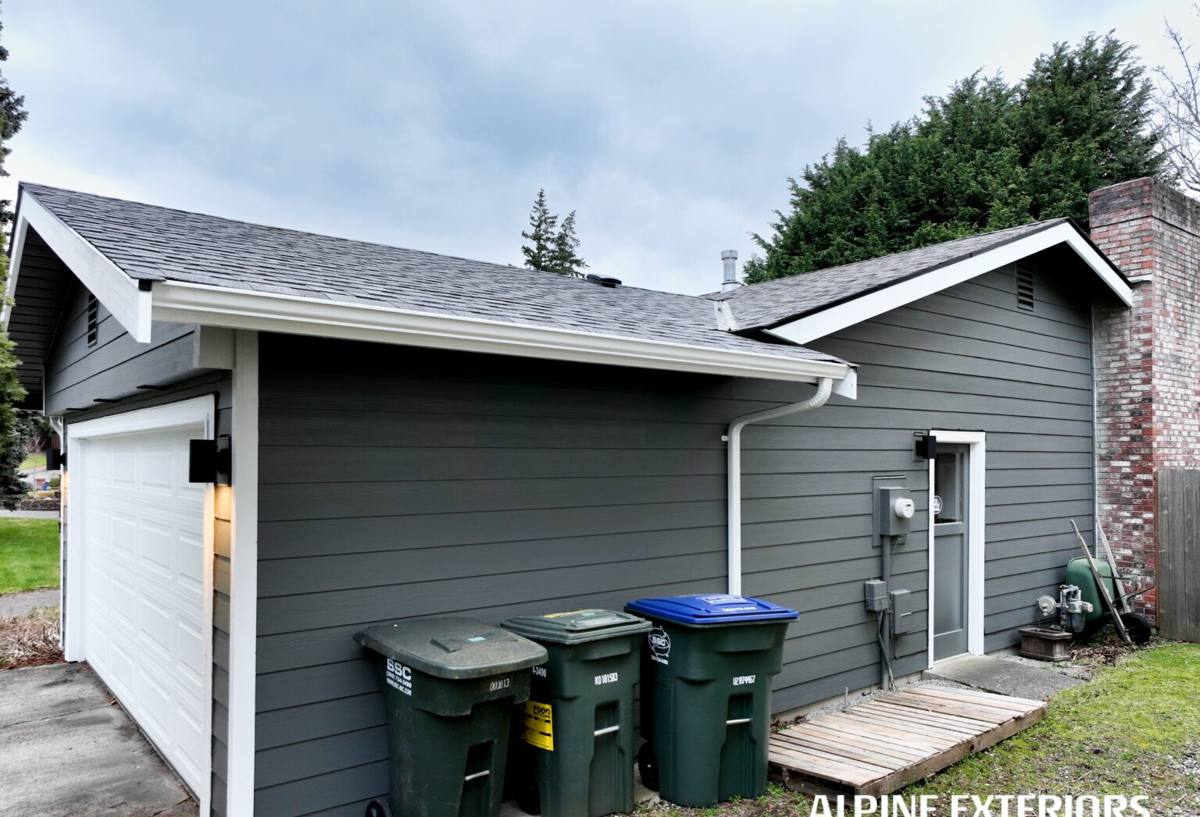
Signs Your Siding Needs Repair
Most siding failure in this climate starts small and stays hidden for a while. Homeowners in Barkley should walk the exterior at least once a year, ideally before the wet season ramps up in fall, and look for the following:
- Soft or spongy spots when you press on siding, especially near the bottom edge of walls or below windows
- Visible moss or dark streaking that keeps returning after cleaning, particularly on shaded or north-facing walls
- Peeling, bubbling, or chalky paint that goes beyond normal weathering
- Gaps at seams, corners, or trim where caulking has shrunk, cracked, or pulled away
- Warping, buckling, or panels that no longer sit flat against the wall
- Staining on interior walls or ceilings near exterior corners, which often points to a siding or flashing failure well before the exterior shows obvious damage
- Insect activity or soft wood around window trim, corner boards, or anywhere wood trim meets siding
Any one of these on its own might be minor. Two or three showing up in the same area of the house is usually a sign that moisture has been getting behind the siding for a while, not just sitting on top of it.
Repair or Replace? How to Tell the Difference
Not every problem calls for a full re-side, and we will tell you honestly when a repair is the right call. The table below covers the judgment calls we make most often on Barkley-area homes.
| What we find | Usually means | Typical path |
|---|---|---|
| Isolated cracked or split boards, storm damage to a small section | Localized damage, structure underneath is sound | Targeted repair and repaint/match |
| Recurring moss and soft paint on one or two shaded walls only | Localized moisture exposure, rest of house is fine | Repair plus improved drainage/clearance in that zone |
| Soft sheathing found once siding is opened up | Water intrusion has reached the wall structure | Repair the framing/sheathing first, then re-side that section |
| Widespread softness, warping, or moss across most elevations | Original material or installation is failing broadly | Full replacement usually makes more financial sense than repeated patching |
| Old siding no longer manufactured or matched color has faded unevenly | Cosmetic mismatch risk even after a good repair | Repair with closest match, or replace the full wall/elevation for a clean look |
The honest answer is usually somewhere in the middle: repair what is genuinely isolated, but don't ignore a pattern. Patching the same wall three times in five years usually costs more in the long run than replacing that section once, correctly.
What a Correct Siding Repair Actually Involves
It starts with what's underneath, not what's visible
A repair that only addresses the surface is not a repair — it's a delay. Before we touch a single board, we check what's behind it: is the sheathing dry and solid, is the house wrap or building paper intact, is water actually draining away from the wall or pooling against it? In a climate with this much sustained moisture exposure, siding damage is very often a symptom of a flashing, caulking, or drainage problem, not just aging material. Fix the symptom without fixing the cause and the same damage comes back in a season or two.
Proper flashing and water management
Every repair we do gets correct flashing at windows, doors, and any horizontal trim, along with proper weep gaps and clearances so water that does get behind the cladding can actually drain and dry out. This is the part of a repair that doesn't show once the job is done, but it's the part that determines whether the repair lasts five years or fifteen.
Matching materials and finish
On homes with existing fiber cement siding, matching board profile, exposure, and ColorPlus finish as closely as possible keeps a repair from standing out. On homes with older wood, vinyl, or other siding types, we'll tell you plainly whether a clean match is realistic or whether the repaired section will look slightly different — that's a decision you should make with full information, not find out after the fact.
Painted vs. factory-finished repairs
Field-painted repairs on wood siding will need repainting on a normal maintenance cycle. Factory-finished fiber cement holds its color far longer and doesn't need that repeat attention, which is one of the reasons we push toward Hardie for any repair that also involves replacing a section of cladding outright.
Our Repair Process
- On-site assessment. We inspect the damaged area and the surrounding wall, probe for soft spots, and check flashing, caulking, and drainage — not just the obvious problem spot.
- Honest scope and options. We tell you what's actually needed: spot repair, section replacement, or a broader conversation if we're seeing a pattern that suggests bigger issues. No upselling, no downplaying.
- Address the cause first. Any moisture source — bad flashing, missing kick-out, failed caulk joint — gets corrected before new siding goes back on.
- Repair or replace the affected material. Damaged sheathing, trim, or siding is replaced with sound material and correctly fastened and sealed.
- Match and finish. We match material, profile, and color as closely as the existing siding allows, and finish with proper caulking and paint or factory finish.
- Walkthrough. We show you what we found, what we fixed, and what to keep an eye on going forward.
Why a Crew That Already Works Barkley Matters
Siding repair done right depends on understanding how a specific house sits in its specific microclimate — which walls get the worst wind-driven rain, which corners hold shade and moss longest, how close the property is to salt air exposure off the water. A crew that regularly works Bellingham and the surrounding Whatcom County neighborhoods has already seen how these patterns play out on homes with similar orientation, similar age, and similar exposure to Barkley's. That's not a marketing point — it's the difference between a repair that guesses at the cause and one that's seen the same failure pattern before and knows what actually stops it from recurring.
It also means someone who can respond in a reasonable timeframe if a repair need turns urgent — a storm-damaged section, a leak that's actively getting worse — rather than waiting on a crew that has to travel in from outside the region.
What We Repair and Rebuild With — and Why
When a repair involves replacing more than a board or two, we use James Hardie fiber cement exclusively. We don't install vinyl, LP SmartSide, Cemplank, Allura, or unprimed cedar or spruce siding, and we won't quote a repair using those materials even if that's what's currently on the house. That's a deliberate standard, not a sales pitch, and it's worth explaining plainly:
- Fiber cement doesn't feed moss the way wood can once it's properly finished, and it holds up to sustained damp exposure far better than untreated wood trim.
- It's non-combustible, which matters increasingly to insurers and homeowners alike.
- ColorPlus factory finish holds color for years longer than field-applied paint, which means a repaired section won't need repainting on the same short cycle as the rest of a wood-sided wall.
- Hardie's HZ product lines are engineered for specific climate zones, including the wet, moderate-temperature conditions common to the Pacific Northwest.
- The warranty is transferable and substantial when the product is installed to Hardie's specifications — which is exactly why correct installation, not just correct material, is the point of everything above.
We'll always tell you honestly if a repair calls for matching what's already there rather than introducing a different material mid-wall. But if you're facing a section that needs full replacement, or a home that's due for new siding altogether, Hardie is what we recommend and what we install.
If you're seeing moss that won't quit, soft spots, or gaps that weren't there last year, we're glad to take a look. Reach out for a free, no-pressure estimate — we'll tell you straight what we find and what it actually needs.