 Bellingham Siding
 Why Siding Installation in Puget Isn't a One-Size-Fits-All Job
Homes in the Puget area of Whatcom County sit in one of the more demanding climates on the West Coast for exterior materials. It's not dramatic weather — no hurricanes, no wildfires pressing right up against the siding — but it's relentless. Salt-laden air drifting off the Sound, long stretches of driving rain that comes in sideways off the water, and a moss season that can run most of the year on shaded north- and west-facing walls. Individually, none of those are unusual for the Pacific Northwest. Together, applied to a wall system day after day for years, they separate siding installations that hold up from ones that quietly fail behind the surface.
A siding installation done right in Puget isn't just about picking a good product. It's about how that product is flashed, gapped, fastened, and finished against a specific set of local conditions. We install fiber cement in this area regularly, and the failures we get called out to inspect almost never trace back to a bad material — they trace back to installation choices that ignored what this climate actually does to a wall.
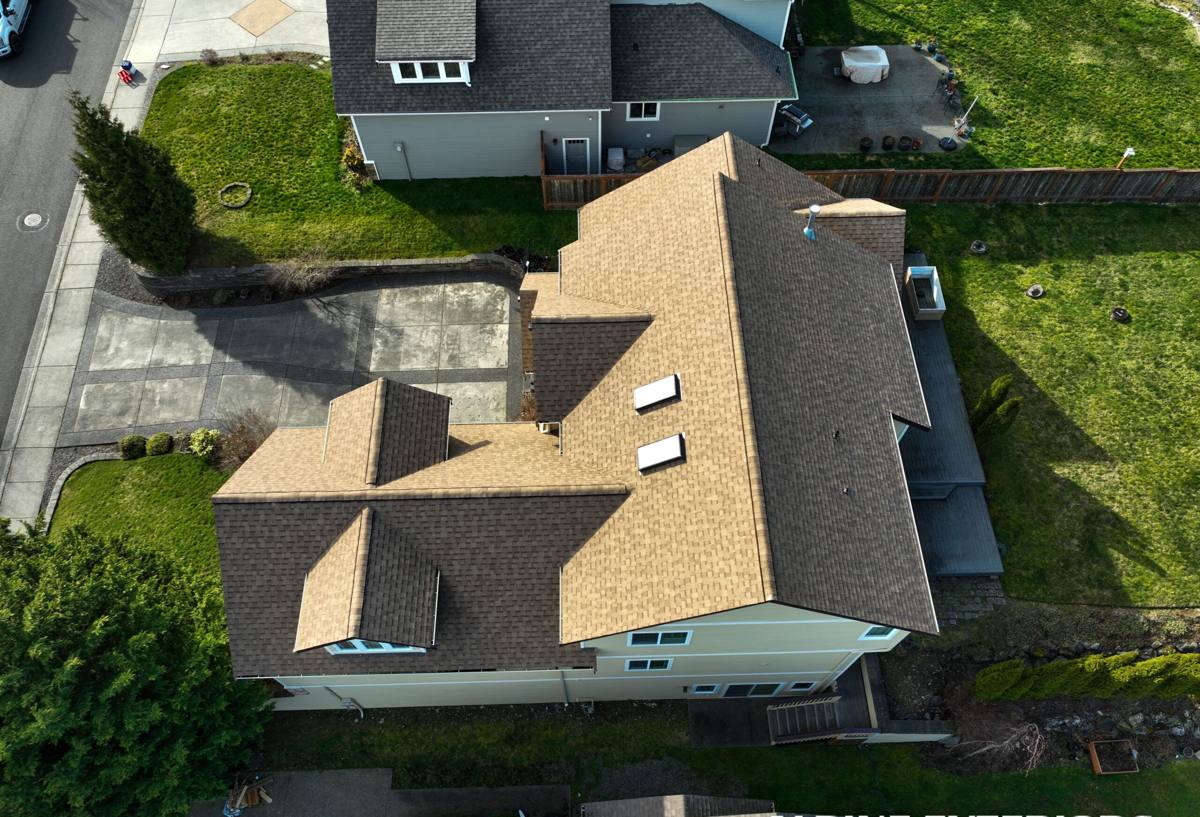
What Salt Air, Driving Rain, and Moss Actually Do to a Wall
Salt Air
Proximity to Puget Sound means airborne salt settles on exterior surfaces even well inland from the water. Salt is corrosive to exposed metal — fasteners, flashing, trim edges — and it accelerates the breakdown of finishes that aren't formulated to resist it. Over years, a siding system with unprotected or undersized fasteners can develop staining and corrosion at the exact points where water intrusion is most likely to start.
Driving Rain
Wind off the water doesn't just drop rain straight down — it pushes it horizontally into wall assemblies, up under laps, and into any gap that wasn't sealed or flashed correctly. A siding system that would perform fine in a calmer inland climate can take on water in Puget simply because the rain is hitting the wall at an angle the original detailing didn't account for.
Moss and Sustained Moisture
Shaded, north-facing, and tree-covered walls in this area stay damp longer than they would almost anywhere else in the country. That constant moisture is what lets moss and algae take hold on siding, trim, and especially on horizontal surfaces like window sills and butt joints. Moss itself doesn't destroy fiber cement, but it holds moisture against the surface for extended periods, and if water is already finding its way behind the cladding, that sustained dampness is what turns a small installation flaw into rot, mold, or a failed wall assembly a few years down the road.
What a Correct Installation Looks Like Here
Every one of these elements matters everywhere fiber cement is installed. In Puget's climate, getting them wrong costs you faster.
- A continuous weather-resistive barrier installed and lapped correctly behind the siding, with every penetration — vents, hose bibs, light fixtures, conduit — properly flashed and sealed before a single board goes up.
- Correct fastener selection — corrosion-resistant, hot-dip galvanized or stainless fasteners driven to the manufacturer's specified depth and pattern, not whatever happened to be in the gun.
- Proper clearance and gapping at the foundation, roofline, and any horizontal trim, so water has somewhere to go instead of wicking into the board's cut edge.
- Rain-screen or drainage detailing where wall orientation and shade call for it, giving trapped moisture a path to escape instead of sitting against the back of the panel.
- Sealed and primed cut edges on every field cut, since an unsealed edge is the single fastest way for a fiber cement board to take on water.
- Flashing above every window, door, and horizontal trim board, lapped in the correct order so water sheds outward at each layer instead of behind it.
None of this is exotic. It's standard fiber cement best practice. But it's also exactly the set of details that get rushed or skipped by crews that don't regularly work in a climate this wet, and it's exactly what separates a siding job that looks fine at handoff from one that's still performing in fifteen years.
Signs a Puget Home's Siding Is Falling Behind
If you're evaluating whether it's time for new siding rather than another round of repairs, these are the patterns we see most often on homes in this area:
| What You're Seeing | What It Usually Means |
|---|---|
| Persistent moss or algae streaking on shaded walls | Normal in this climate, but heavy, fast-returning growth can signal the wall stays wet longer than it should |
| Soft spots, bubbling, or a spongy feel near the base of walls | Water intrusion and possible rot in the sheathing behind the siding — worth an inspection sooner than later |
| Rust streaks below fasteners or trim edges | Fasteners or flashing not rated for salt-air exposure are corroding |
| Paint failing faster than it used to, or repeated repainting | The siding material or finish is no longer sealing out moisture the way it should |
| Visible gaps, warping, or separation at board joints | Original installation gapping or fastening wasn't sized for how much this material moves seasonally |
Why We Only Install James Hardie Fiber Cement
We install one siding system — James Hardie fiber cement — and we don't install vinyl, LP SmartSide, primed spruce, cedar, or other fiber cement brands. That's not a marketing position; it's a standard we hold because of what we've seen these materials do, or fail to do, in exactly this kind of climate.
Vinyl is inexpensive and low-maintenance in mild, dry climates, but it's a thin plastic product that can warp in temperature swings and gets brittle over time — and it relies almost entirely on the walls behind it, rather than the siding itself, to keep water out. Wood-based products, including primed spruce and cedar, look excellent when new, but they're organic materials in a climate that stays damp for months at a stretch; they demand a maintenance schedule most homeowners underestimate, and any lapse in upkeep shows up fast as rot or paint failure. Engineered wood siding like LP SmartSide improved on plain wood in some respects, but it's still a wood-strand product with edges that are vulnerable if they're ever exposed to standing moisture, which is a real risk on rain-driven, moss-prone walls.
James Hardie fiber cement is a cement and cellulose composite. It doesn't absorb water the way wood-based products do, it's non-combustible, and it holds paint and factory finishes far longer than wood or vinyl because it doesn't expand and contract with moisture and temperature the same way. The ColorPlus factory finish is baked on under controlled conditions rather than field-painted, which matters directly for a climate where field-applied coatings take a beating from constant rain. Hardie also engineers specific product lines — including HZ5 — for cold, wet climate zones like ours, and backs the material with a strong transferable warranty. None of that guarantees a good outcome by itself. The installation still has to be done correctly. But it gives us a material that performs when the installation is right, instead of one that's fighting the climate from day one.
How Our Installation Process Works
1. On-Site Assessment
We walk the property, check the existing wall condition, note sun and shade exposure on each elevation, and look for any signs of existing moisture damage that needs to be addressed before new siding goes on top of it.
2. Tear-Off and Substrate Inspection
Old siding comes off and we inspect the sheathing underneath. Any rot or water damage gets repaired at this stage — covering damaged sheathing with new siding just locks a problem inside the wall.
3. Weather-Resistive Barrier and Flashing
A continuous water-resistive barrier goes on, with every window, door, and penetration flashed in the correct shingle-lap order so water is directed outward at every layer.
4. Hardie Installation to Manufacturer Spec
Boards are installed with correct clearances, fastener spacing, and butt-joint treatment, with every field-cut edge sealed. On walls with heavier rain or shade exposure, we detail drainage accordingly.
5. Trim, Caulking, and Finish Details
Trim is installed, joints are sealed with an appropriate exterior sealant, and touch-up paint is applied where field cuts or fastener heads need it to match the factory finish.
6. Final Walkthrough
We walk the finished job with you, elevation by elevation, before calling it done.
Choosing the Right Hardie Line for a Puget Home
James Hardie makes several product lines, and the right choice depends on the home's exposure, style, and your maintenance preferences.
- HZ5 climate-engineered boards — formulated for colder, wetter regions and a common choice for homes with heavier direct rain exposure.
- Lap siding — the traditional horizontal look, available in multiple exposure widths and textures, and the most common choice for full re-sides in this area.
- Board and batten (vertical) siding — a popular look for accent walls or full facades that also sheds driving rain well due to its vertical profile.
- ColorPlus factory-finished color options — a baked-on finish that holds up better against sustained rain and UV exposure than field-applied paint.
We'll walk through which line and profile makes sense for your specific walls and exposure during your estimate — there's rarely a single right answer for an entire house, since sun and shade exposure often varies elevation to elevation.
Cost Factors for a Puget Siding Installation
Every project is different, but the same handful of factors drive most of the cost variation we see on installations in this area:
| Factor | Why It Matters |
|---|---|
| Home size and wall complexity | More elevations, dormers, and trim details mean more labor and material |
| Condition of the existing sheathing | Rot repair discovered during tear-off adds time and material before new siding can go on |
| Product line and profile chosen | HZ5, lap width, and board-and-batten vs. standard lap all price differently |
| Trim and finish scope | Full trim replacement costs more than reusing sound existing trim |
| Site access and exposure | Steep sites, tall walls, and heavy landscaping around the home affect labor time |
We give straightforward written estimates after seeing the home in person — we don't quote sight-unseen, because the sheathing condition alone can change the scope significantly.
Why It Matters to Hire a Crew That Already Works Puget
Fiber cement installation isn't complicated in theory, but the manufacturer's own installation manual runs dozens of pages of clearance, fastening, and flashing specifications for good reason — skipping any one of them is usually invisible at handoff and only shows up years later as a moisture problem. A crew that installs siding across a range of climates might do a technically adequate job and still miss the details that matter specifically here: how much clearance to leave given how much rain this area gets sideways, which walls need extra drainage detailing because they stay shaded and damp most of the year, and which fastener and flashing materials actually hold up against salt air over time rather than just meeting a generic spec sheet.
A crew that works this area regularly has already seen what goes wrong on Puget-area homes and builds around it as a matter of habit, not as an afterthought.
Living With and Maintaining New Siding in This Climate
James Hardie siding installed correctly is low-maintenance, but "low-maintenance" isn't "no-maintenance" in a climate like this one. A simple annual routine keeps a new installation performing the way it should:
- Rinse siding periodically to keep salt residue and organic buildup from accumulating, especially on shaded and north-facing walls.
- Keep gutters clear so water isn't overflowing directly onto siding and trim below.
- Trim back vegetation and tree limbs that are keeping any wall section shaded and damp longer than necessary.
- Inspect caulking at trim joints and penetrations every year or two, and address any cracking before the next wet season.
- Address moss on horizontal surfaces promptly rather than letting it establish and hold moisture long-term.
None of this is heavy upkeep — it's the kind of routine attention that lets a correctly installed Hardie system deliver on its expected lifespan instead of fighting an uphill battle against this climate from year one.
If your Puget-area home needs new siding or you're not sure whether what's on the walls now is still doing its job, we're happy to take a look. Reach out for a free, no-pressure estimate using the form below.