 Bellingham Siding
 Lynden Sits in a Tougher Climate Than It Looks
Lynden reads as a quiet farm-country town, but the siding on its homes takes a beating that has nothing to do with how peaceful the setting feels. Whatcom County sits under a long wet season, and Lynden gets the full package: driving rain that comes in sideways during winter storms, moisture that lingers in the air even on dry-looking days, and enough shade and humidity in the wooded and low-lying lots around town to grow a serious moss and algae season on north-facing walls. Add the salt-tinged air that rides inland off Bellingham Bay and the Strait of Georgia on a west wind, and you have a climate that is genuinely hard on exterior materials, even though it never looks dramatic from the street.
None of that is a reason to panic about siding. It's a reason to be precise about what goes on the wall and how it's installed. Siding failure around here is rarely sudden — it's slow moisture intrusion behind the cladding, or a surface that can't shed moss and mildew fast enough, showing up as soft trim, peeling paint, or a musty smell in a wall three or five years after a rushed installation. A correct job, on the right material, is what keeps that from ever starting.
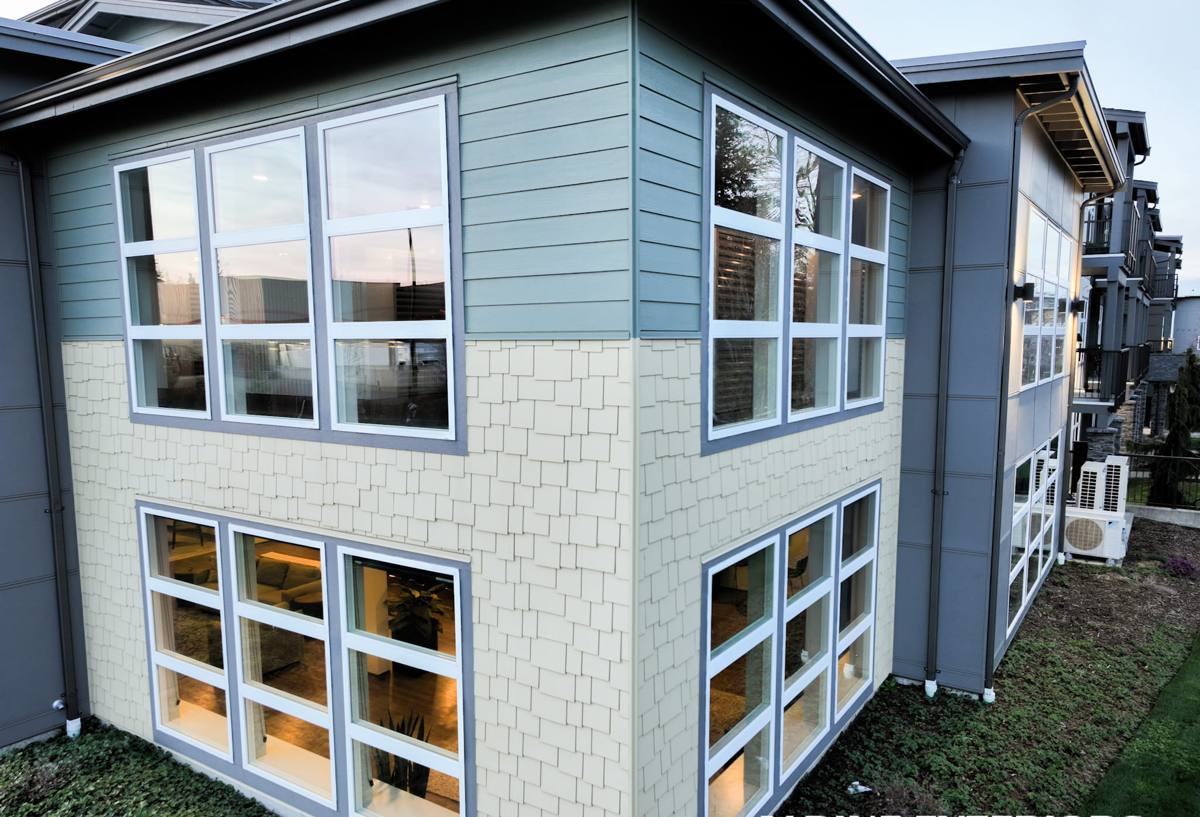
What Driving Rain and Moss Actually Do to a Wall
Wind-Driven Rain Finds the Gaps
Vertical rain is easy for almost any siding to shed. Driving rain — rain pushed sideways by wind — behaves differently. It gets forced up under laps, into unsealed joints, and behind trim that wasn't flashed correctly. Over a Lynden winter, a home can see dozens of these wind-driven rain events. If the water management behind the siding isn't built correctly, that moisture doesn't evaporate quickly in our damp climate — it sits in the wall assembly and starts doing damage that isn't visible until it's advanced.
Moss Doesn't Just Look Bad
Moss and algae growth on siding is more than cosmetic in this region. Once moss establishes on a wall — especially the shaded, north- and east-facing sides common on rural and tree-lined Lynden lots — it holds moisture against the surface for extended periods, which accelerates paint failure, wood rot in trim, and fastener corrosion. A siding material that can't handle repeated wet-dry cycling and doesn't hold a factory finish well will show moss staining and finish breakdown faster here than in a drier part of the state.
Salt Air Adds a Third Stressor
Homes closer to Bellingham Bay feel salt air most directly, but Lynden isn't immune — coastal air moves inland with the weather, and airborne salt accelerates corrosion on fasteners, flashing, and any metal components in the wall assembly. Combined with constant moisture, it's a faster path to hardware failure than most homeowners expect.
What a Correct Siding Installation Involves
Moisture Management Starts Before the Siding Goes On
The siding itself is the least important part of keeping water out of a wall — the water-resistive barrier underneath it does the real work. A correct installation means a continuous, properly lapped weather-resistive barrier, correctly integrated window and door flashing (installed in the right shingle-lap order so water is directed out, not in), and drainage space where the wall assembly calls for it so incidental moisture can escape instead of pooling. Skipping or rushing this layer is the single most common cause of the hidden rot we get called out to diagnose in older installations around Whatcom County.
Fasteners, Clearances, and the Details That Get Skipped
Correct fastening patterns, proper nail penetration into framing, and the right clearances at grade, roof lines, and butt joints all matter more in a wet climate than a dry one, because any shortcut here becomes a moisture entry point that the local weather will find and exploit. Field-cut edges need to be sealed and back-primed to spec. Butt joints need to be flashed, not just caulked. These are the details that separate a siding job that lasts thirty-plus years from one that starts showing problems in five.
| Installation Detail | Why It Matters in Lynden's Climate |
|---|---|
| Continuous weather-resistive barrier | Handles the volume of wind-driven rain typical of Whatcom County winters |
| Properly lapped window/door flashing | Prevents the most common source of hidden wall rot we see in older installs |
| Correct grade and roofline clearances | Keeps splash-back moisture and moss-prone debris away from the siding's bottom edge |
| Sealed and back-primed field cuts | Stops raw edges from wicking moisture during the long wet season |
| Corrosion-resistant fasteners | Offsets the accelerated corrosion from salt-tinged inland air |
Why We Only Install James Hardie Fiber Cement
We don't install LP SmartSide, vinyl, Cemplank, Allura, primed spruce, or cedar — not because those products have no merit, but because we made a professional decision about what performs best, in this specific climate, over the long term, when we're the ones putting our name behind the work. Vinyl expands and contracts with temperature swings and can warp or crack over time; engineered wood products rely on their coating and edge-sealing to keep moisture out, and any breach in that seal invites the kind of rot that thrives in our wet winters. Cedar is a beautiful, legitimate material, but it demands an ongoing maintenance commitment — refinishing, sealing, moss treatment — that most homeowners don't want to sign up for indefinitely.
James Hardie fiber cement is non-combustible, dimensionally stable across our temperature and humidity swings, and finished at the factory with ColorPlus technology, which holds color and resists the fading and moss-related staining that plagues field-painted siding. Hardie also engineers its HZ5 product line specifically for climates with heavy moisture exposure — which describes Whatcom County well — and backs it with a strong, transferable warranty that matters when a home changes hands. For a material that has to survive driving rain, a long moss season, and salt-tinged air without babysitting from the homeowner, it's what we trust.
Our Process for a Lynden Installation
- On-site assessment — we look at wall orientation, moisture exposure, existing damage, and any moss or rot already present before quoting anything.
- Tear-off and inspection — old siding comes off and the sheathing underneath gets inspected for hidden damage before anything new goes up.
- Weather barrier and flashing — the water management layer goes in first and gets inspected before it's covered, not after.
- Hardie installation to manufacturer spec — correct fastening, clearances, and joint treatment, following James Hardie's published installation requirements rather than shortcuts.
- Final walkthrough — we check caulking, trim, and finish details with the homeowner before calling the job done.
Signs Your Current Siding Is Already Losing the Battle
- Persistent moss or algae staining that comes back within months of cleaning
- Paint that's peeling, bubbling, or chalking, especially on shaded walls
- Soft or spongy trim boards around windows, doors, or the bottom edge of walls
- A musty smell near exterior walls that shows up during or after wet weeks
- Visible warping, cracking, or gaps opening up at seams and butt joints
- Rust streaking from fasteners or corroded flashing at joints
Any one of these on its own might be minor. Two or more together usually mean moisture has already found a way behind the cladding, and it's worth having someone look before it's a bigger repair.
Cost Factors for Lynden Homes
| Factor | Why It Moves the Price |
|---|---|
| Extent of hidden damage found at tear-off | Rotted sheathing or framing found during removal adds repair scope before new siding goes on |
| Wall complexity and home size | Multiple stories, dormers, and cut-up wall lines take more labor than a simple rectangular footprint |
| Hardie product line and profile | Lap width, panel style, and HZ5-specific products vary in material cost |
| Trim and accessory scope | Full trim replacement alongside siding costs more than reusing sound existing trim |
| Site access | Rural Lynden lots, tree cover, or tight access can add setup and staging time |
We give exact numbers on-site, after we can actually see the wall condition — broad ranges quoted sight unseen rarely hold up once tear-off starts.
Why Hiring a Crew That Already Works Lynden Matters
A siding crew that only occasionally works out this way tends to treat every job as a first-time read of local conditions. A crew based in Bellingham that regularly works Lynden and the surrounding Whatcom County towns already knows what wind-driven rain does to a wall on an open farm lot versus a tree-sheltered in-town property, already knows which orientations grow moss fastest here, and already builds the water management layer to match — instead of relying on a generic install that works fine in a drier climate but underperforms here. That local repetition is what turns "correctly installed" from a checklist into a habit.
Get a Straight Answer on Your Siding
If your Lynden home's siding is showing moss that won't stay gone, paint that keeps failing, or you're just planning ahead for a replacement done right the first time, we're glad to take a look. There's no pressure and no sales script — just an honest read on your wall's condition and what a correct James Hardie installation would involve. Use the form below to request a free estimate.