 Bellingham Siding
 Blaine's Marine Climate Is Hard on Siding
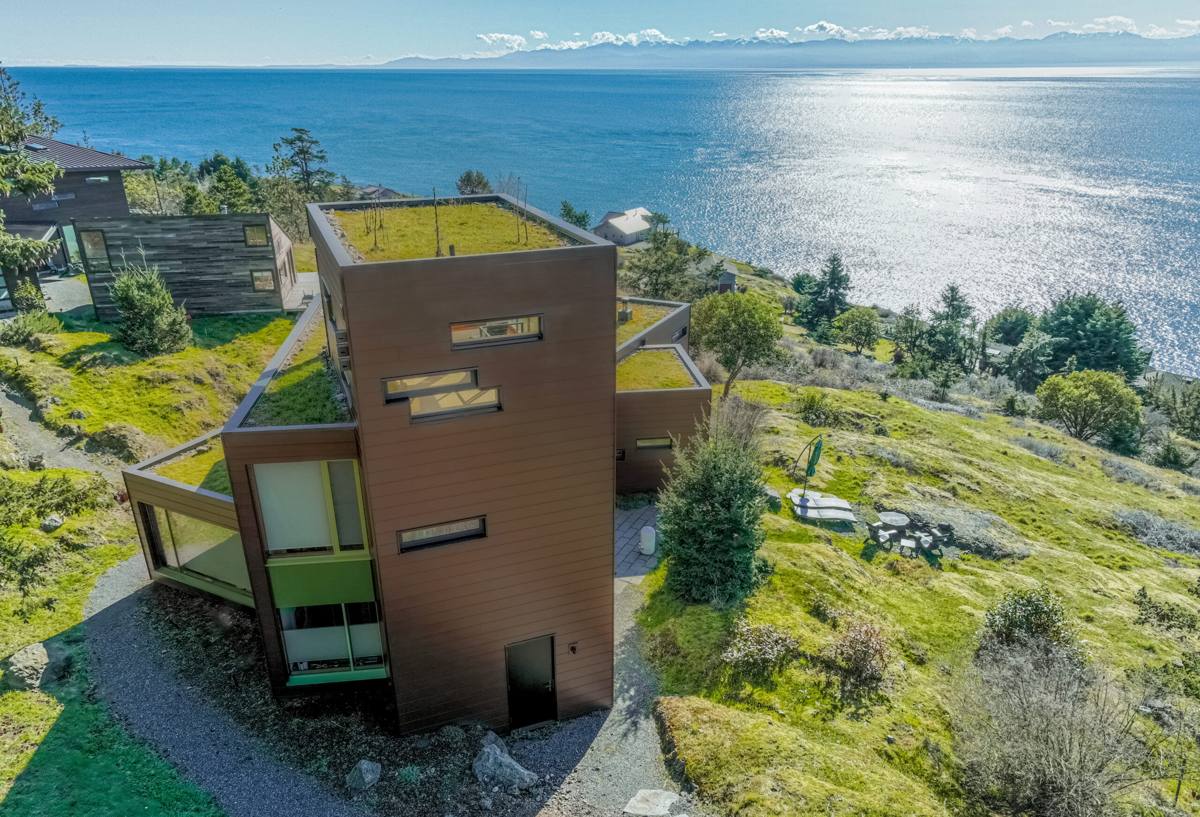
Blaine sits at the northwest corner of Whatcom County, right on the water and a few miles from the Canadian border. That location gives homes here a specific set of exterior problems that inland Whatcom County properties don't deal with in the same way. Salt-laden air moves in off the water and settles on everything, including your siding, trim, and fasteners. Wind-driven rain doesn't just fall straight down here — it gets pushed sideways into wall assemblies, seams, and any gap in the weather barrier. And because so many Blaine lots sit under fir and cedar cover or stay shaded for long stretches of the year, moss and algae get a long runway to establish themselves on north- and west-facing walls.
None of that is unique to Blaine, but the combination is more concentrated here than in Bellingham proper or the inland parts of the county. Siding that's marginal in a drier, more sheltered location can fail years earlier on a waterfront or near-waterfront Blaine home. That's the lens we use when we talk to homeowners here — not generic "Pacific Northwest weather" talk, but what salt air, wind-driven rain, and a long wet-shade season actually do to a wall system over ten or twenty years.
What Salt Air and Driving Rain Actually Do to a Wall
Corrosion at the Fasteners
Salt air accelerates corrosion on any metal it can reach — nail heads, flashing, screws, and trim fasteners. When fasteners are the wrong grade for a coastal environment, they can start rusting from the inside of the wall before there's any visible sign on the surface. Once a fastener corrodes, it loses holding power, and that's how siding starts to loosen, gap, or pull away at the edges.
Water Intrusion Behind the Siding, Not Through It
Most siding failures near the water aren't the panel material failing — they're water getting in behind the siding through a bad seam, a missed flashing detail, or a gap where two materials meet, then sitting there because there's nowhere for it to drain or dry out. Driving rain finds those gaps faster in an exposed, windy location like Blaine than it would on a sheltered inland lot.
Moss, Algae, and Prolonged Dampness
Moss needs shade and moisture, and a lot of Blaine properties have both for much of the year. Moss itself doesn't destroy fiber cement the way it can degrade wood, but it holds moisture against the wall surface longer than an exposed, sun-dried wall would ever experience, and it's unsightly on a painted finish that isn't built to shed it.
Why James Hardie Fits This Climate
We install James Hardie fiber cement exclusively, and Blaine is one of the areas where that decision pays off most clearly. Hardie's HZ5 formulation is engineered specifically for high-moisture, temperate climates like ours — it's built to resist moisture-related damage in a way that wood-based and wood-fiber siding products simply can't match, because fiber cement doesn't have the organic wood content that feeds rot and swelling in the first place.
ColorPlus Factory Finish
Hardie's ColorPlus finish is baked on at the factory in a controlled environment, not brushed or sprayed on-site. That finish is formulated to hold up against UV and moisture cycling far longer than a field-applied paint job, which matters directly in a salt-air environment where painted surfaces tend to chalk, fade, and lose adhesion faster. It also means fewer repaint cycles over the life of the siding — a real cost consideration for a coastal property.
Non-Combustible and Dimensionally Stable
Fiber cement doesn't expand and contract with moisture the way wood or wood-composite products do, so seams and caulk lines stay tighter over time instead of opening up and giving driving rain a path in. It's also non-combustible, which is a genuine advantage regardless of climate, but it's a detail worth knowing when you're comparing products.
What a Correct Installation Involves
The product is only half the equation. Fiber cement siding installed without attention to the details below will still let water in behind it, regardless of how good the panel material is. This is the part of the job that separates a siding installation that lasts decades from one that needs attention again in five or seven years.
| Detail | Why It Matters in Blaine | What We Do |
|---|---|---|
| Drainage plane / rainscreen gap | Wind-driven rain that gets behind the siding needs somewhere to drain and dry instead of sitting against the sheathing | Install an engineered drainage gap behind the siding per Hardie's specifications, not siding installed flat against the wrap |
| Fastener selection | Salt air corrodes the wrong fastener grade from the inside out, long before it's visible | Use corrosion-resistant fasteners rated for the exposure, placed per Hardie's fastening schedule |
| Flashing at penetrations and transitions | Windows, doors, and roof-to-wall transitions are the most common entry points for driving rain | Flash every penetration and transition correctly before siding goes on, not after |
| Clearance from grade and hard surfaces | Siding installed too close to soil, decks, or patios wicks moisture and stays damp longer | Maintain the manufacturer's minimum clearance at grade, decks, and roof lines |
| Joint and seam treatment | Open or poorly caulked seams are a direct path for wind-driven rain | Caulk and treat joints per Hardie's written specifications, using compatible sealants |
Signs Your Current Siding Is Already Losing the Fight
If your home is on or near the water in Blaine, or sits under heavy tree cover, it's worth a look before small problems turn into sheathing or framing damage. Common warning signs we see on coastal Whatcom County homes include:
- Persistent moss or algae streaking on north- or west-facing walls that comes back soon after cleaning
- Rust staining running down from nail heads or trim fasteners
- Soft or spongy spots when you press on siding, especially near the bottom courses
- Paint that's chalking, peeling, or losing adhesion faster than it should for its age
- Visible gaps or separation at seams and corner trim
- A musty smell near exterior walls, which can indicate moisture trapped behind the siding
Our Process for a Blaine Home
- Inspection. We look at the existing siding, the wall assembly underneath where accessible, and the specific exposure of your home — how much direct wind and rain it takes off the water, and how much shade and moss pressure it deals with.
- Tear-off and sheathing check. We remove the old siding and inspect the sheathing and existing moisture barrier for damage before anything new goes up. Water damage found at this stage gets addressed, not covered over.
- Drainage plane and weather barrier. We install a proper weather-resistive barrier and drainage gap, since this layer does most of the real work of keeping wind-driven rain out of the wall assembly.
- Hardie installation to spec. Panels or lap siding go on per James Hardie's written installation instructions — fastening schedule, clearances, flashing, and joint treatment included, not shortcuts.
- Trim, caulking, and finish detail. Corner trim, window and door trim, and all seams get finished and sealed correctly before we consider the job done.
- Walkthrough and cleanup. We walk the job with you, and the site gets cleaned up completely.
Why It Matters That We Already Work in Blaine
A crew that mostly works inland projects doesn't necessarily think about salt-air fastener corrosion or wind-driven rain exposure the same way a crew that regularly works waterfront and near-waterfront Whatcom County properties does. Knowing which walls on a Blaine home take the worst of the weather, how much clearance a given lot needs at grade, and how aggressively moss establishes itself under the tree cover common here changes how we plan and execute the install — not just what product goes on the wall. That local pattern recognition is part of what you're paying for when you hire a crew that already knows the area, not just the product.
Maintenance After Installation
Correctly installed James Hardie siding with a ColorPlus finish is low-maintenance, not zero-maintenance. In a Blaine setting, that mostly means periodic rinsing to keep salt residue and moss spores from building up on the surface, keeping gutters and downspouts clear so water isn't dumping directly onto walls, and a visual check after major storms for anything that looks disturbed at trim or seams. None of that requires repainting on the schedule a field-painted product would need.
Get a Free, No-Pressure Estimate
If you're dealing with moss, staining, soft spots, or aging siding on a Blaine home, or you're planning ahead for a replacement, we're happy to take a look and walk you through what your home actually needs. Use the form below to request a free estimate — no pressure, no obligation.