 Bellingham Siding
 Why Silver Beach Homes Take More Punishment Than Most
Homes in the Silver Beach area deal with a specific combination of stressors that doesn't let up for long stretches of the year. Moist air moving in off Bellingham Bay carries salt that settles on exterior surfaces and slowly works on anything not built to resist it. Add driving rain that comes in sideways during winter storms, tree cover that keeps siding shaded and damp for days after a storm passes, and you get a climate that's genuinely hard on exterior materials. Whatcom County's moss season isn't a two-week nuisance here — it's closer to eight or nine months of the year when conditions favor growth on any surface that stays wet and shaded.
None of that is unique to one street or one lot. It's the baseline condition for this part of Bellingham, and it's why siding choice and installation quality matter more here than they would in a drier, sunnier climate. A siding system that's marginal in Spokane or Yakima can fail outright in a neighborhood like this one within a decade.
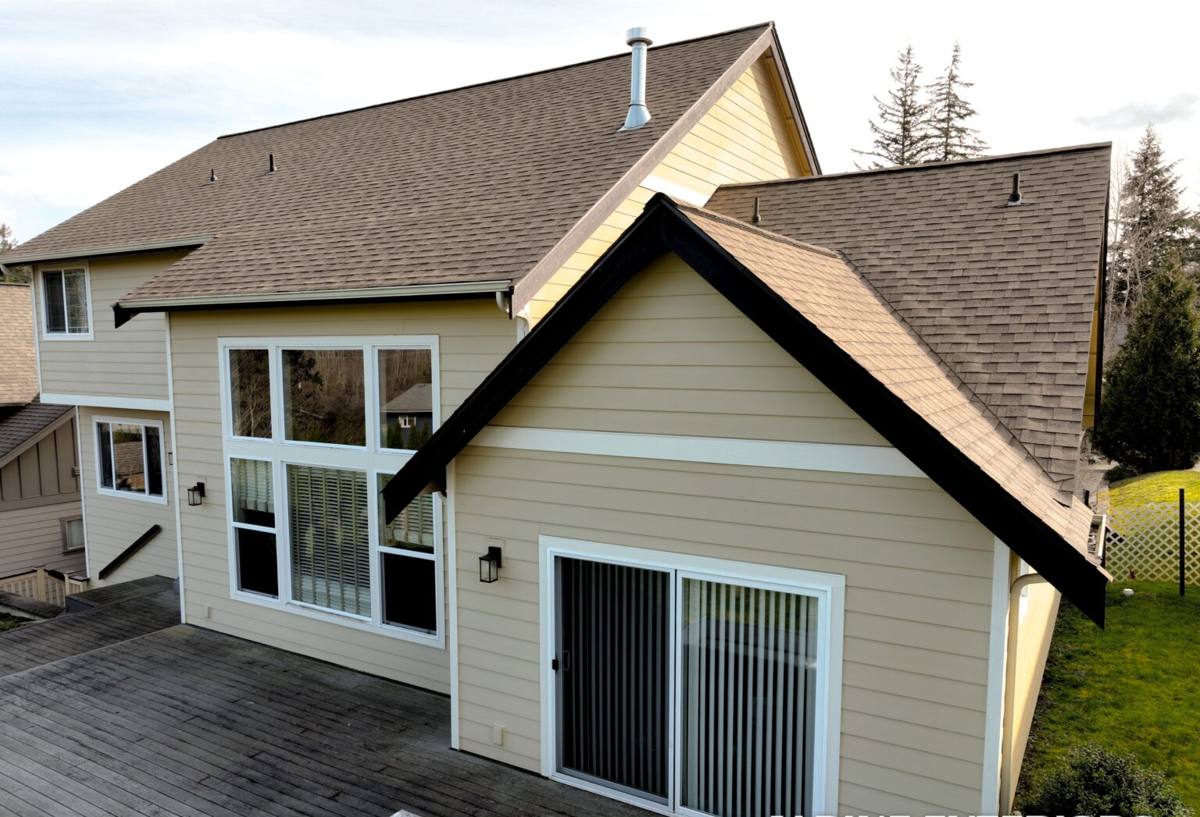
What Fiber Cement Actually Solves
Fiber cement siding is a mix of cement, sand, and cellulose fiber, pressed and cured into planks or panels. That composition gives it three properties that matter directly for a home near the water in a wet, mossy climate:
- Dimensional stability. It doesn't expand, contract, cup, or warp the way wood does when it cycles between wet and dry.
- Moisture resistance at the material level. It won't absorb water and rot from the inside the way untreated wood or engineered wood products can if a seam fails.
- Non-combustibility. It carries a fire-resistance rating that vinyl and wood products simply can't match.
We install James Hardie exclusively, and the reason comes down to two things beyond the base fiber cement formula: the factory-applied ColorPlus finish, and Hardie's climate-engineered HZ product line. ColorPlus is baked on at the factory under controlled conditions, which gives it better fade and adhesion performance in salt air and UV exposure than field-applied paint typically achieves. The HZ5 formulation is engineered specifically for the moisture patterns of the Pacific Northwest — it's not the same product Hardie ships to Arizona or Florida. That distinction is the whole reason "fiber cement" as a category and "correctly specified Hardie product" as an installed system are two different conversations.
What a Correct Fiber Cement Installation Actually Involves
Fiber cement is a forgiving material in terms of durability, but it is not a forgiving material in terms of installation shortcuts. Most of the siding failures we get called out to inspect — cracked caulk lines, staining at butt joints, soft trim boards — trace back to installation details, not the product itself. On a Silver Beach home, where wind-driven rain and prolonged dampness are the norm rather than the exception, these details aren't optional extras. They're the difference between siding that lasts thirty-plus years and siding that starts showing problems in five.
The details that matter most
- Flashing installed at every horizontal joint, window head, and door head — not caulk used as a substitute for flashing.
- A weather-resistant barrier installed and lapped correctly behind the siding, shingle-style, so any water that gets past the cladding drains out instead of pooling.
- Minimum ground clearance maintained so the bottom edge of the siding never sits in contact with soil, mulch, or standing water.
- Fasteners placed at the manufacturer's specified pattern and depth — over-driven nails crack the board's edge and create a moisture entry point.
- Butt joints treated and sealed per Hardie's published details, with back-flashing where the joint isn't over a stud.
- Caulk used only where Hardie specifies it, with the right product for a high-moisture climate — not as a general-purpose gap filler.
- Cut edges of ColorPlus panels sealed or touched up, since a factory finish only protects the surface it was applied to.
Any one of these skipped on a home exposed to salt air and driving rain shows up as a problem within a few years — usually as a dark stain, a soft spot, or moss taking hold at a joint that's staying wet longer than the field of the siding.
Our Process for a Silver Beach Project
The steps don't change much from house to house, but the attention paid to moisture management does, given the neighborhood's exposure.
- Assessment. We look at the existing siding, sheathing condition, and any trouble spots — areas with heavy moss growth, staining, or soft material usually point to an existing moisture problem, not just a cosmetic one.
- Removal and sheathing check. Old siding comes off and the sheathing underneath gets inspected before anything new goes on. Covering damaged sheathing with new siding just hides a problem that will keep growing.
- Weather barrier installation. A new, properly lapped weather-resistant barrier goes on before any flashing or siding.
- Flashing at all penetrations. Windows, doors, hose bibs, vents, and any other penetration get flashed before the siding closes around them.
- Siding installation. HardiePlank, HardiePanel, or HardieShingle goes on per Hardie's fastening and clearance specifications, adjusted for the specific exposure of that elevation.
- Trim, caulking, and touch-up. Trim gets installed, cut edges are sealed, and any factory-finish touch-up is done with Hardie-matched product.
- Final walkthrough. We go over the finished work with the homeowner before calling the job done.
Choosing the Right Hardie Product and Color for This Climate
Hardie's lineup gives homeowners real choices, but not every option performs the same way in a shaded, damp, salt-air setting. HardiePlank lap siding is the most common choice and holds up well across most exposures. HardieShingle gives a more textured, traditional look but has more joint area, which means installation quality matters even more. HardiePanel works well for accent areas but needs careful joint treatment given its larger sheet size.
On color, very light or very dark solid colors both show weathering differently — light colors show moss and organic staining more visibly, while dark colors show fade and chalking more visibly under prolonged UV and salt exposure. There's no single "correct" answer, but it's worth discussing sun exposure and shade patterns on your specific elevations before settling on a color, rather than picking purely on showroom appeal.
How Fiber Cement Compares in This Climate
| Factor | Fiber Cement (James Hardie) | Vinyl | Untreated Wood/Cedar |
|---|---|---|---|
| Moisture & rot resistance | High — won't absorb and rot | Moderate — won't rot itself, but seams and J-channels trap moisture | Low without diligent maintenance |
| Moss & algae resistance | Good, especially with factory finish | Poor — textured surfaces hold organic growth | Poor — porous surface encourages growth |
| Salt air & UV fading | Low with ColorPlus factory finish | Moderate to high over time | High without repainting cycles |
| Impact resistance | High | Low to moderate — brittle in cold, dents easily | Moderate, but dents and splits over time |
| Typical maintenance cycle | Occasional rinse; repaint only if not factory-finished | Occasional rinse; can't be effectively repainted | Repaint or restain every few years |
This isn't a claim that vinyl or wood can't work anywhere — it's a description of how each material tends to perform under this neighborhood's specific combination of salt exposure, shade, and near-constant moisture. It's the reason we standardized on one product system rather than offering all of them.
What Drives Cost on a Silver Beach Home
| Factor | Why It Moves the Price |
|---|---|
| Home size and number of stories | More square footage and elevation height directly affect material and labor time |
| Condition of existing sheathing | Hidden rot or moisture damage found during removal adds repair work before new siding can go on |
| Siding profile chosen | Lap, shingle, and panel styles have different material and labor requirements |
| Trim and detail scope | Window and door trim, corner boards, and fascia work add time separate from the field siding |
| Site access and home complexity | Steep lots, limited access, or complex rooflines slow down staging and installation |
We give a firm, itemized estimate after an in-person assessment rather than a rough number over the phone, since sheathing condition especially can't be judged from photos.
Why a Crew That Already Works in Silver Beach Matters
Siding installed to spec on paper still needs to be adapted to the realities of a specific site — which elevations catch the worst of the wind-driven rain, where tree cover keeps a wall shaded and slow to dry, where salt-laden air off the water hits hardest. A crew that has worked repeatedly in this part of Bellingham has already seen how these conditions play out on real homes, not just in a manufacturer's install manual. That translates into decisions like extra attention to flashing on a west-facing wall that takes the brunt of storms, or flagging a shaded north wall as a priority spot for moisture management during installation.
There's also a practical side: familiarity with Whatcom County permitting and inspection expectations keeps a project moving without avoidable delays, and knowing the area means realistic scheduling around the wetter months rather than promising work that weather won't cooperate with.
Maintenance in a Moss-Prone Climate
Correctly installed Hardie siding is low-maintenance, not no-maintenance. A few habits go a long way in this climate:
- Rinse the siding once or twice a year, focusing on shaded and north-facing walls where moss and algae take hold first.
- Keep gutters clear so overflow doesn't run down the siding face and keep it wet longer than necessary.
- Trim back vegetation and tree limbs that shade walls and restrict airflow, since airflow is what lets siding dry out between storms.
- Check caulking at trim and joints annually and have any cracked or missing sections redone before water finds its way behind the siding.
If you're weighing a siding replacement for a home in Silver Beach and want a straight answer about what your house actually needs, we're happy to come take a look. There's no cost and no pressure for a walkthrough and estimate — just an honest assessment based on what we see on your walls, not a generic quote.