 Bellingham Siding
 Why Blaine Decks Wear Faster Than Most
Blaine sits right where Whatcom County meets the water, and that location is hard on outdoor wood. Salt-laden air drifting off Semiahmoo Bay and Drayton Harbor accelerates corrosion on fasteners and hardware in a way that inland Bellingham decks rarely see. Add the region's long stretch of driving rain each fall and winter, plus a moss season that can run from October through April in shaded yards, and you've got a structure that's under near-constant moisture pressure for most of the year. None of that means a deck is doomed — it means repair work in this area has to account for conditions that a generic contractor from outside the county might not think twice about.
We've worked on decks throughout Whatcom County long enough to know which failure patterns show up here specifically: corroded fastener heads before the wood around them even looks bad, moss holding moisture against boards in shaded north-facing corners, and ledger connections that were fine when built but have been slowly compromised by years of splash-back and standing water.
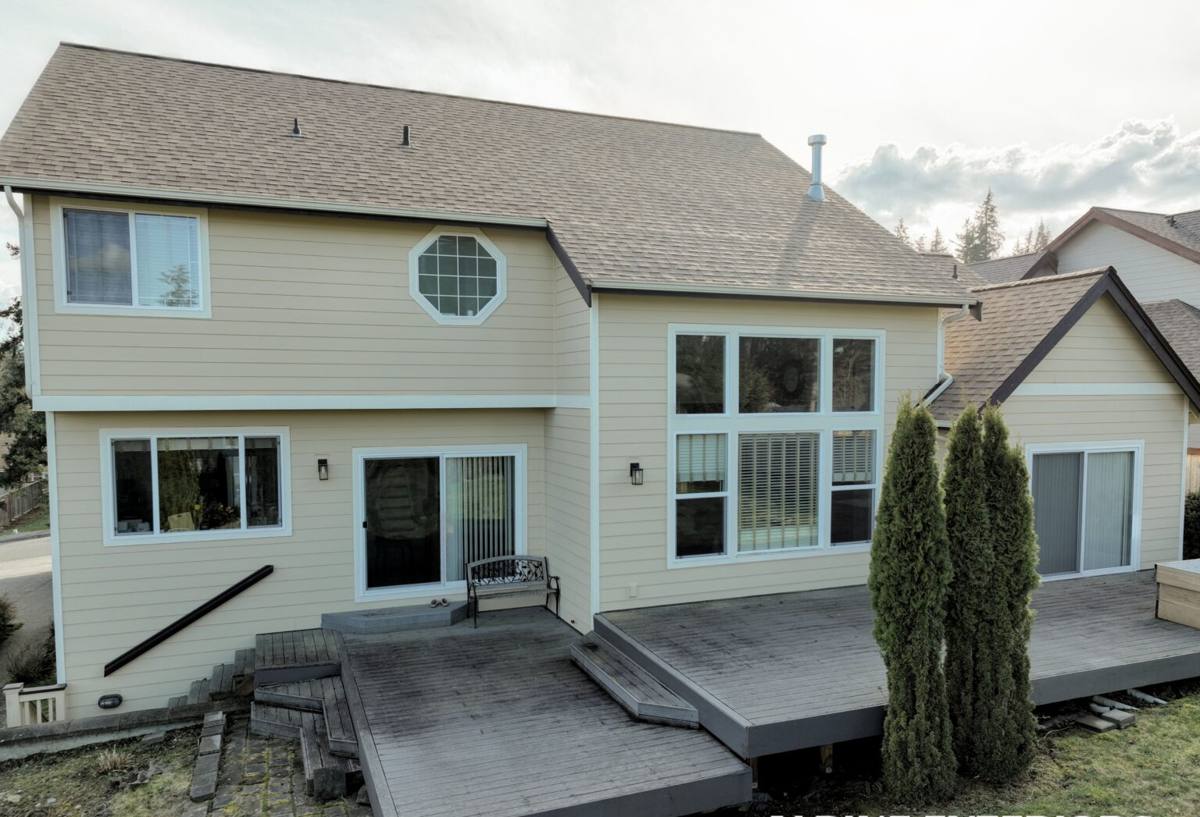
Signs Your Deck Needs Repair, Not Replacement
Most decks don't fail all at once. They show warning signs first, and catching them early is what keeps a repair a repair instead of a full rebuild. Walk your deck and check for the following:
- Boards that feel spongy, springy, or noticeably softer underfoot in specific spots
- Rust streaks bleeding out from screw or nail heads
- Gaps or movement where the deck ledger meets the house
- Railings that wiggle or flex when pushed
- Persistent green or black staining that doesn't scrub off, especially on shaded boards
- Stair stringers that feel uneven or bouncy
- Visible daylight or water stains at joist-to-beam connections
- A musty smell coming from underneath the deck
Any one of these on its own is often a straightforward fix. Several together, especially around the ledger or main support posts, usually mean it's time for a closer structural look before anyone uses the deck heavily.
What a Proper Deck Repair Actually Involves
It Starts Underneath, Not on the Surface
A repair that only replaces what's visible from the top is a repair that misses the point. Surface boards are the easiest part to fix and usually the least important to a deck's actual safety. The real work is checking the framing underneath: joists, beams, posts, and — most critically — the ledger board bolted to the house. That connection carries a huge share of the deck's load, and in a wet climate like ours it's the single most common point of hidden rot.
Fasteners Matter More Here Than Elsewhere
In salt-influenced air, the wrong fastener can corrode and weaken years before the wood itself gives out. A repair that reuses old hardware or grabs whatever is on the truck isn't really solving the underlying problem — it's postponing it.
Drainage and Airflow Get Fixed Too
If moisture caused the original damage, a repair that doesn't improve drainage or ventilation under the deck is just setting up the same failure again in a few years. Sometimes that means adjusting flashing at the ledger, sometimes it means clearing vegetation that's trapping moisture against the structure.
Common Problems We See on Blaine Decks
| Problem | What Causes It | Typical Fix |
|---|---|---|
| Corroded fastener heads | Salt air combined with standard (non-coated) hardware | Remove and replace with corrosion-resistant fasteners rated for coastal exposure |
| Soft or rotted ledger board | Long-term moisture intrusion where the deck meets the house, often from missing or failed flashing | Cut back to sound wood, correct flashing, refasten to code |
| Moss and algae buildup | Shaded, damp areas during the long wet season | Clean, treat, and address the shading or drainage issue causing it to return |
| Loose or wobbly railings | Fastener backout, post rot, or undersized original hardware | Reinforce or replace posts, upgrade to structural fasteners |
| Uneven or bouncy stair stringers | Ground movement, rot at stringer base, or inadequate original support | Sister or replace stringers, correct footing contact with ground |
Repair or Replace? What Actually Decides It
Homeowners often assume any visible damage means a full teardown. In our experience, most decks with a solid original structure can be repaired at a fraction of replacement cost — but that depends on where the damage is and how far it's spread.
| Factor | Repair Usually Makes Sense | Replacement Usually Makes Sense |
|---|---|---|
| Framing condition | Joists and beams are sound; damage is localized | Rot has spread through multiple structural members |
| Ledger connection | Solid, or fixable with targeted flashing/fastener work | Extensively compromised, or never properly flashed to begin with |
| Age of the deck | Under 15-20 years, built to a reasonable standard | Original construction is decades old with outdated or undersized framing |
| Extent of surface damage | Isolated boards or sections | Widespread softness, staining, or splitting across most of the deck |
| Your plans for the space | You're happy with the current size and layout | You want a different footprint, added stairs, or a larger structure |
Our Deck Repair Process
We keep this straightforward because deck repair doesn't need to be complicated when it's done right the first time:
- Inspection. We check the full structure — framing, ledger, posts, footings, railings, and surface boards — not just the spot you called about.
- Honest assessment. We tell you what's actually wrong, what's driving it, and whether repair or replacement is the smarter long-term move for your situation.
- Scope and estimate. You get a clear picture of what work is needed before anything starts.
- Repair work. Damaged framing, boards, railings, or stairs are cut out and replaced with sound material and appropriate fasteners for our climate.
- Moisture and drainage correction. Where moisture caused the original problem, we address the cause — flashing, drainage, or airflow — not just the symptom.
- Final check. We walk the deck with you when it's done so you can see and feel the difference.
Materials We Use and Why
For structural repairs, we favor pressure-treated lumber rated for ground contact where it's in play, paired with fasteners and connectors carrying a corrosion resistance rating appropriate for coastal exposure — standard zinc-coated hardware simply doesn't hold up as long this close to salt air. For visible decking boards, we'll talk through both wood and composite options honestly: wood is more affordable up front and easier to spot-repair later, while composite costs more initially but resists moss staining and moisture absorption better, which matters given how long our wet season runs. There's no universally "right" answer — it depends on your budget, how the deck is used, and how much upkeep you want to do.
What we won't do is patch a structural problem with cosmetic materials or reuse corroded hardware just to save a step. That approach might look fine for a season, but it doesn't hold up against the kind of weather Whatcom County sends through every winter.
Keeping Your Deck in Good Shape After Repair
A repaired deck stays repaired longer with a little seasonal attention. This is the same checklist we'd hand any client after finishing work:
- Sweep debris and standing leaves off the deck regularly, especially in fall
- Clear moss and algae as soon as it appears rather than letting it establish
- Check railings and stair connections for movement once or twice a year
- Keep gutters and downspouts near the deck clear so runoff doesn't pool against it
- Trim back vegetation that's shading and holding moisture against boards
- Reseal or re-stain wood decking on the manufacturer's recommended schedule, not just when it looks faded
Why It Matters to Hire a Crew That Knows Blaine
A contractor unfamiliar with this stretch of coastline might spec the same hardware and materials they'd use in a dry inland climate — and that's exactly how decks end up needing repair again in half the time. We work throughout Whatcom County and see the same salt-air corrosion, moss buildup, and moisture patterns repeat on deck after deck near Blaine. That familiarity shapes real decisions: which fasteners we reach for, where we look first for hidden rot, and what drainage details actually hold up against our driving rain rather than just looking good on installation day.
If your deck has soft spots, corroded hardware, wobbly railings, or stubborn moss that keeps coming back, we're happy to take a look and give you a straight answer about what it needs. Reach out for a free, no-pressure estimate using the form below — we'll walk the deck with you and tell you exactly what we find.