 Bellingham Siding
 Roofing on South Hill Isn't the Same Job as Roofing Downtown
South Hill sits up above the flatter parts of Bellingham, and that elevation changes what a roof deals with day to day. Homes up here catch more open wind off Bellingham Bay, more direct driving rain during winter storms, and often sit under a heavier tree canopy than newer subdivisions closer to the water. Add in Whatcom County's long, damp shoulder seasons and you get a roof that's rarely given a real chance to dry out between October and May. A roof built for a drier climate, or installed with shortcuts that don't show up for a few years, tends to fail here faster than the warranty paperwork suggests.
New roof installation on South Hill isn't about using exotic materials — it's about getting the ordinary details right in a place where ordinary shortcuts get punished. That means proper underlayment, real attic ventilation, correct flashing at every penetration, and a material choice that matches how much shade and moisture the specific roof will see.
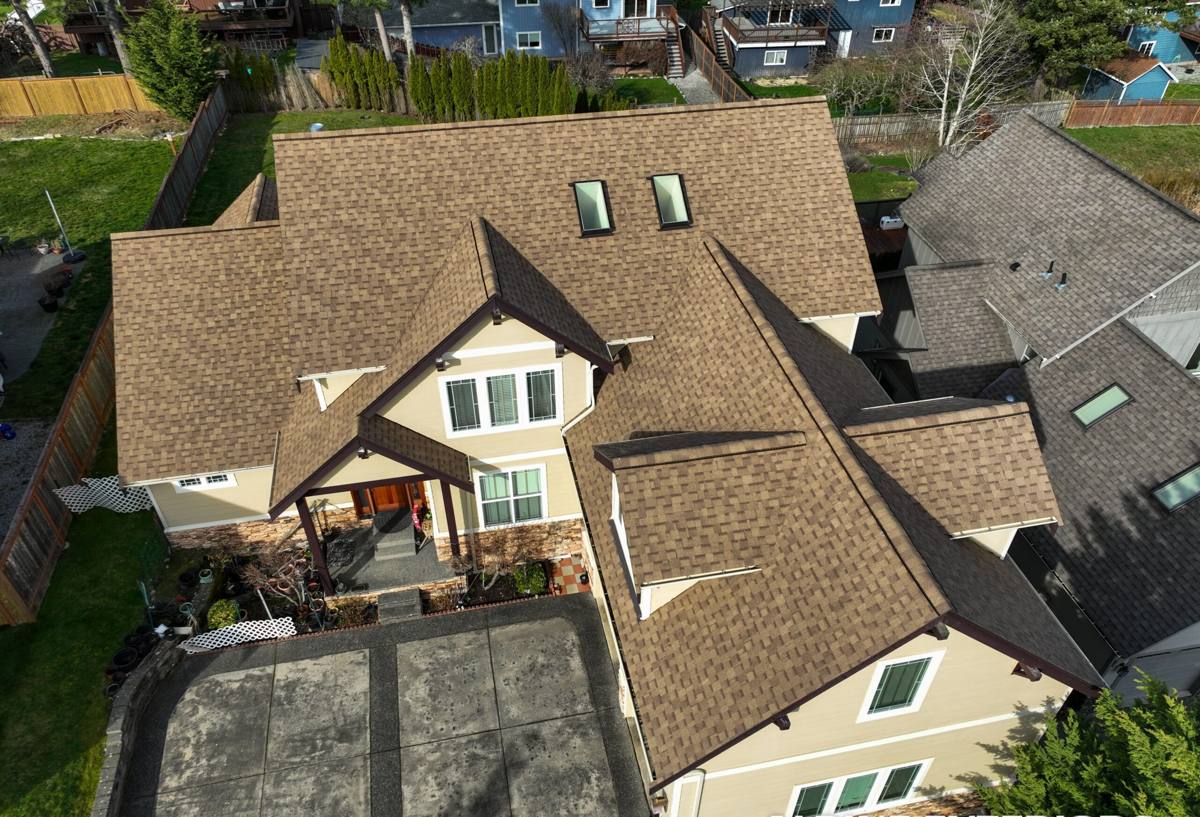
What Bellingham's Climate Actually Does to a Roof
Three things drive most of the roofing problems we see in this part of Whatcom County, and they compound each other:
Salt Air and Metal Fatigue
Proximity to Bellingham Bay means airborne salt reaches fasteners, flashing, and any exposed metal on a roof system. Lower-grade fasteners and flashing corrode faster near the water than they would inland, which is why we specify corrosion-resistant hardware as a default on South Hill jobs, not an upgrade.
Driving Rain
Winter storms here don't just drop rain straight down — wind pushes it sideways, under shingle tabs and into anywhere a roof has a weak seam. That's a flashing and underlayment problem more than a shingle problem. Most leaks we're called out to inspect trace back to a valley, a chimney flashing, or a vent boot, not failed field shingles.
A Long Moss Season
Shaded, north-facing slopes and roofs under mature trees stay damp for months at a time. Moss and algae take hold in that environment, and once established they hold moisture against the roofing material, lift shingle edges, and shorten the life of the roof underneath them. On South Hill, where tree cover is common, moss resistance has to be part of the material decision from day one — not something addressed after the fact with a treatment.
Getting the Installation Right: The Parts You Don't See
Deck Inspection and Repair
Every re-roof starts with the old roofing off and the deck exposed. On older South Hill homes we regularly find soft or delaminated sheathing around chimneys, valleys, and old vent penetrations — usually from years of slow moisture intrusion that never showed up as an obvious interior leak. Replacing bad decking before the new roof goes on isn't an upsell; it's the difference between a roof that lasts and one that fails from underneath regardless of what's on top.
Underlayment and Water Barriers
Given how much wind-driven rain this area sees, we treat self-adhered waterproof underlayment at eaves, valleys, and around all penetrations as standard practice, not an add-on. Synthetic underlayment across the rest of the deck outperforms old-style felt in wet climates — it holds up better to the repeated wet-dry cycles Bellingham winters put it through before shingles ever go down.
Ventilation That Actually Balances
A roof needs balanced intake at the eaves and exhaust at the ridge to keep the attic and deck dry from the inside. Get that balance wrong — too much exhaust, not enough intake, or vice versa — and moisture gets trapped against the underside of the deck, which is exactly the environment that rots sheathing and accelerates shingle failure from below. On homes with additions or past re-roofs, we often find ventilation that was never corrected to match the current roof shape.
Flashing, Not Just Sealant
Chimneys, skylights, dormers, and wall-to-roof transitions all need step flashing and counter-flashing that sheds water by shape, not caulk that's supposed to hold it back by adhesion. Caulk fails; properly lapped metal flashing doesn't need to.
Choosing a Roofing Material for a South Hill Home
There's no single "best" roofing material — there's the right material for a given roof's exposure, slope, and tree cover. Here's how the common options compare for this specific climate:
| Material | Moss/Algae Resistance | Typical Lifespan | Maintenance Needs | Best Fit |
|---|---|---|---|---|
| Algae-resistant architectural asphalt shingle | Good, with copper/zinc granules | 25–35 years | Periodic moss removal on shaded slopes | Most South Hill homes, balanced cost and performance |
| Standard 3-tab asphalt shingle | Poor without treatment | 15–20 years | Regular moss/algae treatment needed | Budget-driven jobs on sun-exposed roofs only |
| Standing-seam metal | Excellent — sheds moss naturally | 40–60+ years | Low; occasional debris clearing | Heavily shaded lots, steep pitches, long-term owners |
| Cedar shake | Requires diligent upkeep | 20–30 years with maintenance | High — regular treatment and inspection | Homeowners committed to the look and the upkeep it demands |
| Synthetic/composite shingle | Good to excellent depending on product | 30–50 years | Low to moderate | Homes wanting shake or slate appearance with less upkeep |
We don't push one material across every roof. A sun-exposed, low-slope roof on South Hill can perform well with a good architectural shingle. A steep, tree-shaded roof on the same street may be a better long-term fit for metal, simply because moss has a much harder time establishing on it. We'll walk the specific roof with you before recommending anything.
Tree Cover, Slope, and Access on South Hill
South Hill's mature trees are part of what makes the neighborhood what it is, but they add real considerations to a roofing job: more debris load in valleys and gutters, more shade holding moisture on north- and east-facing slopes, and in some cases steeper, more complex rooflines than newer flat-lot construction. None of that is a reason to avoid a proper roof — it's a reason to design the roof system (ventilation, material, gutter and debris management) around the actual site instead of a one-size-fits-all install.
Our Installation Process
The steps don't change much from house to house, but the judgment calls at each step do — which is where experience on roofs like this actually matters:
- On-site inspection of the existing roof, decking access points, and attic ventilation before any pricing is finalized
- Written scope covering material, underlayment type, flashing details, and ventilation changes — no vague line items
- Tear-off of existing roofing and full deck inspection, with any soft or damaged sheathing replaced
- Self-adhered waterproof membrane at eaves, valleys, and penetrations; synthetic underlayment across the field
- New flashing at all chimneys, skylights, and wall transitions — not sealant patched over old metal
- Correct balanced intake and exhaust ventilation installed or corrected
- Material installation per manufacturer specification, including proper nailing pattern and exposure
- Full site cleanup, including magnetic sweep for stray fasteners
- Final walk-through and documentation of what was installed and where
Signs a South Hill Roof Needs Replacement, Not Another Repair
Not every roof problem calls for a full tear-off, but a few signs usually mean patching is throwing money at a roof that's past the point of spot repair:
- Granule loss heavy enough to see bald patches or granules collecting in gutters
- Shingles curling, cupping, or lifting at the edges, especially on shaded slopes
- Moss or algae established across large sections rather than isolated spots
- Soft spots or noticeable sag when walking the roof, indicating deck damage underneath
- Repeated leaks in different locations after previous patch repairs
- A roof already past or near the end of its expected material lifespan
Permits and Local Code
Roof replacement in Bellingham typically requires a permit, and inspections check things like proper flashing, ventilation, and in some cases ice-barrier or underlayment requirements tied to the local climate zone. We handle the permit process as part of the job rather than leaving it to the homeowner, and we build the job to pass inspection the first time — not to squeak by.
Why Local Experience on South Hill Matters
A crew that's worked roofs on South Hill before already knows what to expect from this specific stretch of Whatcom County: the wind exposure at this elevation, how shaded lots hold moisture longer than roofs a few blocks away, and which flashing details tend to fail first on the area's older housing stock. That's not something a crew coming from a drier region or a lower-elevation neighborhood picks up on the first pass. It shows up in fewer callbacks and a roof that's actually built for the conditions it has to survive, not a generic installation dropped onto a hillside site.
If you're weighing a repair against a full replacement, or just want an honest read on what your roof needs, we're happy to take a look and put together a clear, no-pressure estimate — use the form below to get started.